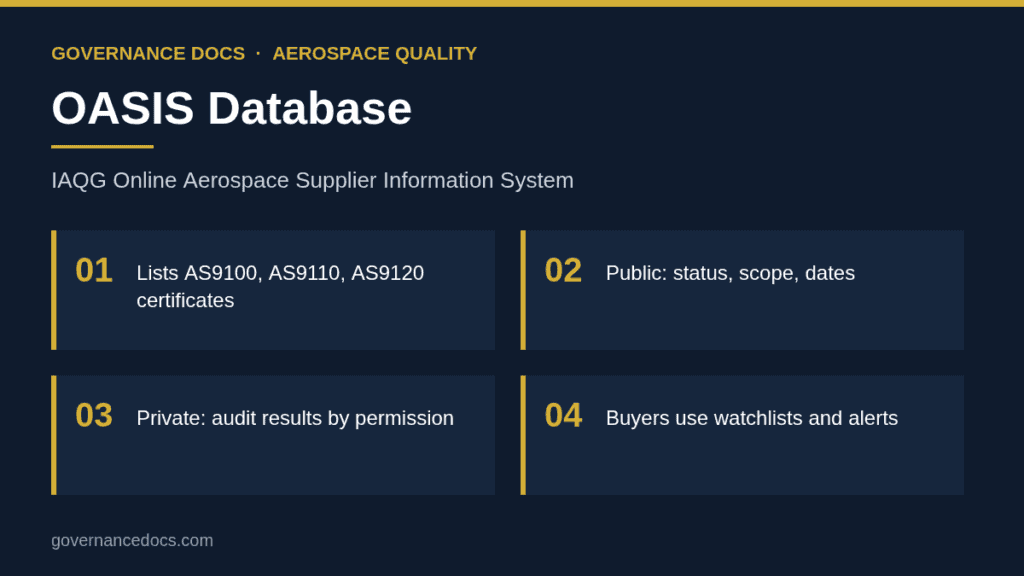
The OASIS database is the IAQG’s official register of organizations certified to AS9100, AS9110 and AS9120, and in aerospace it is the place that decides whether your certificate “exists” in the eyes of a customer. A paper certificate on your wall carries little weight if your record in OASIS is missing, expired or shows a suspension. Primes and buyers check OASIS before they add you to an approved supplier list, and many set alerts so they hear about changes before you tell them.
This guide explains what OASIS is, what it shows to the public versus to permitted users, how certified organizations should manage their record, and how buyers use it in supplier management.
What Is the OASIS Database?
OASIS stands for the Online Aerospace Supplier Information System. It is run by the International Aerospace Quality Group (IAQG), the industry body behind the 9100 series of standards. According to the IAQG’s OASIS page, it lists suppliers certified or registered under the IAQG’s industry-controlled scheme, along with the accreditation bodies, certification bodies and authenticated aerospace auditors that operate within that scheme.
That last point matters. OASIS is not just a list of certificates; it is the backbone of the whole aerospace certification system. Only certification bodies accredited under the IAQG scheme, using authenticated auditors, can issue AS9100-series certificates that appear in OASIS.
What the OASIS Database Holds
Record type
Typical content
Who can see it
Certified organization
Certificate, standard (9100/9110/9120), scope, sites, certification status and dates, basic contact details
Public, free with registration
Audit results
Audit reports, process effectiveness information, nonconformities and their status
Only users the certified organization has granted access to
Certification bodies
Which CBs are accredited for the aerospace scheme
Public
Accreditation bodies
National bodies that accredit aerospace CBs
Public
Auditors
Authenticated aerospace auditors and their status
Public listing
The public versus permissioned split is the key design choice. Anyone can confirm you are certified and for what scope. Detailed audit findings stay private unless you choose to share them, typically with a customer who requests it as part of supplier approval.
Why the OASIS Database Matters for Certified Suppliers
It is the source of truth. Certification bodies publish your certificate and audit results to OASIS after each audit. Several certification bodies state plainly that an organization not listed in OASIS is not recognized under the aerospace scheme. If a customer cannot find you, assume they will treat you as uncertified.
Customers monitor it. Registered users can set up watchlists and receive email alerts when a listed organization has a new audit, a change of status or loses certification. Large primes use this to manage hundreds or thousands of suppliers.
It reflects scope precisely. If your certificate covers machining but a customer is buying assembly from you, OASIS will show that mismatch. Buyers increasingly compare the scope statement to the purchase order.
It supports the risk-based audit model. The IAQG’s newer audit approach uses organizational information gathered through OASIS to profile risk and help set audit focus. Keeping your data accurate is part of making audits run smoothly.
How to Manage Your Organization’s OASIS Record
Register a user account on the IAQG OASIS portal. Registration for basic access is free.
Request access to your organization’s record once your certification body has published your certificate. Your CB can help link your account.
Check the details after every audit: legal name, sites, scope wording, standard and expiry date. Errors are common after site moves or scope changes, and they are your problem to spot.
Review the audit report and nonconformity status online so you know exactly what customers would see if you grant them access.
Decide your sharing policy. Some organizations grant major customers access to audit results by default; others share case by case.
Assign an owner. Make the quality manager or a deputy responsible for the record, and include it in management review.
Check the IAQG’s current fee schedule and help pages before relying on any particular access level, because the portal’s features and access tiers change over time.
How Buyers Use the OASIS Database in Supplier Management
AS9100D clause 8.4.1 requires organizations to evaluate, select and monitor external providers and to maintain a register with approval status and scope. OASIS is the natural evidence source for the certification part of that evaluation. A typical buyer workflow:
Before approval: search the supplier in OASIS, confirm certificate status, standard and scope, and record the check date in the supplier file.
For critical suppliers: request access to the latest audit results to review nonconformities and process effectiveness.
Ongoing: add approved suppliers to a watchlist so changes trigger a review.
At re-evaluation: confirm the certificate is current and the scope still matches what you buy.
Our guide to AS9100 supplier management explains how this fits into the full 8.4 process, including flow-down of requirements and supplier performance monitoring.
OASIS and the Three AS9100-Family Standards
OASIS covers all three IAQG quality management standards:
AS9100 for organizations that design, manufacture or provide aviation, space and defense products and services
AS9110 for maintenance, repair and overhaul organizations
AS9120 for stockist distributors
A distributor’s AS9120 certificate in OASIS tells a buyer something very different from a manufacturer’s AS9100 certificate. Confirm which standard you need before you search. Our AS9110 vs AS9120 comparison explains the difference, and our overview of aerospace quality management covers the full family.
Common OASIS Database Problems and How to Avoid Them
Certificate shows “expired” during recertification. Plan the recertification audit well ahead of expiry so the CB can complete its review and publish before the date passes.
Outdated scope. If you add a process or product line, ask your CB about a scope extension rather than assuming customers will not notice.
Missing sites. Multi-site organizations sometimes find a site was not included. That site’s work is then not covered by the certificate.
Open nonconformities. Overdue corrective actions are visible to anyone with access to your audit results and can trigger certificate suspension.
Nobody owns the account. When the person who registered leaves, access is lost at the worst moment.
Getting Ready for an OASIS Listing
If you are not certified yet, your OASIS record will be created by your certification body after the stage 2 audit and certification decision. The fastest route to a clean first listing is a well-prepared system: a clear scope statement, documented aerospace processes, a complete internal audit and management review, and closed-out stage 1 concerns. The AS 9100 Toolkit provides 38 editable templates covering the quality manual, aerospace procedures and supplier registers to help you get there.
OASIS Database Checks in Your Supplier Procedure
If you buy from aerospace suppliers, write OASIS database checks into your supplier control procedure rather than leaving them to individual buyers. Specify who checks, when (approval, periodic review and before awarding new scope), what evidence is kept (a dated screenshot or export in the supplier file) and what happens if the certificate is suspended or withdrawn. That turns the OASIS database from an occasional lookup into auditable evidence for AS9100D clause 8.4.1.
OASIS Database and Audit Results: What to Share
When a customer asks for access to your audit results, think about what they will see. Detailed audit records typically include the process effectiveness information captured by the auditors, any nonconformities with their classification and status, and the auditors’ notes on corrective action. Before granting access, review the latest audit file yourself and make sure every nonconformity is either closed or has an accepted plan with realistic dates.
Many organizations find that being open with major customers builds trust, especially when the record shows findings handled promptly. Others restrict access to customers who require it contractually. Either policy is reasonable; what matters is that it is a deliberate decision recorded in your procedure, and that the person managing the OASIS database account knows it. Revisit the policy at management review, particularly after a difficult audit or when a new major customer comes on board.
Frequently Asked Questions
Is the OASIS database free?
Basic registration and public searches are free. Viewing a certified organization’s detailed audit results requires that organization’s permission. Check the IAQG’s current fee schedule for any paid features.
How do I check if a supplier is AS9100 certified?
Search the supplier’s name in OASIS and confirm the certificate status, the standard (9100, 9110 or 9120), the scope and the expiry date. A certificate PDF alone is not sufficient evidence in aerospace supply chains.
Why is my company not showing in OASIS?
Your certification body publishes the record after the certification decision. If it is missing or wrong after that, contact your CB, because only they can correct certificate data.
Can customers see my nonconformities in OASIS?
Only if you grant them access to your audit results. Public users see certificate status and scope, not findings.
Who updates information in the OASIS database?
Certification bodies upload certificate and audit data after each audit. Certified organizations manage their own user access and sharing permissions, and should report errors in certificate data to their certification body.