CART
NIST SP 800-53 is the control catalog nearly every US federal security regime is built on — and saying “we’re on Rev 5” no longer tells anyone which controls you mean.
Revision 5 has not become Revision 6. Instead it now receives patch releases, in the way software does, and the most recent one added controls. If your control set was baselined before August 2025, it is missing some.
Free gap assessment
Which 800-53 families would not survive an assessment?
Score all twenty control families, free, plus the categorisation, baseline and parameter decisions everything else depends on.
Run the free NIST SP 800-53 gap assessment → or View premium report sample
Security and Privacy Controls for Information Systems and Organizations is a catalog, not a standard you comply with. It provides controls to protect operations, assets, individuals, other organisations and the nation from a wide range of threats — hostile attacks, human error, natural disasters, structural failures, foreign intelligence entities and privacy risks.
Three design decisions distinguish it from most control sets.
Security and privacy live in one catalog. Revision 5 consolidated them rather than treating privacy as an appendix — which is why the same document underpins both security programmes and privacy programmes in federal agencies.
It is deliberately not federal-only in its language. The controls are written as outcomes for any information system, which is why private-sector organisations with no federal obligation adopt it.
It addresses functionality and assurance separately — the strength of the mechanism, and the confidence you have in it. Those are different questions and most frameworks conflate them.
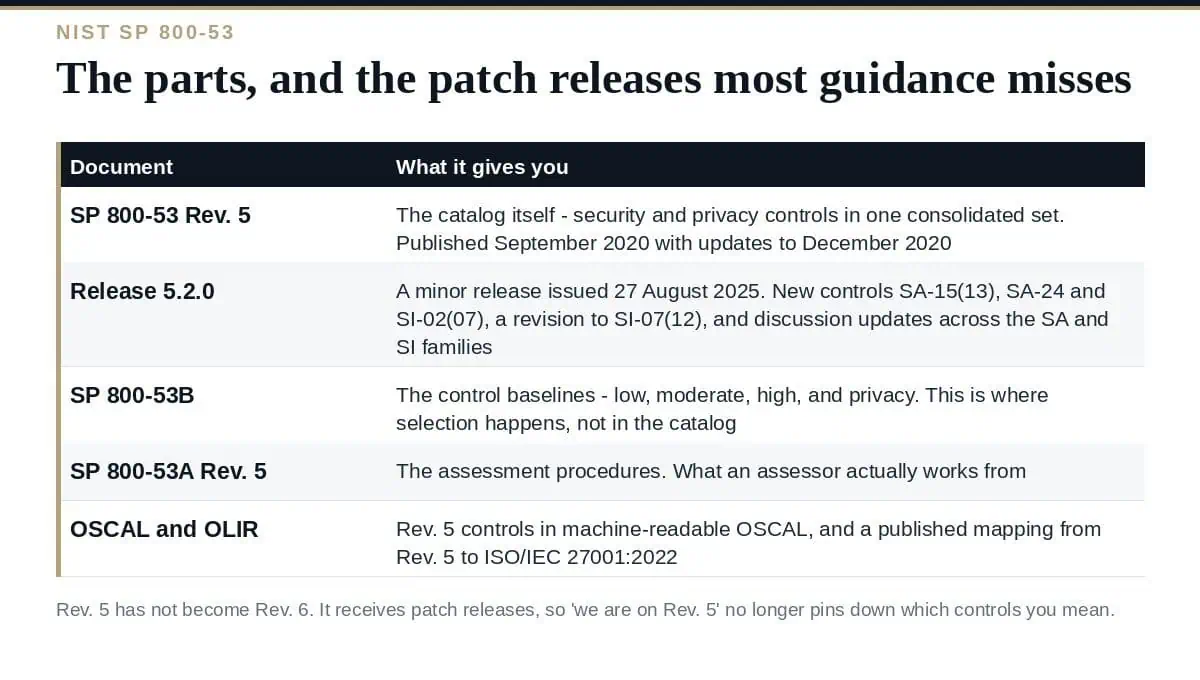
The single most common mistake is treating the NIST SP 800-53 catalog as the whole publication. It is not, and the other parts are where the work happens.
SP 800-53B holds the control baselines — low, moderate, high and privacy. The catalog tells you what a control is; 800-53B tells you which controls apply at your impact level. An organisation that has read the catalog but not the baselines has no basis for selecting anything.
SP 800-53A Rev. 5 holds the assessment procedures. This is what an assessor works from, so it is also the best guide to what evidence you will be asked for.
Two supporting resources are worth knowing about because they save real time. Rev. 5 controls are published in OSCAL, machine-readable, so a GRC platform can ingest them rather than have someone retype them. And NIST publishes an OLIR mapping from SP 800-53 Rev. 5 to ISO/IEC 27001:2022 — which is the fastest honest answer to “we already have ISO 27001, what else do we need?”
On 27 August 2025 NIST issued a minor release of NIST SP 800-53, Release 5.2.0. It was not a cosmetic update:
The weight of this NIST SP 800-53 update sits in the SA (system and services acquisition) and SI (system and information integrity) families — supply chain and software integrity, which is where federal attention has been concentrated.
The practical consequence: record the release you baselined against, not just the revision. “Rev 5” was a sufficient answer in 2021. It is not now, and an assessor comparing your control set against the current catalog will find gaps you did not know you had.
| Regime | How it uses the catalog |
|---|---|
| FedRAMP | Built directly on the baselines, selected by impact level. If you are pursuing federal cloud authorisation, this catalog is the substance of it |
| GovRAMP | Built on Rev. 5, with Core Verification using 60 prioritised controls aligned to the Moderate baseline |
| SP 800-171 | A different publication for a different job — protecting CUI in nonfederal systems, derived from but not equal to the 800-53 catalog |
| ISO 27001 | NIST publishes an OLIR mapping between Rev. 5 and the 2022 edition. Substantial overlap, but ISO 27001 certifies a management system and 800-53 does not certify anything |
That last distinction is the one to hold onto. Nobody certifies you to SP 800-53. You are authorised, assessed or contracted against a baseline drawn from it. The catalog is an input to those processes, never the output.
This guide reflects csrc.nist.gov at 15 August 2026, on which SP 800-53 Rev. 5 with Release 5.2.0 is current. Check the planning notes before baselining — that is where NIST announces patch releases.
The NIST SP 800-53 Security Controls Toolkit provides editable templates covering the system security plan, the control implementation and tailoring records, the assessment evidence and the continuous monitoring artefacts.

October 15, 2026
October 15, 2026
October 14, 2026
October 14, 2026
October 14, 2026

