CART

Most guides to FedRAMP authorization describe a programme that no longer works the way they say. They explain the JAB, the agency sponsor hunt, the control-by-control audit and the annual assessment cycle — and they are describing the legacy model.
FedRAMP 20x is not a pilot any more. As at August 2026 it is in Phase 3, wide-scale adoption, and FedRAMP’s own words are blunt: “The pilots are over. FedRAMP 20x is here to stay.”
Free gap assessment
Are you working to the 2026 FedRAMP rules or the old ones?
Score the Key Security Indicators and the CR26 obligations, free, including the Security Decision Record that replaced the SSP.
Run the free FedRAMP gap assessment → or View premium report sample
The old model asked a cloud service provider to document a large control set, have a third-party assessor test it, and produce a package an agency could review — then repeat annually. It worked, slowly, and it produced a snapshot that was out of date the day it was signed.
20x replaces the snapshot with continuous, automated evidence. The mechanism is the Key Security Indicator: a machine-validatable statement about a security outcome, reported near real time rather than attested once a year.
FedRAMP’s own Phase 1 finding puts it plainly — Key Security Indicators “can demonstrate security posture in near real time, replacing static yearly manual assessments while improving confidence and overall security.”
That is a change in the kind of evidence, not just the amount. If your compliance function is built to produce a large document once a year, it is built for the wrong model.
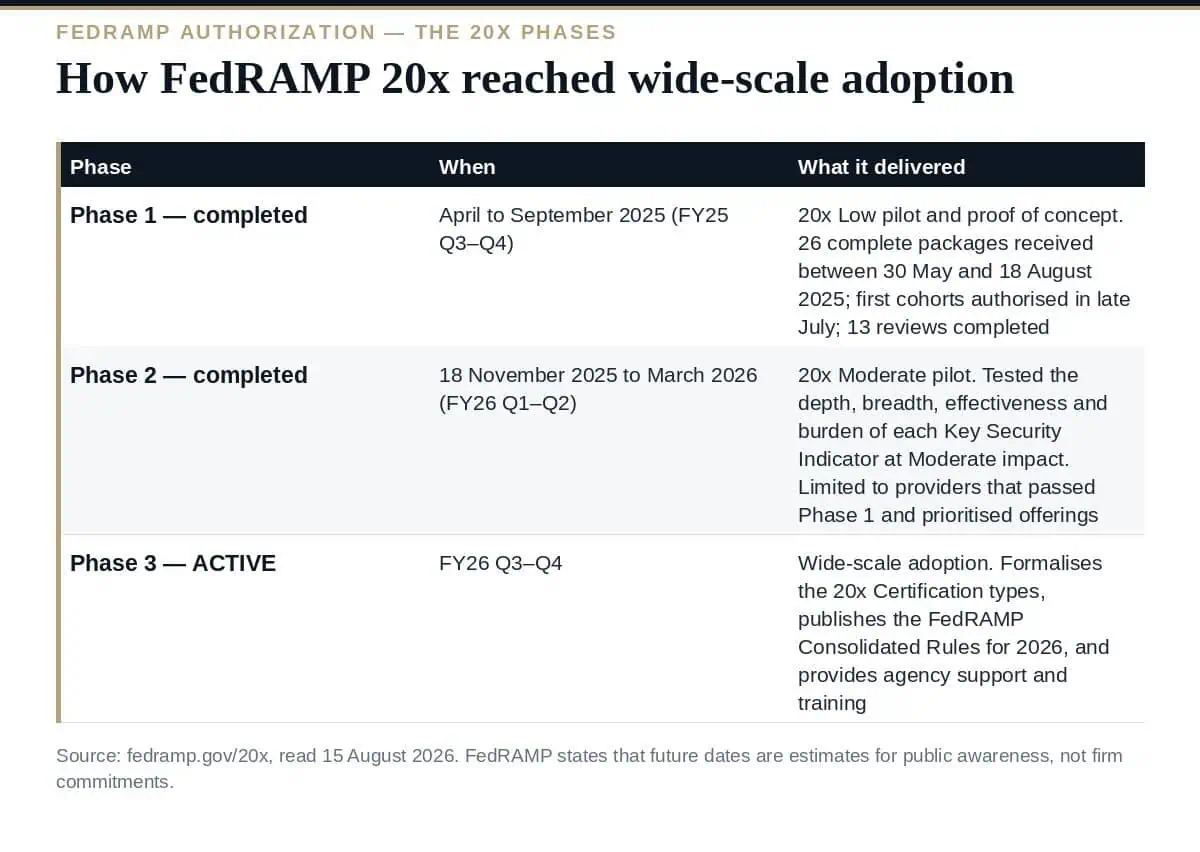
| Phase | When | What it delivered |
|---|---|---|
| Phase 1 — completed | April–September 2025 | 20x Low pilot. 26 complete packages between 30 May and 18 August 2025; first cohorts authorised in late July; 13 reviews completed |
| Phase 2 — completed | 18 November 2025 – March 2026 | 20x Moderate pilot. Tested each Key Security Indicator at Moderate impact. Limited to providers that passed Phase 1 and to prioritised offerings |
| Phase 3 — active now | FY26 Q3–Q4 | Wide-scale adoption. Formalises the 20x Certification types and publishes the FedRAMP Consolidated Rules for 2026 |
One caveat worth carrying: FedRAMP states that future dates on its roadmap are “estimates for public awareness, not firm commitments”. Treat them as direction, not deadline.
The Marketplace is the honest measure of how far FedRAMP authorization has moved. As at August 2026 it lists 529 FedRAMP Certified services — and 28 FedRAMP 20x Certified services.
Two readings of that, both true. The legacy estate is large and is not disappearing overnight, so a provider authorised under the old model is not stranded. And the 20x cohort is still small, which means early certification is still a genuine differentiator rather than table stakes.
Nobody successfully reused existing audits. FedRAMP recorded that “no participants actively reused existing framework assessments such as SOC 2”. If your plan for FedRAMP authorization is to hand over a SOC 2 report and negotiate, the pilots suggest that does not work. The evidence model is different, not merely stricter.
Engineering has to be in the room. FedRAMP found that “cloud providers need deep engagement from engineering teams to adopt the approach”. Automated validation of security outcomes cannot be produced by a compliance team working from documents — someone has to instrument the system.
An open door attracts the wrong queue. FedRAMP noted that authorisation without an agency sponsor “opened the door to offerings such as GRC tools — the largest submission category”. Expect the sponsorship question to keep shaping who gets prioritised.
Whichever path applies, the substance rests on the same foundation: the NIST SP 800-53 control baselines, selected by impact level, and evidence that the controls work for a defined boundary.
| If you hold | What it is worth |
|---|---|
| SOC 2 | Good security practice and useful evidence internally — but the pilots showed no provider successfully reused it for FedRAMP |
| ISO 27001 | A management system that makes the programme runnable. It is not a FedRAMP status and does not shorten the assessment |
| CMMC | A separate DoD regime. A FedRAMP-authorised cloud helps where CUI sits in it, but does not cover your own boundary |
The pattern repeats across all three: an existing certification tells a buyer you take security seriously. FedRAMP authorization tells a federal agency it may lawfully put its data in your service. Those are different questions.
This guide reflects the position at 15 August 2026, read from fedramp.gov. FedRAMP is changing quickly and publishes a changelog; check it before committing to a date.
The FedRAMP Toolkit provides 52 editable documents rebuilt for the Consolidated Rules for 2026: the Certification Package Overview and Security Decision Record with their JSON companions, the Minimum Assessment Scope record, the Accepted Weaknesses List and the Ongoing Certification artefacts, plus the Rev 5 control-family policies. If your programme also touches the underlying control catalogue directly, the NIST SP 800-53 Toolkit covers it.


October 15, 2026
October 15, 2026
October 14, 2026
October 14, 2026

October 14, 2026

