CART
ISO 37301 is the standard that turned compliance management from something you described into something you can be certified against. That single change — from guidance to requirements — is what makes it worth understanding.
Its predecessor, ISO 19600:2014, offered recommendations. You could align with it and say so, but no certification body could audit you against it, because “should” is not auditable. ISO 19600 is now withdrawn.
Free gap assessment
Is risk management actually changing decisions?
A maturity assessment against all eight principles, the framework and the process, free. Nobody can certify you to ISO 31000, so this scores distance from good practice instead.
Run the free ISO 31000 maturity assessment → or View premium report sample
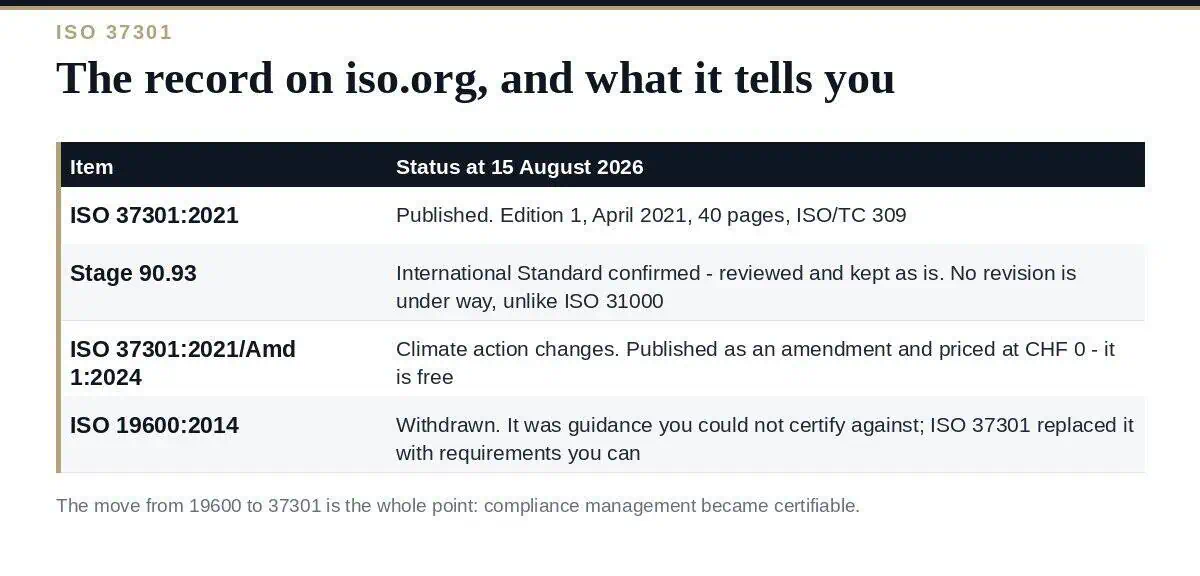
ISO 37301:2021 — Compliance management systems — Requirements with guidance for use — was published in April 2021. It is the first edition, 40 pages, maintained by ISO/TC 309.
Two details on that record repay attention.
It sits at stage 90.93: International Standard confirmed. ISO reviewed it and kept it as it stands. That is a meaningfully different position from a standard at 90.92, where a decision to revise has been taken — so unlike some neighbouring standards, ISO 37301 is stable ground to build on.
There is a free amendment. ISO 37301:2021/Amd 1:2024 covers climate action changes and is listed at CHF 0. If your copy of the standard predates it, you are missing content you can obtain at no cost.
ISO 37301 follows the harmonised management system structure — context, leadership, planning, support, operation, performance evaluation, improvement — with compliance-specific requirements inside it.
The obligations register is where implementations succeed or fail. Everything else in ISO 37301 is proportionate to it, and a register assembled once by a consultant and never updated makes the whole system indefensible in an audit.
These two are frequently confused and are genuinely complementary.
| ISO 37301 | ISO 37001 | |
|---|---|---|
| Covers | All compliance obligations | Bribery specifically |
| Depth | Broad, one method across every obligation | Deep, with detailed requirements for one risk |
| Current edition | 2021, confirmed, free 2024 climate amendment | 2025 — the 2016 edition is withdrawn |
| Typical use | The framework an organisation runs compliance through | Nested inside it where bribery exposure is material |
An organisation with wide regulatory exposure and real bribery risk usually wants both: ISO 37301 as the operating frame, ISO 37001 as the specialist module inside it. Certifying to ISO 37001 alone leaves every other obligation ungoverned.
| Standard | Relationship |
|---|---|
| ISO 31000 | Supplies the risk method underneath the compliance risk assessment, so compliance risk is scored on the same scale as everything else |
| ISO 27001 | Shares the management system backbone. If you hold it, the audit, review and improvement machinery is already running |
| ESG reporting | Governance disclosures need evidence that obligations are identified and managed. A compliance management system is that evidence |
| ISO 37002 | Whistleblowing management guidance — the natural companion to the raising-concerns requirement |
This guide reflects the ISO 37301 record on iso.org at 15 August 2026: published, first edition, confirmed at stage 90.93, with the 2024 climate amendment available.
The ISO 37301 Compliance Management Toolkit provides 24 editable templates covering the compliance policy, the obligations register, the compliance risk assessment, the concern-raising and investigation procedures, and the audit and management review records.

October 15, 2026
October 15, 2026
October 14, 2026
October 14, 2026
October 14, 2026

