CART
ISO 37001 is the international standard for anti-bribery management systems — and if the version you are working from says 2016, you are working from a withdrawn edition.
That is the first thing to fix, because it propagates. Supplier questionnaires, consultant proposals, internal policies and gap analyses across the market still cite the old number, and a programme built on a superseded edition is a programme that has to be redone.
Free gap assessment
Is risk management actually changing decisions?
A maturity assessment against all eight principles, the framework and the process, free. Nobody can certify you to ISO 31000, so this scores distance from good practice instead.
Run the free ISO 31000 maturity assessment → or View premium report sample
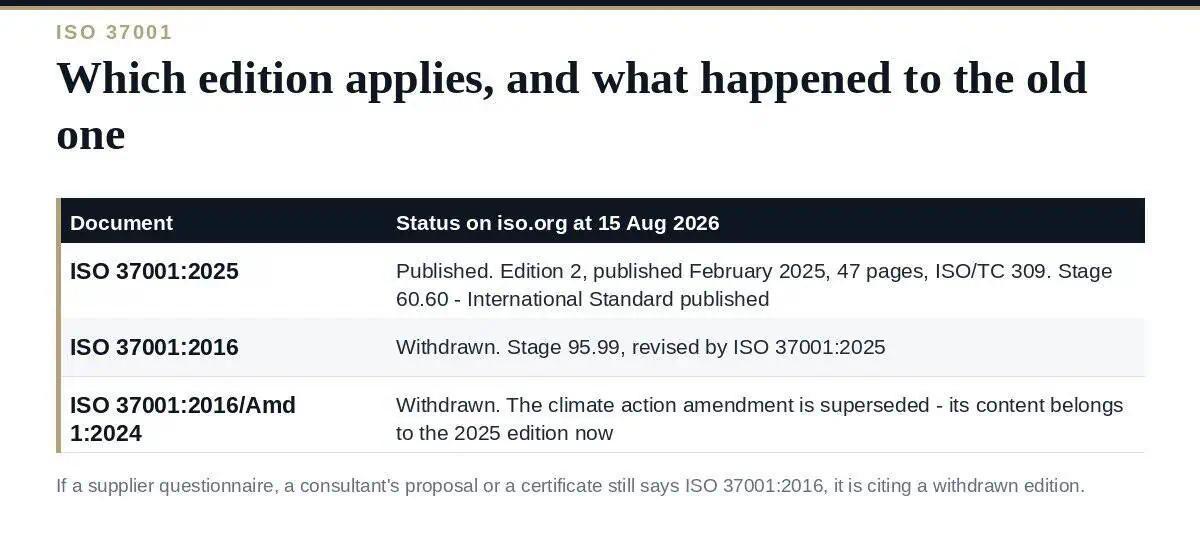
ISO 37001:2025 is the current edition — the second — published in February 2025, running to 47 pages and maintained by ISO/TC 309. Its stage on iso.org is 60.60, International Standard published.
The 2016 edition is recorded at stage 95.99, withdrawn, and revised by the 2025 text. The separate climate action amendment, ISO 37001:2016/Amd 1:2024, is also withdrawn — that content now lives in the current edition rather than alongside it.
It is a management system standard, so it follows the familiar structure: context, leadership, planning, support, operation, performance evaluation, improvement. What makes it specific to bribery is a small number of demanding requirements underneath that frame.
The standard is explicit that measures should be reasonable and proportionate to the bribery risk faced. That phrase is doing important work. It is what makes ISO 37001 workable for a fifteen-person consultancy and for a multinational, and it is also why an auditor will want to see your reasoning, not just your controls.
Two limits worth stating plainly, because the standard states them and marketing material often does not.
Certification does not prove bribery has not occurred. It provides assurance that a management system meeting the requirements is in place. That is genuinely valuable — it is not the same claim.
It is not a substitute for legal advice. ISO 37001 helps you comply with anti-bribery laws; it does not tell you what the UK Bribery Act 2010, the US Foreign Corrupt Practices Act or your local equivalent require of you. The mapping between the standard and any specific statute is work you still have to do.
ISO 37001 is certifiable, and accredited certification runs through ISO/IEC 17021-1 with ISO/IEC TS 17021-9 setting the competence requirements for anti-bribery auditors. The IAF Multilateral Recognition Arrangement has been extended to cover anti-bribery management systems, which is what makes an accredited certificate mean the same thing across borders.
On the transition from the 2016 edition: IAF MD 30:2025, Transition Requirements for ISO 37001:2025 (issued 10 October 2025), sets a two-year transition ending 28 February 2027. Its key timescale: certification bodies to be transitioned by their accreditation bodies by 28 February 2026; initial certification and recertification to ISO 37001:2025 only from 31 August 2026; certified clients transitioned — at a scheduled surveillance audit or a special transition audit — by 28 February 2027, when 2016-edition certificates expire. (Updated 19 September 2026; an earlier version of this post, written before MD 30 was published, said no transition date had been set.) IAF itself ceased operations on 1 January 2026 and its role passed to Global Accreditation Cooperation Incorporated (Global ACI), but MD 30 remains the transition document. Our guide to ISO 37001 certification cost prices the transition.
Confirm the dates with your certification body in writing — they are bound by what their accreditation body has set, and a certificate that lapses on 28 February 2027 costs a full initial audit rather than a transition.
| Standard | Relationship |
|---|---|
| ISO 37301 | Compliance management systems — the broader frame. ISO 37001 is the deep, single-risk sibling. Organisations with wide regulatory exposure often run 37301 with 37001 nested inside it for bribery specifically |
| ISO 27001 | Shares the management system structure, so the context, leadership, audit and management review machinery is reusable. The risk methodology is not — bribery risk is assessed differently from information security risk |
| ISO 9001 | Same structural backbone again. If you are already certified, the integration cost is far lower than the standard looks from outside |
| ISO 37002 | Whistleblowing management systems — guidance, not requirements. It is the natural companion to the “raising concerns” requirement |
The practical version: if you hold any ISO management system certificate, roughly half of ISO 37001 is machinery you already operate. The other half — risk assessment, due diligence, the compliance function, gifts and hospitality controls — is genuinely new work.
This guide reflects iso.org and the IAF resolutions page at 15 August 2026. Editions and transition arrangements change; check both before making a commitment that depends on a date.
The ISO 37001 Anti-Bribery Toolkit provides 55 editable compliance templates covering the anti-bribery policy, the bribery risk assessment, the due diligence records, the gifts and hospitality register, the concern-raising and investigation procedures, and the audit and management review artefacts.

October 15, 2026
October 15, 2026
October 14, 2026
October 14, 2026
October 14, 2026

