CART
The SWIFT CSP assessment cost is not published by Swift, not fixed by the framework, and not the same for any two users: it is a function of the architecture type, which decides how many of the 32 CSCF v2026 controls are in scope; of whether the independent assessment is performed by an internal function or an external assessment provider; of how many sites and components the assessor has to see; and of how much remediation and reassessment the first pass produces.
What follows is our own estimate, built the way we build every certification-cost guide on this site — assessor days by scope multiplied by the day-rate band accredited assessors charge in 2026 — and labelled as such throughout, because the honest answer to “what does the independent assessment cost” is a method, not a number. This guide sets out the cost drivers, assessor-day and fee estimates by architecture type, the internal cost that exists whichever route is chosen, the remediation cycle that doubles many first-year budgets, a worked example, and six ways to bring the figure down.
Free gap assessment
Where do you actually stand against ISO 27001?
Score every management system clause and all 93 Annex A controls, free, and get a prioritised gap list back.
Run the free ISO 27001 gap assessment → or View premium report sample
| Driver | Effect on cost | What you control |
|---|---|---|
| Architecture type (A1, A2, A3, A4, B) | Decides which of the 26 mandatory controls apply; A1 carries nearly all of them, B carries a handful | Whether a customer client connector is in use — from v2026 it moves a type B user to A4 |
| Internal or external assessor | External providers charge per assessor day; an internal function costs staff time but must be independent of the first line and competent | The choice, subject to having a genuinely independent function |
| Sites and components | Each secure zone, data centre, jump-server estate and HSM location adds inspection time | Consolidation; a single documented flow table per site |
| Evidence readiness | An assessor who has to find the evidence bills the finding time | Per-control evidence packs prepared before the engagement |
| First assessment or repeat | The first year includes scoping and learning the environment; repeat years reuse it | Keeping the same provider and the same workbook structure |
| Remediation and reassessment | Findings on mandatory controls need fixing and re-checking before 31 December | Assessing early in the window; closing gaps before the assessor arrives |
The first driver dominates. Applicability is read positionally from the CSCF matrix per control, and it is not intuitive: 1.5 Customer Environment Protection applies to A4 only; 1.1, 2.1 and 2.10 apply to A1–A3; 6.3 applies to A1, A2 and A4; and 1.2, 1.3, 2.3, 2.7, 2.9 and 7.3A apply to all five types including B. Our guide to SWIFT architecture types explains the classification; get it right before pricing anything, because a B-to-A4 reclassification roughly doubles the assessable scope.
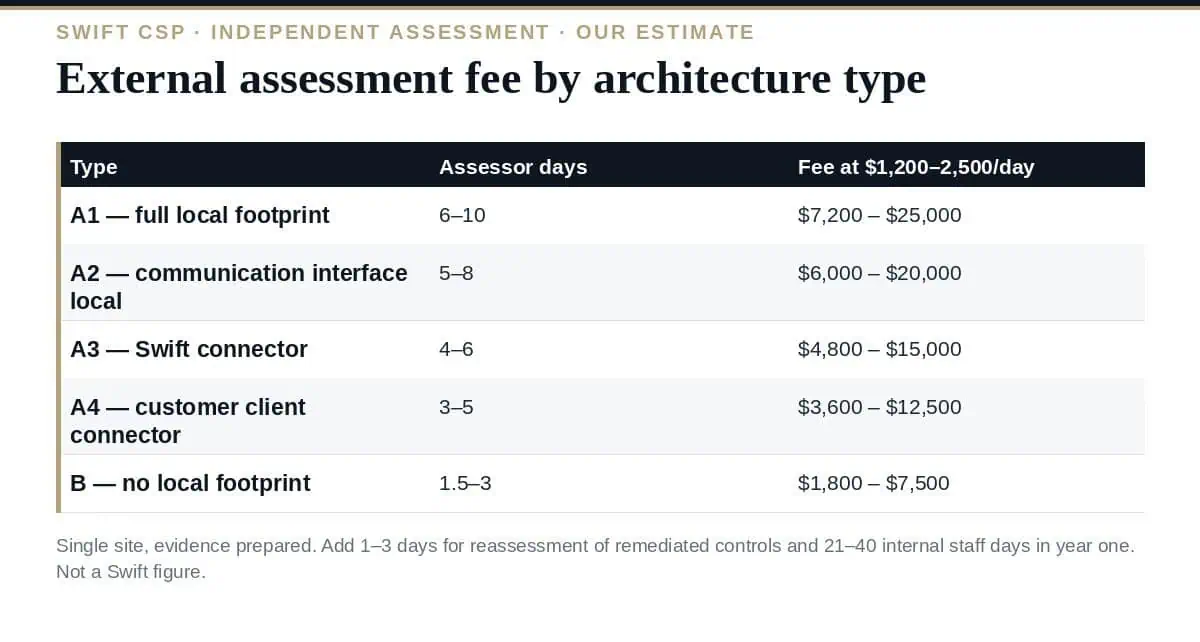
The estimates below assume one site, evidence prepared in advance, and an external provider at the $1,200 to $2,500 per assessor day that accredited assessment and certification bodies typically charge in 2026 — the same band used across this site’s certification-cost guides. They cover the assessment only, not remediation, not the reassessment of remediated controls, and not the internal time in the next section. Larger multi-site users, and users whose assessor is a Big Four firm rather than a specialist, sit above the top of each range.
| Architecture type | Mandatory scope (approx.) | Assessor days (our estimate) | External fee at $1,200–2,500/day |
|---|---|---|---|
| A1 — full local footprint: messaging and communication interface | Nearly all 26 mandatory controls | 6–10 | $7,200 – $25,000 |
| A2 — communication interface local, messaging interface hosted | Most of the 26 | 5–8 | $6,000 – $20,000 |
| A3 — Swift connector to a hosted interface | Most of the 26, minus the interface-specific ones | 4–6 | $4,800 – $15,000 |
| A4 — customer client connector (formerly many type B users) | Around half, including 1.5 and the fourteen connector-scope controls | 3–5 | $3,600 – $12,500 |
| B — no local footprint | A handful (1.2, 1.3, 2.3, 2.7, 2.9 plus the people and process controls) | 1.5–3 | $1,800 – $7,500 |
Two adjustments move a user within the range. Each additional site with its own secure zone adds roughly one to two assessor days. And a user whose evidence is organised per control — policy, procedure, configuration extract, log sample, in one place — sits at the bottom of the day range; one whose assessor has to request and chase it sits at the top. Our guide to the SWIFT CSCF independent assessment covers what the assessor tests per control.
Whether the independent assessment is external or internal, the first line has to produce the evidence, and that is the larger part of the SWIFT CSP assessment cost for most users. Our estimate for a single-site A1 or A2 user preparing properly for the first time:
| Activity | Who | Staff days (our estimate) |
|---|---|---|
| Read CSCF v2026, confirm architecture type, derive applicability per control | Security / compliance lead | 2–3 |
| Build the per-control evidence pack: policy, procedure, configuration, samples | Security, infrastructure, Swift operations | 10–20 |
| Update the secure zone diagram and flow table; reconcile against the firewall rule base | Network / infrastructure | 2–4 |
| Internal readiness review before the assessor arrives | Internal audit or second line | 3–5 |
| Support the assessment: interviews, walkthroughs, evidence requests | All of the above | 3–6 |
| Attest in KYC-SA: workbook, approval, submission, counterparty grants | Compliance lead, approver | 1–2 |
That is 21 to 40 staff days in year one, falling to perhaps half in a repeat year when the evidence pack is maintained rather than built. Where the independent assessment is performed internally, add the assessor’s own time — typically 60 to 80 per cent of the external assessor-day estimate above, because an internal function already knows the environment — and check the independence test honestly: the function must not have designed or operated the controls it assesses.
The figure most budgets miss is the one Deloitte Canada quantified from more than 200 assessments in 2025: 80% of major financial institutions were non-compliant on at least one mandatory control at their initial assessment, and that fell to 10% after remediation and reassessment. Read as a cost driver, that means most first assessments produce findings that have to be fixed and re-checked before the 31 December deadline.
Our estimate for the reassessment of remediated controls is one to three assessor days — $1,200 to $7,500 — plus the remediation itself, which ranges from a configuration change to a network redesign under 1.1 or 2.4. A user that assesses in July has six months to absorb that; one that assesses in November pays for it at expedited rates or attests non-compliant. Our guide to the KYC-SA application covers what a non-compliant attestation means in practice.
A single-site A2 bank, evidence reasonably organised, external assessor at $1,800 per day, first assessment under CSCF v2026 — our estimate, illustrative only:
| Line | Basis | Estimate |
|---|---|---|
| Independent assessment | 6 assessor days at $1,800 | $10,800 |
| Reassessment of remediated controls | 2 assessor days at $1,800 | $3,600 |
| Assessor expenses | One site visit | $1,000 – $2,500 |
| External assessment subtotal | $15,400 – $16,900 | |
| Internal preparation and support | 30 staff days | Internal cost — budget the days, not a fee |
| Remediation | Two findings: back-office flow protection under 2.4, MFA gap on an LSO/RSO account under 4.2 | Highly variable; the 2.4 fix is the larger |
The SWIFT CSP assessment cost pattern holds across types: the external fee is a five-figure line for A1 and A2 users, a low five-figure or high four-figure line for A3 and A4, and a four-figure line for B — and the internal effort exceeds the fee in every case.
How much does the SWIFT CSP independent assessment cost?
Swift does not publish a figure and none is fixed. Our estimate for an external assessment of a single-site user at 2026 assessor day rates of $1,200 to $2,500 is roughly $7,200 to $25,000 for A1, $6,000 to $20,000 for A2, $4,800 to $15,000 for A3, $3,600 to $12,500 for A4 and $1,800 to $7,500 for B, before remediation, reassessment and internal time.
Is an internal assessment cheaper?
Usually, in cash terms: no external fee, and an internal function that knows the environment needs fewer days. It still costs staff time, and it must be genuinely independent of the teams that designed and operate the controls, with the competence to assess them.
Does Swift charge for the attestation?
No. Submission through KYC-SA carries no fee; the cost of the programme is the independent assessment, the internal effort and any remediation.
What does remediation add?
Deloitte Canada found 80% of major institutions non-compliant on at least one mandatory control at first assessment in 2025, falling to 10% after remediation. Budget one to three assessor days for reassessment plus the fix itself, and assess early enough to absorb both before 31 December.
Are these Swift’s figures?
No. Swift publishes no pricing. Every figure here is our estimate from assessor-day assumptions by architecture type multiplied by the day-rate band accredited assessors typically charge in 2026; confirm against quotes from providers on Swift’s CSP assessment provider directory.
Budget the SWIFT CSP assessment cost in three lines, not one: the external or internal assessment priced by architecture type and assessor days, the internal evidence and support effort that exceeds it, and the remediation and reassessment that most first assessments produce. Then move the assessment to the first half of the window and build the evidence pack before the assessor arrives — the two decisions that pull every line toward the bottom of its range.
The CSCF Control Implementation Summary keyed to v2026, the Independent Assessment Evidence Pack, the KYC-SA Self-Attestation Workbook and the assessment planning templates that turn the evidence-pack step into a checklist are in the SWIFT CSP Compliance Toolkit, or start with the free templates.

October 11, 2026
October 11, 2026
October 11, 2026
October 11, 2026
October 11, 2026

