CART
SWIFT architecture types decide how much of the Customer Security Controls Framework you have to implement. Get the classification right and your control set is settled for the year; get it wrong and you have either done work you never needed or attested to controls you were never assessed against.
This guide covers the five types, what determines yours, what changed for the 2026 framework, and how to document the decision so an assessor accepts it.
Free gap assessment
Where do you actually stand against ISO 27001?
Score every management system clause and all 93 Annex A controls, free, and get a prioritised gap list back.
Run the free ISO 27001 gap assessment → or View premium report sample
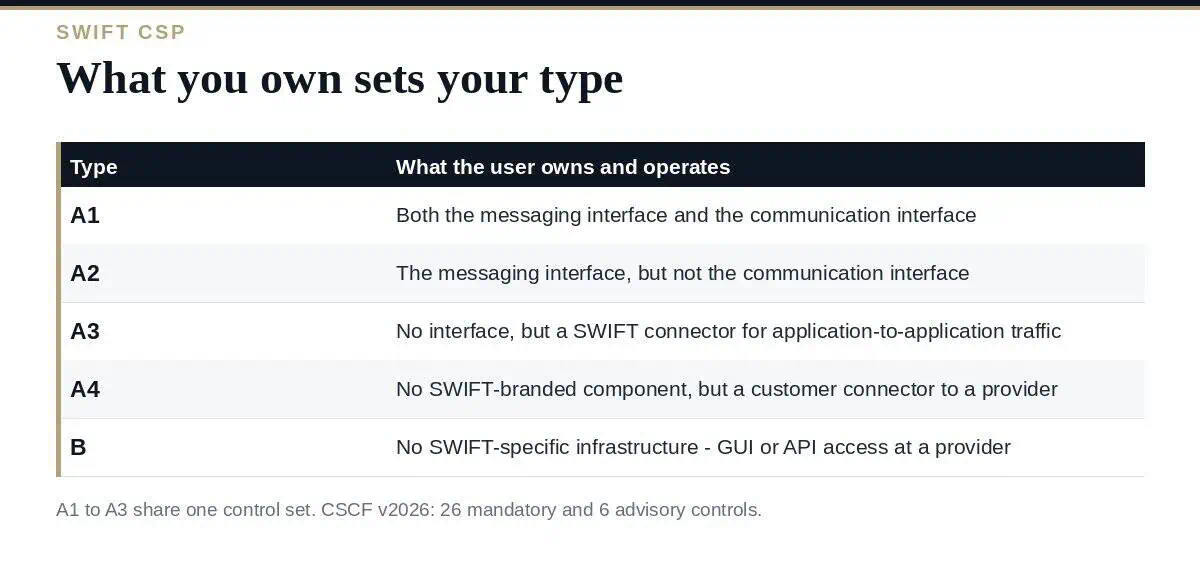
The five SWIFT architecture types are separated by one question: which components of the messaging chain sit inside your own secure zone, under your control, rather than at a service provider.
| Type | What the user owns and operates |
|---|---|
| A1 | Both the messaging interface and the communication interface, on its own premises |
| A2 | The messaging interface, but not the communication interface |
| A3 | No interface, but a SWIFT connector for application-to-application traffic |
| A4 | No SWIFT-branded component, but a customer connector sending application-to-application traffic to a provider |
| B | No SWIFT-specific infrastructure at all — operators reach the service through a GUI or an API at a provider |
The control sets for A1, A2 and A3 are identical, so the practical distinction inside type A is smaller than the labels suggest. Fewer controls apply to A4, and fewer again to B — but the operator PC, the credentials and the local environment stay in scope for every type, which is where B users are most often surprised.
The framework is republished every July, and the 2026 version defines 32 controls: 26 mandatory and 6 advisory, across three objectives and seven principles. Two of the changes bear directly on SWIFT architecture types.
First, control 2.4 on back office data flow security moved from advisory to mandatory, so protecting the flow between back office applications and the SWIFT infrastructure is no longer optional.
Second, the treatment of customer connectors tightened. Organizations that considered themselves type B because nothing SWIFT-branded sits on their estate may find that a connector they already own puts them into A4 — a materially larger control set, and one that has to be assessed before the attestation window closes on 31 December.
The attestation itself runs annually through the KYC-SA application and must be supported by an independent assessment, which can be performed internally provided the assessors are independent of the operations they review. Our guide to the SWIFT CSCF covers that route in detail, and the attestation process covers the submission itself.
Claiming type B while operating a customer connector. It removes a substantial block of controls from your assessment, which is exactly why it is scrutinised — and the correction lands in December, when there is no time left to implement what was skipped.
How many SWIFT architecture types are there?
Five: A1, A2, A3, A4 and B. Types A1 to A3 share the same control set; A4 and B have progressively fewer applicable controls.
Who decides our architecture type?
You do, and you attest to it. The independent assessment tests whether the classification matches the environment.
Does using a service bureau make us type B?
Not automatically. If any connector transmitting transaction data sits on your side, you are likely type A4. Type B means no SWIFT-specific infrastructure of your own at all.
Do advisory controls have to be implemented?
No, but they are published in advance of becoming mandatory. Control 2.4 becoming mandatory in v2026 is the pattern: today’s advisory control is a reasonable prediction of tomorrow’s requirement.
Can our architecture type change mid-year?
Yes, and if it does you assess and attest against the environment as it is. Infrastructure changes are worth planning around the July-to-December attestation window rather than into it.
Settle which of the five SWIFT architecture types you are before you plan any CSCF work, because it determines the size of the job. Draw the component diagram, record who owns each piece, and write the reasoning down. Re-check the classification every year and after any change to connectors, hosting or providers — and treat the 2026 tightening around customer connectors as a prompt to test whether type B is still the honest answer.
Architecture diagrams, scoping worksheets and the control evidence set are in the SWIFT CSP Compliance Toolkit, or start with the free ISO templates.

October 13, 2026
October 12, 2026
October 12, 2026
October 12, 2026
October 12, 2026

