CART
The register of information is the DORA deliverable that turns ICT third-party risk from an internal discipline into a supervisory one. It is also routinely underestimated, because “register” sounds like a spreadsheet and Article 28(3) asks for considerably more than that.
Four separate obligations sit in a single paragraph, and the ones organisations miss are not the ones about building it.
Free gap assessment
How much of DORA could a supervisor already test?
Score all five pillars, free, including the register of information and the Article 30 contract terms.
Run the free DORA gap assessment → or View premium report sample
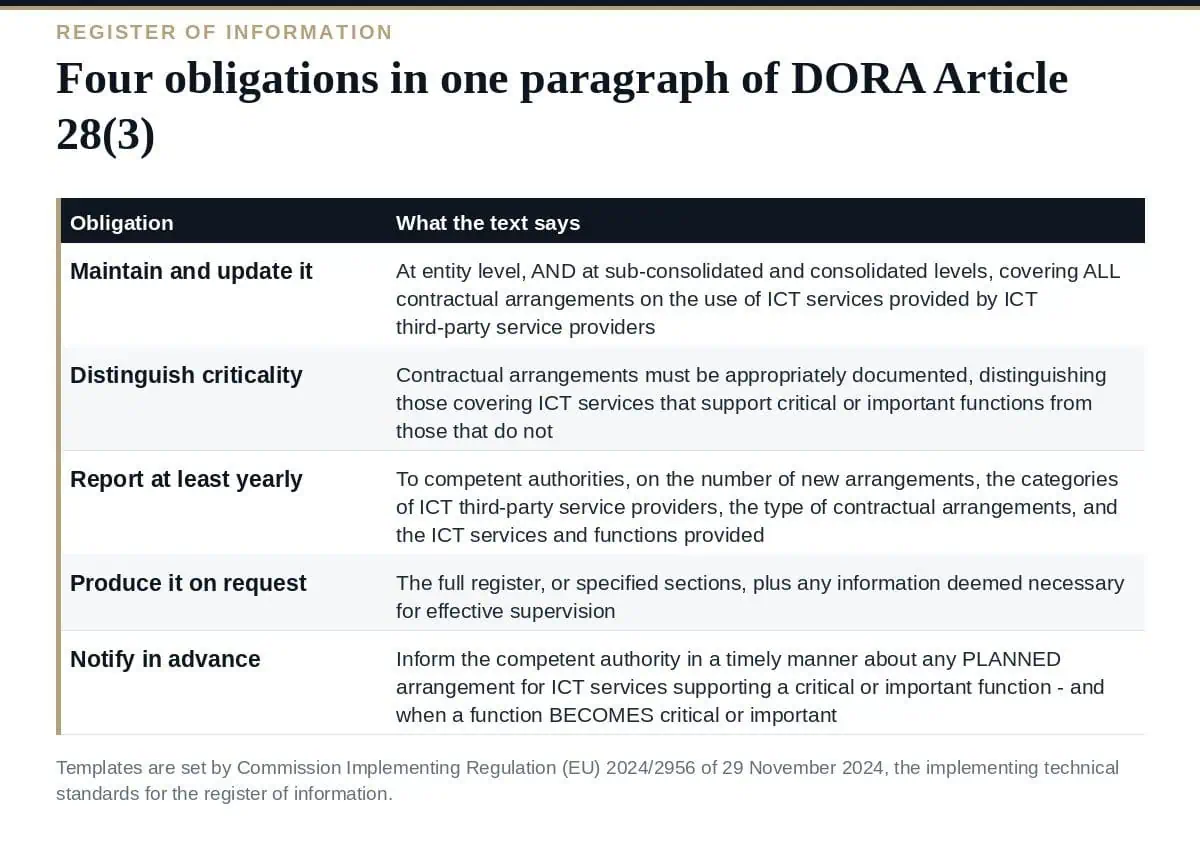
Article 28(3) requires financial entities, as part of their ICT risk management framework, to maintain and update a register of information covering all contractual arrangements on the use of ICT services provided by ICT third-party service providers.
Three phrases in that sentence do the work.
“All contractual arrangements.” Not the critical ones, not the material ones — all of them. The criticality distinction comes later and governs how they are documented, not whether they appear.
“At entity level, and at sub-consolidated and consolidated levels.” A group cannot satisfy this with one flat list. The register has to exist at each level, which is a data modelling problem before it is a compliance one.
“Maintain and update.” It is a live record. A register assembled for a submission and left alone until the next one does not meet the wording.
The second subparagraph requires contractual arrangements to be appropriately documented, distinguishing between those that cover ICT services supporting critical or important functions and those that do not.
That classification is the spine of the whole DORA third-party regime. It determines contractual content, exit planning, testing expectations and supervisory attention — and it is decided in the register.
Which makes the register of information a governance artefact, not an inventory. If your criticality determinations live in someone’s judgement rather than in a recorded, defensible assessment, the register documents a decision nobody can explain.
Free third-party risk assessment
How much risk does this vendor bring?
Tier the vendor, check the evidence, rate the risks from 30 third-party scenarios and choose controls referenced to ISO 27001, NIST CSF 2.0 and DORA. You get a tier, a heat map and the findings an auditor would raise, free.
Start the free vendor risk assessment → or View premium report sample
Financial entities shall report at least yearly to the competent authorities on:
“At least yearly” is a floor, not a schedule. And note what is being reported: change over the period, provider categories and service types — which is only extractable if the register carries those attributes consistently from the start. Retrofitting a taxonomy across hundreds of arrangements the month before a submission is where these programmes fail.
On request. Financial entities shall make available to the competent authority, upon its request, the full register of information or specified sections, along with any information deemed necessary to enable effective supervision. There is no notice period in the text. The register must be in a producible state continuously.
In advance. This is the sentence most often overlooked. Financial entities shall inform the competent authority in a timely manner about any planned contractual arrangement on the use of ICT services supporting critical or important functions — as well as when a function has become critical or important.
Read that twice. Two separate triggers, both forward-looking:
The second trigger has no natural owner in most organisations. Nobody is watching for the moment a previously routine service becomes critical, and there is no procurement event to prompt it. That is a monitoring control you have to build deliberately.
You do not get to design the format. Commission Implementing Regulation (EU) 2024/2956 of 29 November 2024 lays down the implementing technical standards for the application of DORA with regard to standard templates for the register of information.
That matters more than it sounds for a register of information programme. A prescribed template means the fields, relationships and identifiers are fixed — so the question is not “what should we record?” but “can our contract and asset data populate these fields?” Most of the effort in a register programme is reconciliation: matching legal entities, provider identifiers, contracts and the functions they support across systems that were never designed to join up.
| Obligation | Connection |
|---|---|
| DORA requirements | Article 28(1) makes ICT third-party risk an integral component of the ICT risk management framework, applied proportionately. The register is where that framework becomes visible |
| DORA compliance | Article 28(4) requires a pre-contractual assessment — including whether the arrangement supports a critical or important function, and whether it reinforces ICT concentration risk |
| Supply chain security | The same providers, assessed for security rather than for supervisory reporting. One provider inventory should feed both |
| ISO 27001 | Supplier relationship controls give you much of the underlying discipline, though not the prescribed fields |
This guide reflects Regulation (EU) 2022/2554 and Implementing Regulation (EU) 2024/2956 as published on EUR-Lex, read at 16 August 2026. Competent authorities publish their own submission arrangements — confirm yours.
The DORA Toolkit provides 100+ editable templates covering the ICT third-party risk framework, the register of information structure, the pre-contractual assessment and criticality determination, and the contractual and exit documentation DORA expects.

October 15, 2026
October 15, 2026
October 14, 2026
October 14, 2026

October 14, 2026

