CART
ISO 55001 vs ISO 41001 vs ISO 50001 is a question that usually arrives disguised as something else: an organisation with buildings, plant and an energy bill is told it should certify to “one of the estate standards” and cannot work out which.
They are not alternatives. They manage different things about the same estate, and picking the wrong one produces a certificate that does not answer the question anyone was actually asking.
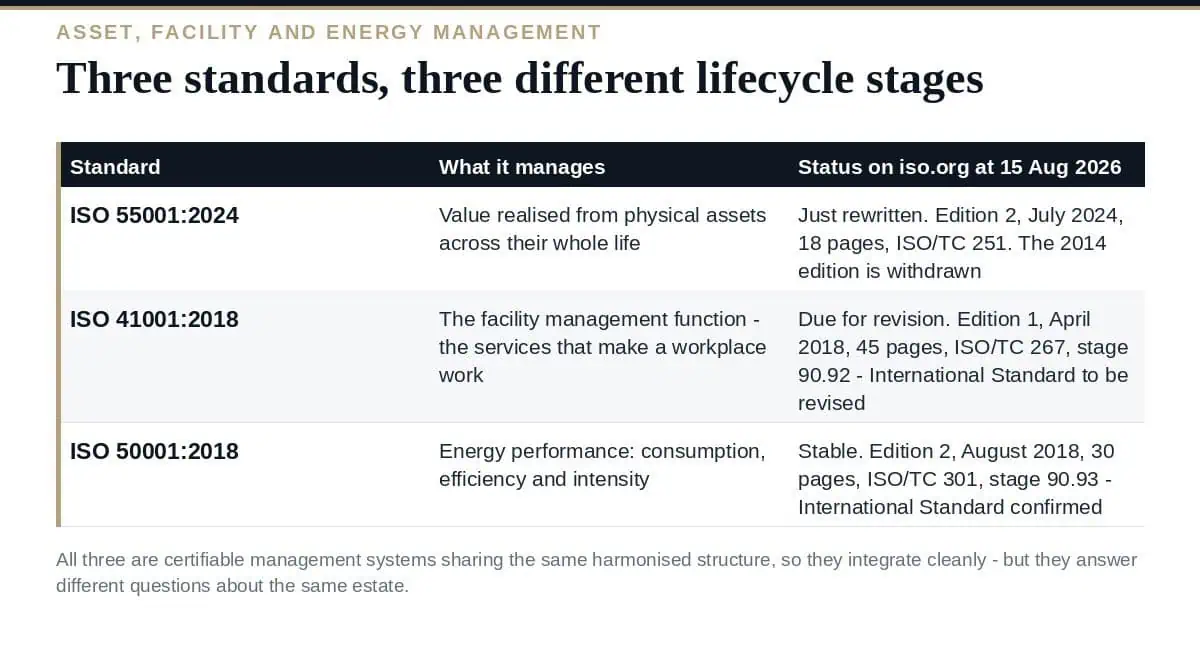
One useful fact before the detail: the three standards are at three completely different points in their lifecycles right now, and that affects when you should commit to each.
ISO 55001:2024 was rewritten in July 2024 — second edition, 18 pages, ISO/TC 251, with the 2014 edition withdrawn.
ISO 41001:2018 is recorded at stage 90.92, International Standard to be revised. It remains the current, certifiable text — a decision to revise has simply been taken.
ISO 50001:2018 sits at stage 90.93, International Standard confirmed: reviewed and deliberately kept as it is. It is the most stable of the three.
This is the pairing that causes the most confusion, because both involve buildings.
ISO 55001 is about the asset itself — the chiller, the pipeline, the substation, the fleet — and about realising value from it across its whole life. Its central question is whether to invest, maintain, refurbish, defer or dispose, and whether that decision can be justified against organisational objectives. Its signature artefact is the Strategic Asset Management Plan.
ISO 41001 is about the service wrapped around the asset — the facility management function that keeps a workplace working. Cleaning, security, catering, space planning, maintenance delivery, the supplier relationships behind them, and the experience of the people using the building.
The practical test in ISO 55001 vs ISO 41001 terms: if your hardest questions are about capital and whole-life cost, you want ISO 55001. If they are about service delivery and occupant experience, you want ISO 41001.
A useful example. A twenty-year-old air handling unit fails repeatedly. ISO 55001 asks whether replacing it is justified against the organisation’s objectives and what the whole-life case looks like. ISO 41001 asks whether the FM service responded within the agreed standard and how the occupants were affected. Both are legitimate; they are not the same question.
ISO 50001 is narrower and deeper than either. It manages energy performance specifically — consumption, efficiency, intensity — through an energy review, a baseline, energy performance indicators and objectives that must demonstrably improve.
Where ISO 55001 asks whether an asset delivers value, ISO 50001 asks whether it delivers that value using less energy than before, and demands measurement rather than assertion.
It is also the one with the clearest external driver. Energy costs are visible, regulators increasingly ask for evidence of energy management, and the standard is explicitly linked to climate action — ISO records it as contributing to greenhouse gas mitigation and to integrating climate action into corporate governance.
These two overlap in practice more than either does with ISO 55001, because the facility management function usually controls the systems that consume the energy.
The split is ownership of the outcome. ISO 41001 makes FM accountable for delivering services to an agreed standard. ISO 50001 makes someone accountable for the energy performance those services produce. Where FM is outsourced, that distinction becomes contractual very quickly — and a service contract written without it tends to reward availability at the expense of consumption.
All three are certifiable management systems built on the same harmonised structure: context, leadership, planning, support, operation, performance evaluation, improvement. That means the machinery is shared.
This is the argument for an integrated management system. Certifying to all three separately, with three document sets and three audit programmes, costs far more than it should and produces contradictions the auditors will find.
This guide reflects the ISO 55001, ISO 41001 and ISO 50001 records on iso.org at 15 August 2026.
Toolkits for each: the ISO 55001 Asset Management Toolkit, the ISO 41001 Facility Management Toolkit and the ISO 50001 Energy Management Toolkit — each with the policy, planning, operational and review artefacts its standard expects, built on a shared management system structure so they integrate rather than duplicate.

October 15, 2026

October 15, 2026
October 14, 2026
October 14, 2026
October 14, 2026

