CART
ISO 55001:2024 is the current edition of the certifiable asset management standard, rewritten in July 2024. If your gap analysis, policy set or consultant’s proposal cites the 2014 edition, it cites a withdrawn document.
That is the first thing to check, because the whole family moved at once.
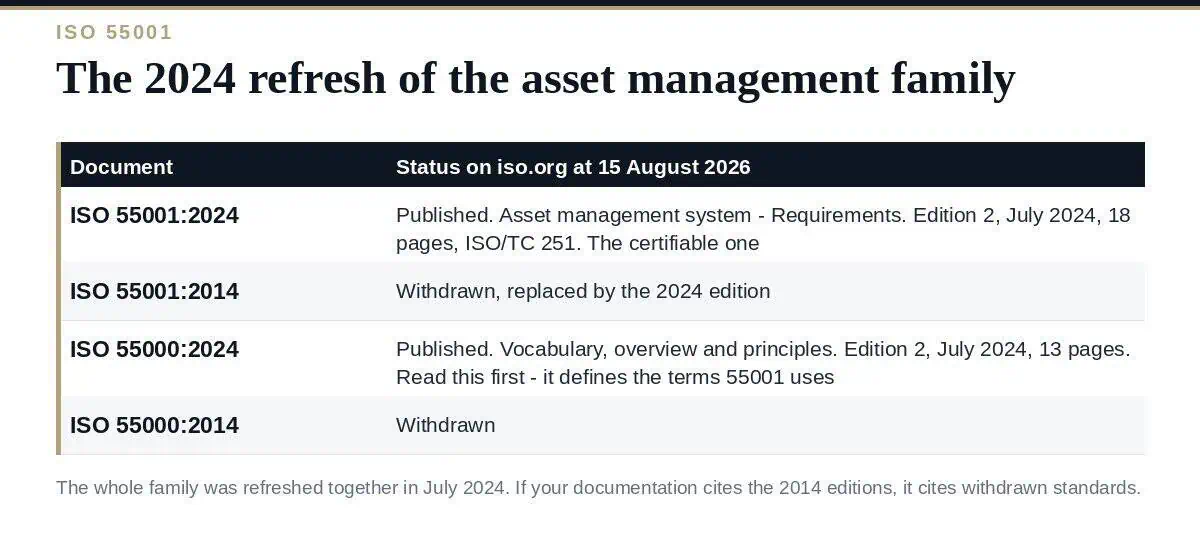
ISO 55001:2024 — Asset management — Asset management system — Requirements — is the second edition, published July 2024, running to 18 pages and maintained by ISO/TC 251. The 2014 first edition is withdrawn.
Alongside it, ISO 55000:2024 — Vocabulary, overview and principles — replaced its own 2014 edition on the same schedule. Read that one first: it defines the terms the requirements standard uses, and a surprising number of ISO 55001 disagreements turn out to be definitional.
Eighteen pages of requirements is short. That is not a sign the standard is undemanding — it is a sign that almost everything is expected to come from your organisation’s own context.
The common misreading is that this is a standard about maintaining equipment. It is not. It is a standard about realising value from assets, and value is defined by the organisation and its stakeholders rather than by the standard.
That framing produces requirements a maintenance regime does not:
The SAMP is the artefact ISO 55001:2024 auditors reach for first, and it is worth dwelling on. It is the bridge between corporate strategy and the asset base, and its absence is why so many asset management systems consist of good operational practice with no line back to what the organisation is trying to achieve.
ISO 55001:2024 is generic by design, but the value concentrates where assets are capital-intensive, long-lived and consequential: utilities, transport, energy networks, ports, local government infrastructure, healthcare estates, manufacturing plant, and increasingly data centre and digital infrastructure.
The test is not asset value. It is whether decisions about assets — replace, refurbish, run to failure, defer — carry consequences measured in years and are currently being made without a written basis.
| Standard | Relationship |
|---|---|
| ISO 41001 and ISO 50001 | Facility management and energy management. All three touch the same physical estate from different angles, and we compare them directly in that guide |
| ISO 31000 | Supplies the risk method ISO 55001 expects you to integrate with, rather than inventing an asset-specific scale |
| ISO 9001 | Shares the management system backbone. If you are certified, the audit, review and improvement machinery is reusable and the integration cost is low |
| ESG reporting | Asset lifecycle and renewal data feeds sustainability disclosure directly. The 2024 edition sits against a much stronger reporting backdrop than the 2014 one did |
This guide reflects the ISO 55001 and ISO 55000 records on iso.org at 15 August 2026, on which the 2024 second editions are published and the 2014 editions are withdrawn.
The ISO 55001 Asset Management Toolkit provides 44 editable templates covering the asset management policy, the Strategic Asset Management Plan, the objectives and decision criteria, the asset information requirements, and the audit and management review records.

October 15, 2026

October 15, 2026
October 14, 2026
October 14, 2026
October 14, 2026

