
CART
No products in the cart.
ISO Compliance Insights & Best Practices
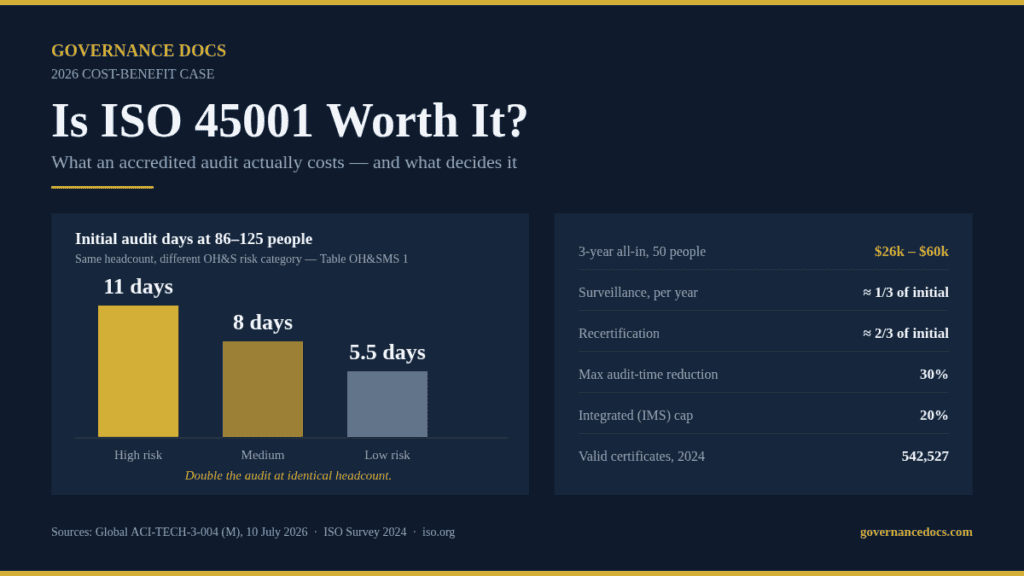
Is ISO 45001 worth it? For a construction, manufacturing or logistics business that already carries real injury risk and already loses tenders to certified competitors, yes — but the return comes from the safety work, not from the certificate, and the price of the certificate is set by a table most buyers never see. For a 12-person software consultancy whose biggest hazard is a badly adjusted monitor, the honest answer is usually no.
Answering whether is ISO 45001 worth it properly means running a cost-benefit case, not a benefits listicle. Every audit-day figure below comes out of Global ACI-TECH-3-004 (M), the mandatory document accredited registrars have to follow when they price your audit, issued 10 July 2026. Every economic figure is attributed, and where the evidence is weaker than the marketing around it, this post says so.
Free gap assessment
Could you prove workers take part in safety decisions?
Score every clause of ISO 45001, free, including the consultation and participation evidence that fails more audits than any other requirement.
Run the free ISO 45001 gap assessment → or View premium report sample
| Your situation | Verdict | Why |
|---|---|---|
| Construction, manufacturing, energy, waste, logistics — bidding for contracts | Yes | Certification is a routine prequalification gate. Losing one mid-size tender usually costs more than the whole three-year cycle. |
| You have had a reportable incident, an enforcement notice or a rising claims history | Yes | The management system is the cheapest way to build the documented evidence a regulator, insurer or claimant’s lawyer will ask for. |
| Multi-site operator with inconsistent safety practice between sites | Yes | The standard’s real product is one system instead of twelve local habits. That benefit scales with site count. |
| Office-based SME, no client asking, low hazard profile | Probably not | You will pay 2.5–3 audit days a year to certify a risk profile that a written risk assessment already covers. |
| You want the safety improvement but nobody is asking for a certificate | Implement, don’t certify | Build to the standard, skip the registrar. You keep roughly 100% of the safety benefit and lose only the badge. |
| You already hold ISO 9001 or ISO 14001 | Yes, and time it | An integrated audit is capped at a 20% reduction, but the shared clauses are already written. Add it at recertification. |
Registrars do not invent your fee. Accredited certification bodies price initial audits off Annex C, Table OH&SMS 1 of Global ACI-TECH-3-004 (M) — the document that replaced IAF MD 5 when the International Accreditation Forum was wound up and Global ACI took over its mandatory documents. The table takes your effective number of personnel and your complexity category of OH&S risk, and returns the combined Stage 1 plus Stage 2 duration in days.
| Effective personnel | High risk (days) | Medium risk (days) | Low risk (days) |
|---|---|---|---|
| 1–5 | 3 | 2.5 | 2.5 |
| 11–15 | 4.5 | 3.5 | 3 |
| 26–45 | 7 | 5.5 | 4 |
| 46–65 | 8 | 6 | 4.5 |
| 86–125 | 11 | 8 | 5.5 |
| 176–275 | 13 | 10 | 7 |
Read the 86–125 row. Two companies of identical size, and one pays double the other. That is the single biggest lever on whether ISO 45001 is worth it financially, and it has nothing to do with how many people you employ.
Two details in that annex are worth arguing about before you sign a quote. First, the environmental version of this table has a fourth, cheaper “limited” column; the OH&S table has only three. There is no bargain basement for safety — 5.5 days at 100 people is the floor, whatever your registrar says about your low-risk office. Second, the document states that a certification body shall document every case where it lowered a sector’s default complexity category. That makes the question legitimate: ask which category they have assigned you and why. Table OH&SMS 2 puts mining, quarrying, oil and gas extraction, offshore fishing, tanning and pulping in the high band, and public administration, local authorities, financial institutions and advertising agencies in the low one. Shipbuilding is high — unless, in the document’s own example, you build small carbon-fibre boats, in which case medium is defensible.
Quotes are for year one. The commitment is three. The same document sets the ratios: surveillance audits run at roughly one third of the initial audit time each year and are unlikely to fall below one day; recertification is about two thirds of what a fresh initial audit would cost you at that time — not two thirds of what you originally paid. Reductions for offsite work or sampling shall not exceed 30% of the table figure, and total duration should typically not drop below 80% of the calculated time. Those two clauses are why “we got a great deal” quotes below the table are usually a sign of an unaccredited certificate.
US registrars typically charge $1,200–$2,500 per auditor day in 2026; UK registrars publish roughly £850–£1,500. Applying that to the table:
| Profile | Initial audit | Registrar fees, 3 years | Realistic all-in, 3 years |
|---|---|---|---|
| 14 people, low risk (professional services) | 3 days | $6,000 – $12,500 | $14,000 – $32,000 |
| 50 people, medium risk (light manufacturing) | 6 days | $12,000 – $25,000 | $26,000 – $60,000 |
| 100 people, high risk (construction) | 11 days | $22,000 – $46,000 | $45,000 – $110,000 |
“All-in” adds the things the registrar does not invoice: the standard itself (CHF 196, about US$240 — though Amendment 1:2024, the climate action change, is free), internal hours at roughly $50 loaded, training, and a consultant if you use one. Our own ISO 45001 certification cost breakdown takes each of those apart line by line.
One cost that is specific to this standard: for an OH&S management system, where work runs on shifts, the document requires that at least one shift inside and one outside regular office hours shall be audited during the first certification cycle. For quality and environmental audits, one shift is enough. If you run nights, ISO 45001 costs you audit time that ISO 9001 does not, and no amount of negotiation removes it in cycle one.
Three of the four returns below can be priced. The fourth cannot, and anyone telling you is ISO 45001 worth it on the strength of that fourth one is selling.
This is the return that is easy to measure and the reason most certificates get bought. Principal contractors, public buyers and large industrial clients list ISO 45001 in prequalification questionnaires. There is no published study that will tell you your win rate improves by x percent — but you can price this yourself in ten minutes by counting the tenders you were screened out of last year. If the answer is zero, that column of the business case is zero, and you should be honest about it.
US penalties for 2026 sit at $16,550 per serious or other-than-serious violation and $165,514 for a willful or repeated violation, with failure to abate charged at $16,550 per day beyond the abatement date. Those figures did not rise this year: OSHA’s 21 May 2026 memorandum confirms there is no inflation adjustment for 2026, because the Bureau of Labor Statistics could not publish October 2025 CPI-U data during the shutdown, and the Federal Civil Penalties Inflation Adjustment Act allows no substitute measure. A management system does not make you immune to any of that. What it does is produce the hazard identification records, competence evidence and incident investigations that turn a willful finding into a serious one.
Liberty Mutual’s 2025 Workplace Safety Index, cited on OSHA’s business case for safety and health, puts employer spending at more than $1 billion per week in direct workers’ compensation costs for disabling, non-fatal injuries. OSHA also cites a Cal/OSHA study in which inspected firms saw a 9.4% drop in injury claims and 26% average savings on workers’ compensation costs, and a Liberty Mutual survey in which over 60% of CFOs said each $1 invested in injury prevention returns $2 or more.
Be careful with that last one, because your competitors will not be. It is a survey of executive opinion, not a measured return, OSHA curates these findings rather than producing them, and none of the studies on that page are about ISO 45001 certificates. They are about safety programs. The honest version of the claim is: safety work pays back, and ISO 45001 is one structured way to do safety work. The certificate is evidence, not the mechanism.
The benefit that does not show up in any study is the one multi-site operators report most: worker consultation, incident reporting, contractor control and legal register maintenance stop being site-level folk practice. If you run more than three locations, this is usually where the money actually comes back.
Run the arithmetic rather than the argument. Take a 30-person medium-risk fabrication shop. Table OH&SMS 1 gives 5.5 days initial, call it $9,000 at the middle of the day-rate range, plus about $6,500 of surveillance across years two and three. Add 250–400 internal hours to build and run the system — $12,500 to $20,000 at $50 loaded — plus training and the standard. A realistic three-year figure is $30,000 to $40,000, most of it staff time you are partly spending already.
Against that, one lost-time injury of the kind that produces a claim, a replacement worker and an investigation routinely runs into five figures before anyone counts the disruption. You need the system to prevent roughly one serious injury across three years to break even on the safety case alone — and if a single certified-only tender comes through, the certificate pays for itself independently.
That is why, for a small business, is ISO 45001 worth it turns on hazard rather than headcount. A 30-person fabrication shop clears the bar easily. A 30-person accountancy practice does not, and no consultant should tell it otherwise.
There are four situations in which the honest answer to is ISO 45001 worth it is no, at least for now.
This is the live timing question, and it changed this month. ISO 45001:2018 is still Edition 1, published March 2018, reviewed and confirmed in 2024, now sitting at stage 90.92 — “International Standard to be revised”. Its ISO page carries the line “Expected to be replaced by ISO/DIS 45001 within the coming months.” The draft ran its international ballot from 16 June to 8 September 2026 and, as of today, ISO/DIS 45001 is at stage 40.60, “Close of voting”, as Edition 2. Certification bodies expect publication in 2027 with a three-year transition — that is registrar expectation, not an ISO commitment, and it has slipped before.
Does that argue for waiting? No, and for a practical reason. Certificates issued now stay valid through the transition window, and a transition audited as part of a scheduled recertification costs close to nothing extra because the recertification duration already covers every clause. A standalone transition audit bolted on mid-cycle does not. If you certify in the next twelve months, put the transition on your recertification date and the edition change becomes a paperwork exercise. Waiting for Edition 2 costs you a year of tender eligibility to avoid a cost you can engineer away.
If you have concluded that ISO 45001 is worth it, four levers move the number, in order of impact:
Challenge the complexity category. Worth 30% or more of your audit fee if you are sitting in a band above your actual risk. The registrar has to document lowering it, so make the case at contract review, with evidence.
Integrate, and time it. If you hold ISO 9001 or ISO 14001, an integrated audit reduces total time — but Global ACI-TECH-3-008 (M) caps that reduction: it “shall not exceed 20% from the starting point T”. Twenty percent is the ceiling, so treat larger promises with suspicion. The bigger saving is that leadership, competence, documented information, internal audit and management review are already written.
Check who is on the clock. Time spent by auditors-in-training, observers and technical experts does not count toward your audit duration. If a trainee shadows your Stage 2, that is not your day.
Do not pay twice for documentation. Most of the first-year internal hours go into writing the OH&S policy, hazard identification procedure, legal register, consultation arrangements, emergency preparedness plans and internal audit programme — the mandatory documents for ISO 45001 are a known, finite list. Starting from a structured template set rather than a blank page is the cheapest hour you will save.
How many organisations are certified? The ISO Survey 2024 records 542,527 valid ISO 45001 certificates across 941,546 sites. Treat the year-on-year jump with caution: the 2024 survey moved to IAF CertSearch data, so much of the apparent growth is a change in counting method, not new certificates.
Is ISO 45001 worth it purely for the insurance saving? Rarely. Premium movement is real but seldom large enough to carry the decision on its own. Underwriters respond to claims history and controls evidence; certification helps you present both. Ask your broker for a number before you build a business case on it.
Is ISO 45001 worth it if we already have ISO 9001? Usually yes, and it is cheaper than it looks. The shared management-system clauses carry over almost unchanged. What does not carry over is the hazard, legal-compliance and worker-consultation machinery, which is where your effort will actually go.
Does the certificate protect us in an enforcement action or a claim? Not directly. It is not a defence. What helps is the evidence the system generates — risk assessments, training records, consultation minutes, investigation reports — which you can produce quickly and consistently because the system requires them.
Can we get the benefit without certifying? Yes, if the only driver is safety performance. Build to the standard and run internal audits. You lose the tender eligibility and the external discipline of a registrar visit; you keep everything else.
Is ISO 45001 worth it? It is worth it when a customer is asking, when your hazards are real, or when you operate across enough sites that inconsistency is itself the risk. It is not worth it as a wall decoration for a low-hazard office, and the ROI numbers circulating about it belong to safety programmes rather than to certificates. Price it honestly off the audit-day table, argue your complexity category, time the Edition 2 transition to your recertification, and the decision is usually clear within an hour.
If you have decided to go ahead, the documentation is the part you can buy rather than write. Our ISO 45001 Toolkit is a 50+ template document set written to ISO 45001:2018 for $99 — set against $12,500 to $20,000 of internal drafting hours, it is the least consequential line in the budget. For the wider decision pattern, is ISO 27001 worth it applies the same cost-benefit method to information security.

October 19, 2026
October 19, 2026
October 18, 2026
October 18, 2026
October 15, 2026
