


Critical limits are the numbers a HACCP plan lives or dies by: the value at each critical control point that separates safe product from unsafe, monitored during production and acted on the moment it is breached. Codex defines a critical limit as a criterion, observable or measurable, which separates acceptability from unacceptability of the food; 9 CFR 417.2(c)(3) requires the FSIS HACCP plan to list them at each CCP and to design them so that the applicable performance standards are met; 21 CFR 117.135(c)(1) asks the same of process controls, as the maximum or minimum value to which a parameter must be controlled. The requirement is simple to state and routinely got wrong in three ways — limits that cannot be measured, limits that have never been validated, and operating targets mistaken for limits. This guide, updated in November 2026 for the 2026 FDA Food Code, explains what a critical limit is and is not, gives ten worked examples by CCP, where the values come from, how they are validated, how they connect to monitoring and corrective action, and the errors that turn a plan with numbers in it into a plan with no limits at all.
Free gap assessment
Would your HACCP plan survive an inspection?
Score the whole of the Codex text, free - the good hygiene practices as well as the seven principles, with the US and EU overlays on top.
Run the free HACCP gap assessment → or View premium report sample
What is a critical limit in a HACCP program?
A critical limit is the maximum or minimum value, or the observable criterion, that a hazard must be controlled to at a critical control point (CCP). On one side of it the food is acceptable; on the other it is potentially unsafe and the plan’s corrective action starts. Critical limits are HACCP principle 3, and every CCP in the plan needs at least one. Three tests decide whether a value is a real limit:
- It controls a named hazard. The value exists because a hazard analysis found a significant hazard at this step, such as Salmonella surviving a cook.
- It can be checked at the step, in time to act. A thermometer reading at the end of the cook qualifies; a lab result that comes back after the product has shipped does not.
- It is validated. A regulation, guidance table, study or process authority shows that holding the value controls the hazard on this product and this equipment.
Typical critical limits are 165 °F (74 °C) at the thickest part of cooked poultry, a finished equilibrium pH of 4.6 or below for an acidified food, and 161 °F (72 °C) for 15 seconds for HTST milk pasteurization. The table of critical limits examples below gives ten more.
What critical limits are — and what they are not
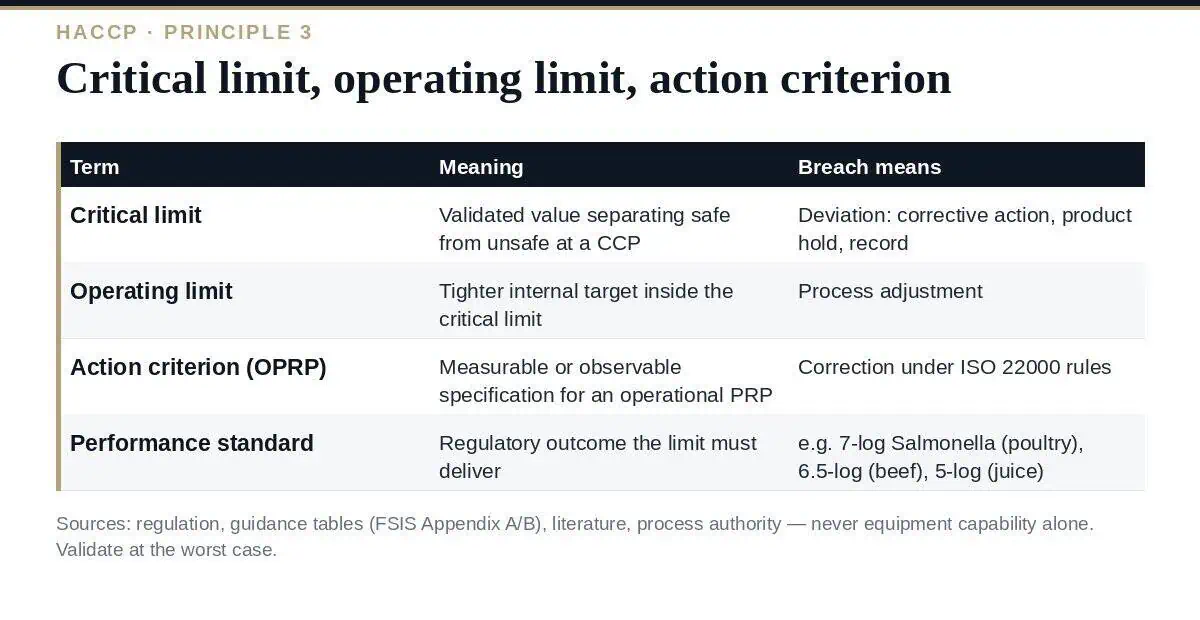
| Term | Meaning | Example at a cook CCP |
|---|---|---|
| Critical limit | The validated value that separates acceptable from unacceptable; a breach means the product is potentially unsafe and corrective action is required | Internal temperature ≥ 74 °C (165 °F) held for the validated time |
| Operating limit (target) | A tighter internal value set to keep the process away from the critical limit; a breach is a process adjustment, not a deviation | Set point 78 °C; adjust below 76 °C |
| Action criterion (ISO 22000 OPRP) | A measurable or observable specification for an operational PRP; not a critical limit, and a breach is handled differently | Sanitizer concentration in range before start-up |
| Performance standard | The regulatory outcome the limit must deliver | 7-log₁₀ Salmonella reduction for fully cooked poultry (9 CFR 381.150); 6.5-log₁₀ for cooked beef (9 CFR 318.17); 5-log for juice (21 CFR 120.24) |
| Specification | A quality or customer requirement, not a safety limit | Colour, moisture, weight |
Two consequences follow. A critical limit must be measurable or observable at the CCP, in real time or close to it — “adequately cooked”, “visually clean” and “supplier certificate on file” are not limits because nothing at the step can be measured against them. And a critical limit is a boundary, not a target: the target belongs to the operating limit, and confusing the two produces either a plan whose every small drift is a recorded deviation, or one whose real breaches are treated as adjustments.
Why you set critical limits in a HACCP plan
The purpose of critical limits is to turn “this step controls the hazard” into a decision an operator can make on the line, every batch, without calling the food safety manager. Critical limits do four jobs at once:
- They separate acceptable from unacceptable product. Without a limit, nobody can say whether a given batch was safe; with one, the record answers the question.
- They define what monitoring measures. The parameter, the units and the instrument all follow from the limit.
- They trigger corrective action. A breach is the only event that starts the deviation procedure, so a plan without critical limits has no deviations, only opinions.
- They make the plan auditable. An inspector or certification auditor tests the plan by comparing recorded values against the limits and the limits against the validation file.
That is why a common training question, “why should you set a critical limit in your HACCP plan?”, has one correct answer: to separate the acceptable from the unacceptable and control the hazard. Identifying hazards is principle 1; checking that the plan works is verification, principle 6.
Where critical limits come from
| Source | What it gives you | When it is enough on its own |
|---|---|---|
| Regulation and performance standards | The outcome, and sometimes the number: FSIS lethality and stabilization standards; the juice 5-log requirement; state and retail food codes | When the standard is written as a time/temperature or process value your equipment can deliver and monitor |
| Regulatory guidance tables | Time/temperature combinations that achieve the standard — FSIS Appendix A (lethality) and Appendix B (stabilization), FDA’s Fish and Fishery Products Hazards and Controls Guidance | When your product and process match the assumptions the table states (humidity, product type, fat content) |
| Scientific literature | D- and z-values, pH and water activity growth boundaries, thermal death data for the organism of concern | When the study conditions match your product; otherwise it is an input to your own validation |
| Process authority or challenge study | A limit established for your specific product and process, with inoculated-pack or worst-case data | When published data does not fit — novel products, marginal processes, combined hurdles |
| Equipment capability | What the line can do | Never on its own — capability sets the operating limit, science sets the critical limit |
The common parameters are time and temperature (cooking, pasteurization, chilling, holding), pH and titratable acidity, water activity, salt and preservative concentration, humidity, flow rate, metal detector sensitivity by test piece size, sieve or filter aperture, and sanitizer concentration and contact time. Whichever parameter is chosen, it must be the one that actually controls the hazard: a metal detector limit stated as “detector on” is a presence check, not a limit; the limit is the test-piece size it must reject.
Critical limits examples by CCP
The table shows common critical limits as they appear in real plans, with the source that supports each value. Retail values come from the FDA Food Code, which is a model code: it applies only once a state or local jurisdiction adopts it, and many still enforce an earlier edition. FDA issued the 2026 edition on 17 September 2026; it adds an approved alternative cooling method for cooked TCS food under specified conditions, including continuous electronic monitoring, so check which edition and which cooling option your regulator accepts before you copy a number.
| CCP | Hazard controlled | Example critical limit | Source |
|---|---|---|---|
| Cooking poultry (retail) | Salmonella, other vegetative pathogens | Internal temperature of 165 °F (74 °C) or above, instantaneous | FDA Food Code § 3-401.11 |
| Cooking comminuted meat such as ground beef (retail) | E. coli O157:H7, Salmonella | 155 °F (68 °C) for 17 seconds, or an equivalent time/temperature from the Code table | FDA Food Code § 3-401.11 |
| Cooking ready-to-eat meat and poultry (FSIS plant) | Salmonella | A time/temperature combination that delivers 6.5-log10 (cooked beef) or 7-log10 (poultry) reduction, taken from Revised Appendix A or the plant’s own validation | 9 CFR 318.17, 381.150; FSIS cooking guideline |
| Cooling cooked TCS food (retail) | C. perfringens, B. cereus | From 135 °F to 70 °F (57 °C to 21 °C) within 2 hours, and to 41 °F (5 °C) or below within 6 hours in total | FDA Food Code § 3-501.14 |
| Hot holding | Growth of spore-formers | 135 °F (57 °C) or above | FDA Food Code § 3-501.16 |
| Cold holding | Listeria, other pathogens | 41 °F (5 °C) or below | FDA Food Code § 3-501.16 |
| HTST milk pasteurization | Vegetative pathogens in raw milk | 161 °F (72 °C) for at least 15 seconds | Grade “A” Pasteurized Milk Ordinance |
| Acidification | C. botulinum | Finished equilibrium pH of 4.6 or below, reached within the time the scheduled process sets | 21 CFR 114.80 |
| Juice treatment | Pertinent pathogen for the juice | 5-log reduction of the pertinent microorganism | 21 CFR 120.24 |
| Metal detection or X-ray | Hard or sharp foreign objects | Reject every test piece of the validated size (ferrous, non-ferrous and stainless steel) at each check | Plant validation; FDA CPG Sec. 555.425 as the outer boundary |
Two cautions apply to all critical limits in the table. First, a number from a table is only your limit if your product and process match the table’s assumptions; a thick roast in a slow oven is not the case the table was written for. Second, the metal detection row shows why the regulatory figure is a ceiling, not a target: FDA’s compliance policy treats a hard or sharp object 7 mm to 25 mm long in ready-to-eat food as an adulterant, so a detector set to catch only 7 mm pieces is set to fail. The test-piece sizes come from your own validation of what the line can reliably reject.
How critical limits are measured
Common ways to measure critical limits include temperature, time, pH, water activity, chemical concentration, physical detection and, where the 2020 Codex text allows it, a defined visual criterion. Whatever the parameter, critical limits are only as good as the instrument that checks them: 9 CFR 417.5(a)(3) requires records of the actual values, and the instrument has to be calibrated or the reading means nothing.
| Parameter | Instrument | How it is monitored | Common failure |
|---|---|---|---|
| Temperature | Calibrated probe thermometer, thermocouple, data logger or chart recorder | Probe the thickest piece or the slowest-heating point; log continuously on ovens and pasteurizers | Measuring oven air or water bath temperature instead of product core temperature |
| Time | Timer, belt-speed check, flow-diversion record, data logger timestamps | Record start and end times, or the belt speed that sets the dwell time | A temperature recorded with no time, when the limit is a time/temperature combination |
| pH | Calibrated pH meter (two-point calibration each shift) | Test the finished equilibrium pH of the batch, not the brine | Using pH paper where the margin to the limit is small |
| Water activity | Water activity meter | Sample each batch at the end of drying | Measuring moisture content and treating it as water activity |
| Concentration | Titration, refractometer, chemical test strips | Check at make-up and at a set frequency during the run | Recording “OK” instead of the measured value |
| Physical detection | Test pieces passed through the detector | At start-up, at a set interval, at product changeover and at the end of the run | Checking the detector without confirming the reject mechanism removed the test piece |
| Observable criteria | Visual check against a defined standard (seal integrity, colour change) | Every unit or a defined sample, by a trained person | A criterion vague enough that two operators would judge it differently |
Validating critical limits
Codex step 8 in the 2020 revision reads “establish validated critical limits”, and both US regimes require validation: 9 CFR 417.4(a)(1) initial validation “that the HACCP plan is functioning as intended”, and 21 CFR 117.160 validation by a PCQI before implementation or within 90 days of first production, with “scientific and technical evidence (or, when such evidence is not available or is inadequate, conducting studies)”. Validation answers one question: does this value, delivered by this equipment on this product at the worst case, control the hazard? Four elements make the validation file complete.
- The hazard and the required outcome — the organism or agent, and the log reduction or growth limit that constitutes control.
- The scientific basis — the regulation, guidance table, study or process authority letter, cited.
- The link to your process — evidence that the assumptions hold: thickest piece, coldest spot, slowest belt, lowest incoming temperature, highest fat.
- The in-plant confirmation — temperature mapping, heat penetration, or trial runs showing the limit is achieved at the worst case with the monitoring method in use.
Our guide to HACCP validation vs verification covers the difference between proving the limit works and checking it is being applied.
Critical limits, monitoring and corrective action
The limit dictates the monitoring: what is measured, with what instrument, where, how often, by whom, and what is recorded. 9 CFR 417.5(a)(3) requires records of “actual times, temperatures, or other quantifiable values” — a tick in a box is not a monitoring record. The limit also dictates the corrective action, which 9 CFR 417.3(a) requires the plan to identify for each deviation: identify and eliminate the cause, bring the CCP back under control, establish measures to prevent recurrence, and ensure no product injurious to health enters commerce. A deviation record therefore names the limit, the measured value, the product affected since the last good check, its disposition, and the sign-off. Under Part 117, § 117.150 asks for the same elements as corrective action procedures, and distinguishes corrections — minor, isolated problems fixed in a timely way — from corrective actions.
Worked example: a cook CCP breach
Take a cook-chill line for chicken breast, with a critical limit of 165 °F (74 °C) at the thickest part and an operating limit of 170 °F (77 °C). The operator probes three pieces from the end of the oven every 30 minutes and records the values. At 10:30 one piece reads 162 °F.
- Stop and hold. Everything cooked since the last acceptable check at 10:00 goes on hold; nothing moves to chilling until it has a disposition.
- Restore control. The supervisor finds the belt speed was raised after a jam. The speed is reset and the next three readings are 171 °F, 173 °F and 170 °F.
- Disposition. The held product is recooked to the limit and re-probed, or destroyed; it is never released on the strength of the other two readings.
- Prevent recurrence. Belt-speed changes now need supervisor sign-off and trigger an extra temperature check.
- Record. The deviation record names the limit, the 162 °F reading, the product and time window affected, the disposition, the cause and the sign-off.
Had the reading been 168 °F, it would sit between the critical limit and the operating limit: a process adjustment, not a deviation, and no product would be held.
Critical limits under Codex, FSIS, FDA and ISO 22000
The concept of critical limits is the same everywhere; the wording and the evidence asked for are not. The point that catches most teams moving between schemes is measurability: Codex accepts an observable limit, ISO 22000:2018 does not, and an observable control under ISO 22000 is an operational prerequisite program (OPRP) with an action criterion. A revision of ISO 22000 is in development, but the 2018 edition is the one certification bodies audit against today.
| Framework | Where critical limits are required | Measurable or observable | Validation required |
|---|---|---|---|
| Codex CXC 1-1969 (2020 revision) | Step 8, principle 3: “establish validated critical limits” | Measurable or observable | Yes, before the plan is implemented |
| USDA FSIS, 9 CFR Part 417 | § 417.2(c)(3): critical limits at each CCP, designed so that applicable performance standards are met | Measurable in practice, with actual values recorded under § 417.5(a)(3) | Yes, initial validation under § 417.4(a)(1) |
| FDA, 21 CFR Part 117 (preventive controls) | § 117.135(c)(1): the maximum or minimum value to which a parameter must be controlled | Parameters and values, monitored and recorded | Yes, by a PCQI under § 117.160, within 90 days of first production unless an exception applies |
| ISO 22000:2018 | Clause 8.5.4.2: critical limits for CCPs, action criteria for OPRPs | Critical limits must be measurable; observable criteria belong to OPRPs | Yes, validation of control measures in clause 8.5.3 |
Errors that leave a plan without real critical limits
- Unmeasurable limits. “Cooked thoroughly”, “chilled promptly”, “no foreign material” — nothing to measure against, nothing to breach, nothing to act on.
- Limits without validation. A number copied from a previous plan or a competitor’s, with no file showing why it controls the hazard on this product.
- Operating limits recorded as critical limits. The set point becomes the limit, every drift becomes a deviation, and the plant stops treating deviations seriously.
- Limits the monitoring cannot see. A core-temperature limit monitored by oven air temperature; a time limit with no clock in the record.
- Limits set from what the line can do. The oven achieves 70 °C, so 70 °C is the limit — whether or not the science supports it.
- Combined parameters stated singly. A lethality that depends on time and temperature together, written as a temperature alone.
Our guide to the HACCP hazard analysis covers the step before the limit — which hazard the number exists to control — and OPRP vs CCP covers when a measure gets a critical limit and when it gets an action criterion.
Frequently asked questions
What are critical limits in HACCP?
The criterion at each critical control point — observable or measurable, in Codex’s words — that separates acceptable food from unacceptable. A value outside the limit means the product is potentially unsafe and corrective action is required. They are HACCP principle 3 and are required by 9 CFR 417.2(c)(3) and, as process control values, by 21 CFR 117.135(c)(1).
What is the difference between a critical limit and an operating limit?
The critical limit is the safety boundary; the operating limit is a tighter internal target that keeps the process away from it. Exceeding an operating limit is a process adjustment; exceeding a critical limit is a deviation with product disposition and a record.
Do critical limits have to be validated?
Yes. Codex step 8 is ‘establish validated critical limits’; 9 CFR 417.4(a)(1) requires initial validation; 21 CFR 117.160 requires validation by a PCQI with scientific and technical evidence or studies. The file must connect the number to your product and equipment at the worst case.
Can a critical limit be observable rather than measured?
Under the 2020 Codex revision, yes — a visual criterion such as a sealed pack or a colour change can be a limit if it separates acceptable from unacceptable and can be monitored consistently. Most limits remain numerical because numbers are easier to validate and defend.
What is an example of a critical limit in a HACCP plan?
Cooked poultry held to an internal temperature of 165 °F (74 °C) at the thickest part, an acidified sauce held to a finished equilibrium pH of 4.6 or below, and HTST milk pasteurized at 161 °F (72 °C) for 15 seconds are three of the most common. Each is tied to a named hazard and a published source.
Who sets the critical limits?
The HACCP team sets critical limits, using regulation, guidance tables, scientific literature or a process authority. Under 21 CFR Part 117 a preventive controls qualified individual (PCQI) must validate them. Equipment suppliers and consultants can supply data, but the plant owns the limit and its validation file.
What happens when a critical limit is exceeded?
The corrective action in the plan: identify and eliminate the cause, restore control, prevent recurrence, and hold and disposition all product produced since the last acceptable check. The record shows the limit, the measured value, the product and the decision.
Where this leaves you
Set critical limits as validated boundaries on the parameter that actually controls the hazard: one value or combination per CCP, measurable or observable at the step, tied to a regulation, guidance table, study or process authority and confirmed on your own line at the worst case, with an operating limit inside it and a corrective action beyond it. A plan whose limits meet that test has numbers that mean something; one whose limits do not has a list.
References
- 9 CFR Part 417 — §§ 417.2(c), 417.3, 417.4, 417.5 (eCFR) — Critical limits in the plan, corrective actions, validation and the records of actual values.
- 9 CFR § 381.150 and § 318.17 — lethality performance standards (eCFR) — The 7-log₁₀ (poultry) and 6.5-log₁₀ (cooked beef) Salmonella reduction standards.
- 21 CFR Part 117 — §§ 117.135(c)(1), 117.150, 117.160 (eCFR) — Process control parameter values, corrective actions and corrections, validation.
- FDA Food Code (2026 edition, issued 17 September 2026) — Retail cooking, cooling and holding values (§§ 3-401.11, 3-501.14, 3-501.16).
- 21 CFR Part 114 — Acidified foods (eCFR) — The finished equilibrium pH of 4.6 or below.
- FDA CPG Sec. 555.425 — Hard or sharp foreign objects — The 7 mm to 25 mm adulteration benchmark.
More on HACCP
- Critical limits — you are here
- The seven HACCP principles
- HACCP hazard analysis: the worksheet
- HACCP validation vs verification
- OPRP vs CCP
- The HACCP plan in 12 Codex steps
The Critical Limits Register, the CCP Monitoring Plan and Monitoring Records, the Corrective Action Records and the Calibration and Verification procedure that hold the limits, the readings and the deviations together are in the HACCP Toolkit, or start with the free templates.

Recent Posts

November 22, 2026
November 21, 2026
November 20, 2026
November 19, 2026

November 18, 2026