CART
The HACCP hazard analysis is the step the rest of the plan depends on and the one auditors read first, because every critical control point, critical limit and monitoring record downstream is only as sound as the reasoning that identified the hazard. It is Codex principle 1 and step 6 of the twelve-step application; it is required in near-identical terms by the US regulations — 9 CFR 417.2(a) for meat and poultry, 21 CFR 120.7 for juice, 21 CFR 123.6 for seafood, and 21 CFR 117.130 for every other FDA-registered facility, which adds that the analysis “must be written regardless of its outcome”. It has two stages that plans routinely collapse into one: identifying the hazards that could occur at each step, then evaluating which of them are significant enough to need control. This guide sets out the inputs, the two stages, a worksheet with a worked row, the hazard categories the regulations now expect to see considered, how the analysis decides between a CCP and a prerequisite, and the errors that produce a plan that looks complete and is not.
Free gap assessment
Would your HACCP plan survive an inspection?
Score the whole of the Codex text, free - the good hygiene practices as well as the seven principles, with the US and EU overlays on top.
Run the free HACCP gap assessment → or View premium report sample
Codex places five preliminary steps before the analysis, and the regulations echo them: 9 CFR 417.2(a)(2) requires “a flow chart describing the steps of each process and product flow” and identification of “the intended use or consumers of the finished product”. The analysis needs, in hand: the product description (composition, water activity, pH, packaging, shelf life, storage), the intended use and consumer (including vulnerable groups), a flow diagram that has been walked and confirmed on the floor, and the team with product, process and hazard knowledge to do the work. A hazard analysis conducted from an unconfirmed flow diagram analyzes a process that does not exist. Our guide to the HACCP plan in 12 Codex steps covers the preliminaries.
At each step of the flow diagram, list every hazard that could be introduced, increased or survive — with a reason. The regulatory definitions of what to consider have widened and a current analysis should show that each category was considered even where the answer is “none at this step”.
| Category | What to consider | Regulatory anchor |
|---|---|---|
| Biological | Pathogens (vegetative and spore-forming), parasites, viruses; environmental pathogens where ready-to-eat food is exposed to the environment; growth, survival and contamination at each step | 21 CFR 117.130(b)(1)(i) and (c)(1)(ii); 9 CFR 417.2(a)(3) |
| Chemical | Pesticide and drug residues, natural toxins, decomposition, unapproved additives, allergens, radiological hazards | 21 CFR 117.130(b)(1)(ii) — radiological is named explicitly; 9 CFR 417.2(a)(3) |
| Physical | Metal, glass, hard plastic, stones, bone, wood — anything that can injure | 21 CFR 117.130(b)(1)(iii); 9 CFR 417.2(a)(3) |
| How the hazard arises | Naturally occurring; unintentionally introduced; intentionally introduced for economic gain | 21 CFR 117.130(b)(2) |
| Where it arises | Before, during and after entry into the establishment — incoming materials, the process, distribution | 9 CFR 417.2(a)(1) |
The sources of the list are the ones § 117.130(a)(1) names — “experience, illness data, scientific reports, and other information” — plus the product’s own history: complaints, deviations, recalls in the category, supplier data, and the raw material hazards a separate analysis of ingredients and packaging should feed in.
Identification produces a long list; evaluation decides which entries matter. Codex asks which hazards are of such a nature that their elimination or reduction to an acceptable level is essential; § 117.130(c) asks for “the severity of the illness or injury if the hazard were to occur and the probability that the hazard will occur in the absence of preventive controls”; 9 CFR 417.2(a)(1) asks which are “reasonably likely to occur” — those a prudent establishment would control because they have occurred historically or there is a reasonable possibility they will. Three points decide most evaluations.
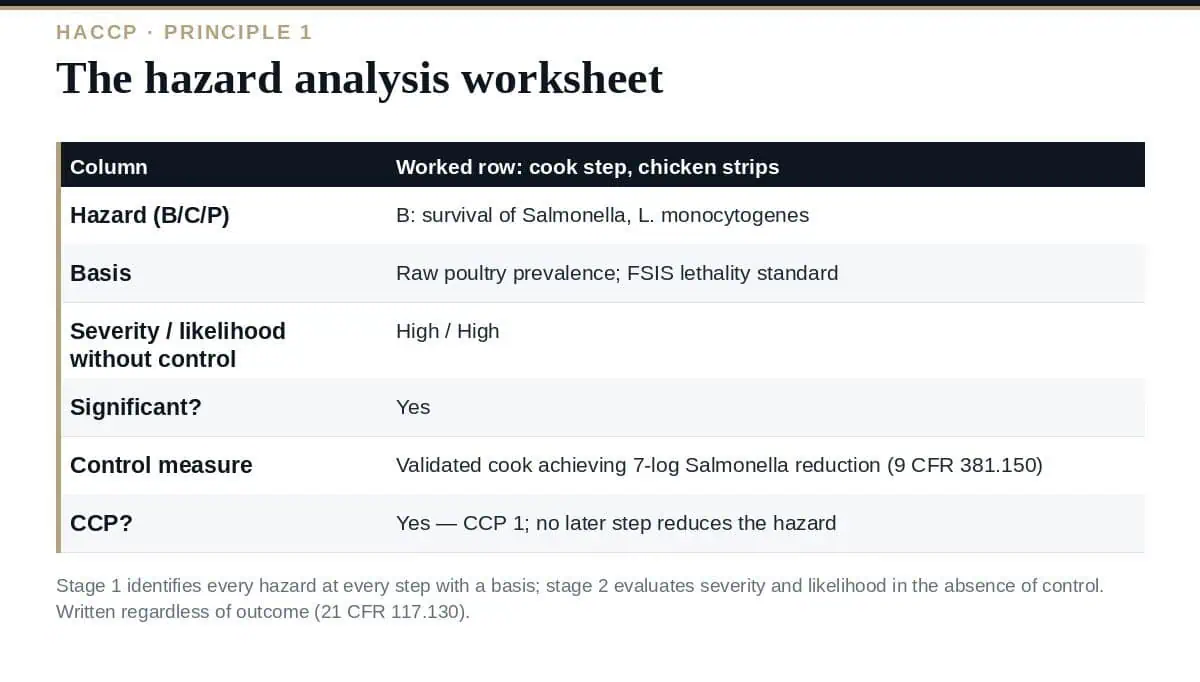
| Column | What it records | Worked row: cooked chicken strips, step ‘Cook (continuous oven)’ |
|---|---|---|
| Process step | From the confirmed flow diagram | Cook |
| Hazard (B / C / P) | Each hazard that could be introduced, increased or survive | B: survival of Salmonella and Listeria monocytogenes |
| Basis | Why it is listed — data, history, science | Raw poultry pathogen prevalence; FSIS lethality performance standard for poultry |
| Severity | Consequence if it occurs | High — invasive illness, fatal in vulnerable groups |
| Likelihood without control | Probability in the absence of the control measure | High — raw material routinely contaminated |
| Significant? | The evaluation decision, with reasoning | Yes |
| Control measure | What prevents, eliminates or reduces it | Cook to a validated time/temperature achieving a 7-log Salmonella reduction (9 CFR 381.150) |
| CCP? | Decision tree or equivalent reasoning | Yes — CCP 1; later steps do not reduce the hazard |
| Reference to plan | Where the limit, monitoring and corrective action live | HACCP plan, CCP 1; critical limits register |
The same worksheet carries rows that end “not significant” — glass at the cook step, for example, with the basis “no glass in the area; controlled by the glass and brittle plastics PRP” — and rows where the control is a prerequisite programme rather than a CCP. Our guides to critical limits and OPRP vs CCP cover what happens after the CCP decision.
A significant hazard needs a control measure; a control measure is a CCP when it is the step at which control is essential and a measurable or observable critical limit can be set and monitored. The Codex decision tree asks the questions in sequence — is there a control measure at this step, does the step eliminate or reduce the hazard to an acceptable level, could contamination exceed acceptable levels, will a later step eliminate it — and the answers are recorded on the worksheet, not just the result. Under Part 117 the same analysis feeds a wider set of controls: process controls at CCPs, and allergen, sanitation and supply-chain controls for hazards that a PRP-style measure controls. Our guide to HACCP vs HARPC covers the difference.
What is a HACCP hazard analysis?
The first HACCP principle: identifying, at each process step, the biological, chemical and physical hazards that could occur, then evaluating which are significant enough — by severity and likelihood in the absence of control — to need a control measure. It is required by 9 CFR 417.2, 21 CFR 117.130, 21 CFR 120.7 and 21 CFR 123.6.
Does the hazard analysis have to be written?
Yes under 21 CFR 117.130(a)(2) ‘regardless of its outcome’, and as a record under 9 CFR 417.5(a)(1) ‘including all supporting documentation’. Codex expects the reasoning to be documented as part of the plan.
What is the difference between hazard identification and hazard evaluation?
Identification lists every hazard that could occur and why; evaluation decides which are significant by severity and probability without controls. Collapsing the two produces a list of hazards with no decisions, or decisions with no basis.
Do allergens belong in the hazard analysis?
Yes, as chemical hazards — undeclared allergens are among the most common recall causes, and 21 CFR 117.130 names food allergens explicitly; Part 117 then controls them through food allergen controls.
How often must the hazard analysis be reviewed?
At least annually and on any change for USDA-inspected establishments (9 CFR 417.4); at least every three years and on trigger for Part 117 facilities (§ 117.170); Codex expects review when anything affecting the analysis changes.
Run the HACCP hazard analysis as two stages on one worksheet: identify every hazard at every step with a basis, evaluate severity and likelihood without the controls in place, write down the decisions that end “not significant” as carefully as the ones that become CCPs, and date the reassessment. The plan downstream inherits exactly the quality of this page.
The Hazard Analysis Worksheets, the Hazard Analysis of Raw, Packing and Product Contact Materials, the Product Description Sheet, the Intended Use & Target Consumer Statement and the Complete HACCP Process Steps workbook are in the HACCP Toolkit, or start with the free templates.

October 11, 2026
October 11, 2026

October 11, 2026

October 11, 2026
October 11, 2026

