CART
An OPRP is the control ISO 22000 added that HACCP does not have, and deciding which of your control measures are OPRPs and which are critical control points is the single most contested judgment in a food safety management system. Get it wrong in one direction and you are monitoring things you cannot meaningfully monitor; wrong in the other and a significant hazard is managed by a programme with no defined action criterion.
This guide sets out what ISO 22000:2018 actually says, the test that separates the two, and how each is documented in the hazard control plan.
Free gap assessment
Would your HACCP plan survive an inspection?
Score the whole of the Codex text, free - the good hygiene practices as well as the seven principles, with the US and EU overlays on top.
Run the free HACCP gap assessment → or View premium report sample
The standard defines both terms, and the definitions carry the whole distinction.
A critical control point is a step in the process at which control measures are applied to prevent or reduce a significant food safety hazard to an acceptable level, and where defined critical limits and measurement enable the application of corrections. A critical limit is a measurable value that separates acceptability from unacceptability; if it is exceeded or not met, the affected product is handled as potentially unsafe.
An operational prerequisite programme is a control measure, or combination of control measures, applied to prevent or reduce a significant food safety hazard to an acceptable level, where the action criterion and measurement or observation enable effective control of the process or product. An action criterion is a measurable or observable specification for the monitoring of an OPRP, established to determine whether the OPRP remains in control.
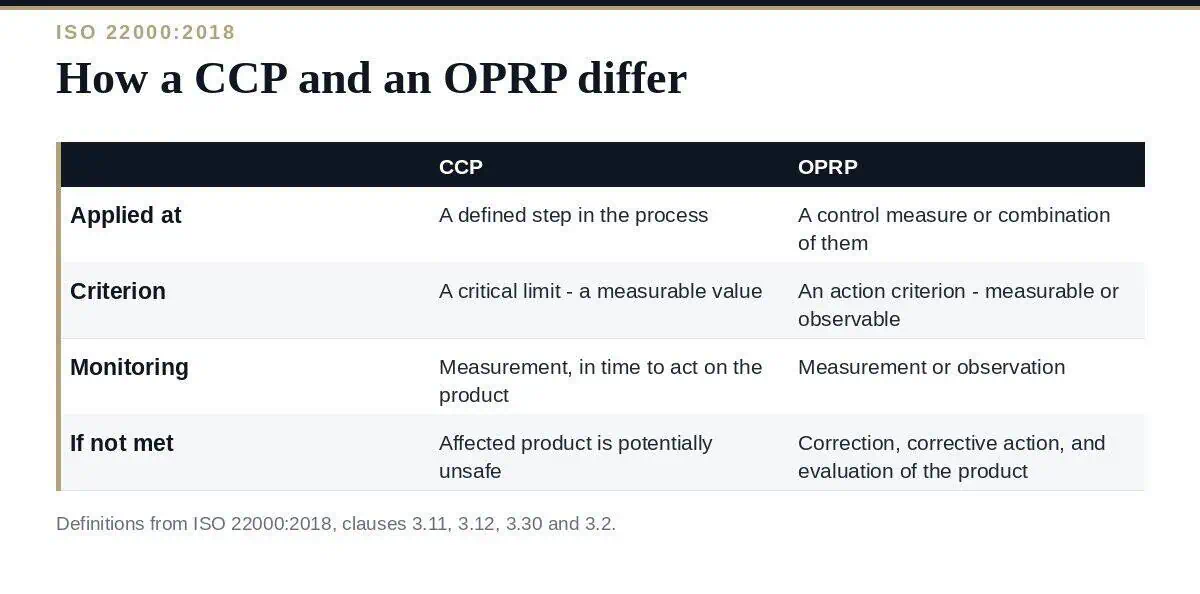
| CCP | OPRP | |
|---|---|---|
| Applied at | A defined step in the process | A control measure or combination of them, not necessarily one step |
| Criterion | A critical limit — a measurable value | An action criterion — measurable or observable |
| Monitoring | Measurement, at a frequency that detects loss of control in time to act | Measurement or observation |
| When the criterion is not met | Affected product is potentially unsafe and is handled as such | Correction and corrective action, plus an evaluation of the product’s safety |
Work through three questions in order, per significant hazard:
The pivot is the second question, and it has two parts people separate too rarely: whether a measurable limit exists, and whether you can monitor it in time to act on the product. A control with a real limit but no timely monitoring is not a functioning CCP.
ISO 22000 puts both into one artifact — the hazard control plan, which the standard also calls the HACCP/OPRP plan. For each CCP and each OPRP it records the hazard controlled, the critical limit or action criterion, the monitoring procedure, the corrections and corrective actions if the criterion is not met, responsibilities and authorities, and the records of monitoring.
Three practices keep the plan defensible:
Two patterns attract findings. The first is reclassifying a CCP as an OPRP to avoid the consequences of a breach — if a measurable critical limit exists and monitoring can act on product, calling it an OPRP will not survive scrutiny. The second is the opposite: declaring everything a CCP, which produces a plan with fifteen control points, monitoring nobody can sustain, and deviations recorded as routine.
A well-built system usually has a small number of CCPs, a modest set of OPRPs, and a strong prerequisite layer underneath both. If your plan does not look like that, the hazard analysis is doing too much or too little work — not the classification step.
What does OPRP stand for?
Operational prerequisite programme. It is a control measure for a significant hazard, distinguished from a CCP by having an action criterion rather than a measurable critical limit.
Is an OPRP the same as a prerequisite programme?
No. A PRP maintains hygienic conditions generally; an OPRP controls a specific significant hazard identified by the hazard analysis. Our guide to prerequisite programmes covers the base layer.
Does HACCP have OPRPs?
Not as a Codex concept — the classification is an ISO 22000 feature. Codex-based plans control the same hazards through CCPs and good hygiene practices.
Can an OPRP become a CCP?
Yes, and it should when the process changes such that a measurable limit and timely monitoring become possible. The reverse also happens. Reassess after any process change.
Where are these documented?
In the hazard control plan, alongside the monitoring, corrections, corrective actions, responsibilities and records for each control.
Decide the classification from the hazard analysis, not from convenience. If a measurable limit exists and you can monitor it in time to act on the product, it is a CCP and the consequences of a breach follow. If control is real but the criterion is observational or spread across several measures, it is an OPRP — and the plan still has to say how you judge whether product is affected. Keep the prerequisite layer strong so that neither list grows longer than the process warrants, and re-run the decision every time the process changes.
Hazard analysis worksheets, the hazard control plan and monitoring records are in the ISO 22000 Toolkit, or start with the free ISO templates.

October 14, 2026

October 13, 2026
October 12, 2026

October 12, 2026

October 12, 2026

