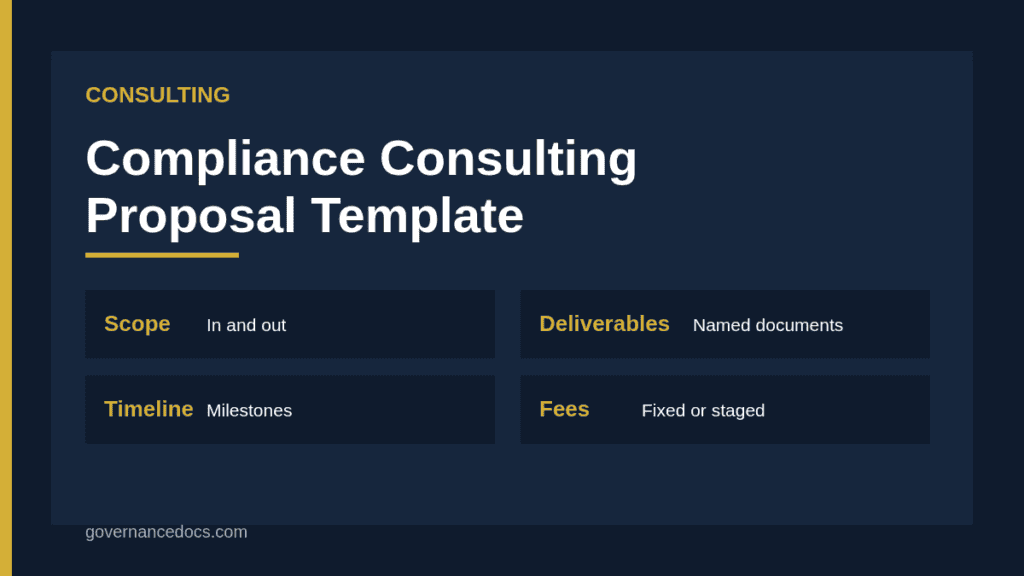
A compliance consulting proposal template is a reusable outline for the document that turns a sales conversation into an agreed piece of work: what you will do, what the client gets, how long it takes, what it costs and what each side must provide. A good one helps you win the job and protects you from scope creep.
Many consultants write each proposal from scratch, which is slow and produces uneven quality. Others copy a long generic document full of boilerplate that clients do not read. A template should be short, specific and easy to adapt, with the parts that vary clearly marked.
This guide describes ten sections, explains what to put in each and shows how to keep the proposal consistent with your contract. It is general business guidance, not legal advice, so have a lawyer review your standard terms.
Why a compliance consulting proposal template helps
Compliance work is easy to underestimate. A client who says “we need ISO 27001” may really need a gap assessment, a risk assessment, policy writing, training, an internal audit and support during the certification audit. Without a clear proposal, you either under-price or argue about what was included.
A template forces the right questions every time. What is the framework and scope? What is the deadline and why? Who will own the project on the client side? What evidence will be produced? By answering them in writing, you reduce disputes and speed up signature.
It also saves time. A consultant who sends a clear compliance consulting proposal within a day of a discovery call looks organized and credible, and many prospects choose the first provider who shows a structured plan.
Context and objective
Open with a short summary of what you learned in discovery: the business, the driver for the project, the frameworks involved and the deadline. Use the client’s words. This section proves you listened and lets them correct misunderstandings before you price the work.
State the objective as an outcome, not an activity. “Prepare the company for a first-time certification audit by a named date” is better than “provide ISO 27001 consulting”. Outcomes help you define when the work is complete.
Keep the tone plain. Clients read proposals quickly, and often share them with finance and legal, who were not on the call.
Section
Purpose
Keep it
Context and objective
Show you understood the need
One paragraph
Scope
State what is in and out
Bulleted
Deliverables
Name what the client receives
Numbered list
Approach and timeline
Show how and when
Phases with dates
Responsibilities
What the client must provide
Short list
Fees and terms
Price and payment
Table
Scope: what is in and what is out
Scope is the most important part of a compliance consulting proposal. List what you will do in specific terms: frameworks, sites, business units, systems, number of documents and number of workshops. Then list what you will not do, such as remediating technical findings, running penetration tests, acting as the named responsible officer or attending the certification audit.
Use measurable limits. “Up to ten policy documents” or “two rounds of review” prevent endless revisions. Anything outside is handled through change control.
Name dependencies. If the work depends on the client providing access, interviews or evidence by certain dates, say so, and state what happens to the timeline if they are late.
Deliverables and acceptance
List each deliverable as a named item the client will receive: a gap assessment report, a risk register, a set of policies and procedures, a Statement of Applicability, a training session or an internal audit report. For each, note the format and who approves it.
Describe acceptance in one sentence. For example, a deliverable is accepted when the client approves it or when ten working days pass without written comments. This prevents work from sitting in limbo.
Show the work in phases: discovery, assessment, design, implementation support, internal audit and audit support. Give each phase a duration and the main output. A simple timeline table with start and end dates is enough.
Set out what the client must provide: a named project owner, access to systems and staff, timely review of documents and approval of decisions. The details of how the kickoff works are in compliance consulting client onboarding.
Be clear about communication. Specify the regular meeting, the main contact and how issues are escalated. Clients value predictability, and so do you.
Fees, payment and change control
Choose a pricing model and explain it. Fixed fees work well for a defined scope, since the client knows the cost and you are rewarded for efficiency. Time and materials suits uncertain or ongoing work. The trade-offs are explained in fixed fee vs time and materials, and benchmarks are discussed in compliance consulting rates.
Tie payments to milestones, for example a deposit on signature, a payment at gap assessment delivery and a balance at completion. State when invoices are due and what happens on late payment.
Add a change control clause. Any work outside scope is quoted separately and approved in writing before you start. This single paragraph prevents most disputes.
Terms, assumptions and risk
List assumptions that affect price and timeline: the number of sites, the state of existing documentation, the availability of staff and the maturity of the current controls. If assumptions prove wrong, the price or schedule may change.
Include the key commercial terms or link to your master agreement: confidentiality, intellectual property, limitation of liability, termination and data handling. Make clear that consulting does not guarantee certification or a passed audit, since the outcome depends on the client’s implementation and the auditor’s independent judgement.
Have a lawyer review the terms, and check your professional indemnity insurance covers the work. Many consultants also keep a short statement that they do not provide legal advice.
A short compliance consulting proposal template example
Imagine a 60-person software company seeking ISO 27001 within nine months. The proposal summarizes the driver, a customer requirement, and sets the objective: readiness for a stage one audit by a named month. Scope covers the main office and cloud environment, with eleven policies, a risk assessment, a Statement of Applicability, awareness training and one internal audit.
Deliverables are listed with due dates. The client provides a project owner, weekly access and review within five working days. Fees are a fixed amount paid in four milestones, with extra work quoted separately. The certification audit fee and any remediation work are excluded. The example is invented, but it shows how each part of a compliance consulting proposal template turns vague need into a clear agreement.
Common mistakes in a compliance consulting proposal template
The first mistake is being vague about scope. Phrases like “compliance support” invite the client to assume everything is included. The second is pricing before discovery is finished, which forces you to guess at maturity and then absorb the cost. The third is hiding exclusions in fine print. Put them on the first page where the client can see them.
Another mistake is promising outcomes you do not control, such as a passed audit or an approval date. A fifth is sending a long proposal nobody reads. Keep the core to three or four pages, and move detailed terms to an appendix. Finally, do not forget to follow up. A proposal sent without a call to walk through it often stalls, while a short meeting to confirm scope and answer questions can close the deal the same week.
Adapting the compliance consulting proposal template by service type
Different services need different emphasis. A gap assessment proposal should stress the method, the sample size and the report format. An implementation proposal should stress the document set, workshops and client responsibilities. An audit support proposal should stress availability, the dates of the certification audit and how findings are handled. A retainer proposal should stress hours, response times and what is excluded. Keep one master compliance consulting proposal template and create short variants so each new proposal starts 80 percent complete.
Using a ready-made compliance consulting proposal template
Much of the effort in delivering a fixed-scope engagement goes into producing the documents themselves. A licensed library of templates lets you quote more confidently, because the deliverables already exist and only need tailoring.
The Consultant Package provides the Governance Docs catalogue, 85 toolkits and more than 7,700 editable documents, licensed for client engagements across your firm. Consultants can build proposals around known deliverables, and clients keep the documents you deliver.