CART
White label compliance templates are the quiet foundation of most consulting
practices. Almost nobody drafts an information security policy from a blank page for every client,
and almost nobody says so. What separates a defensible practice from an exposed one is not whether
you use templates — it is whether the licence you bought actually permits what you are doing
with them.
The term covers any documentation set a consultant buys, adapts and delivers under their own or
the client’s branding: policies, procedures, registers, assessment workbooks, audit checklists. The
client receives a finished deliverable. The origin of the underlying draft is, commercially, the
consultant’s business.
That is entirely legitimate, and it is how the profession works. Nobody expects a lawyer to write
every contract from first principles either. The exposure is not the practice — it is buying a
single-organisation licence and behaving as though it were a firm-wide one.
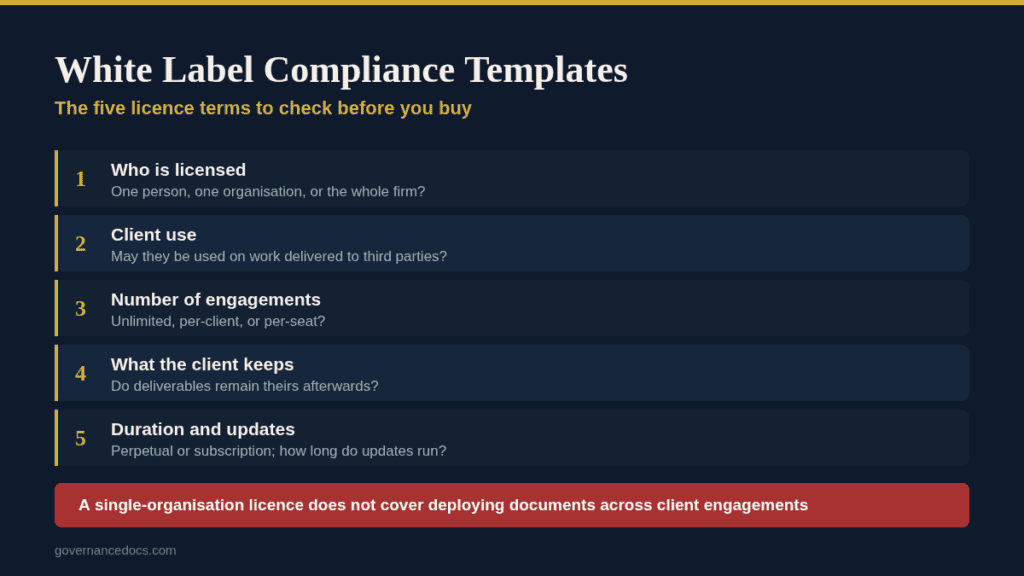
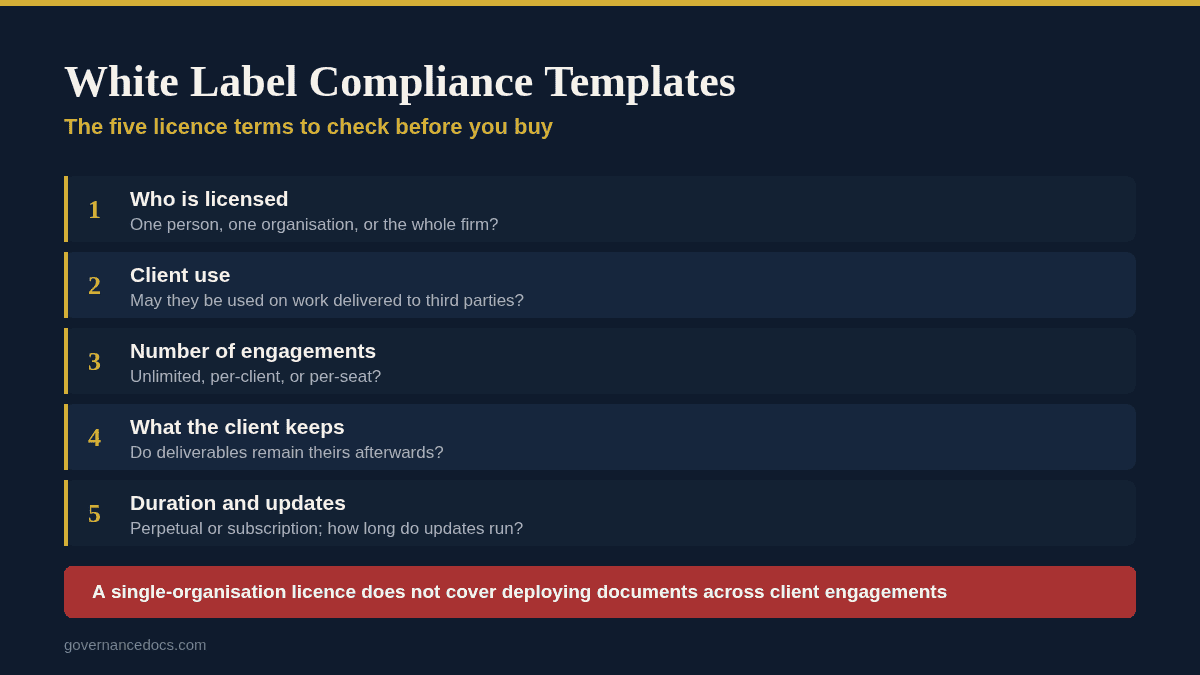
Before any purchase, get answers to these five. If the seller’s page does not address them, that
absence is itself an answer.
| Term | The question to ask |
|---|---|
| Who is licensed | One named person, one organisation, or the whole firm including associates? |
| Client use | May the documents be used on work delivered to third parties at all? |
| Number of engagements | Unlimited, or per-client, or per-seat? |
| What the client keeps | Do the deliverables remain theirs after the engagement ends? |
| Duration and updates | Perpetual or subscription; how long do updates run, and what happens after? |
Most template packs are sold on a single-organisation licence: you may use them
inside the entity that bought them. A consultancy buying that licence and deploying the documents
across a dozen client engagements is outside its terms, regardless of how much editing was done.
The awkward part is that nothing announces the breach. No system blocks it, no invoice bounces.
It surfaces years later, usually in a due diligence questionnaire or an acquisition, when somebody
asks to see the licences behind the firm’s intellectual property.
Even generous licences usually distinguish between using documents to deliver a service
and reselling them as a product. Handing a client a tailored ISMS as part of an engagement is
use. Publishing the same pack on your website as a downloadable product is resale, and almost no
licence permits it. If your business model includes the second, you need explicit written permission,
not an inference from the first.
A licence written for consultancies, not for one company.
The Consultant Package licenses all 87 toolkits — 7,900+ documents — to your whole consulting firm, for unlimited client engagements, with clients keeping the deliverables you hand them. It is a one-time $1,399, perpetual, with 12 months of updates including toolkits published in that window. Bought individually the same toolkits are $8,883.
Licensing settles whether you may. Craft settles whether it works. A template delivered with the
placeholders filled and nothing else is worse than no template, because the client can tell —
and an auditor certainly can.
Worth its own line because it is so consistently missed. Word, Excel and PowerPoint files carry
author, company, last-modified-by and sometimes a full revision history in their document properties.
A pack that has passed through two consultancies can arrive at a client naming both. Clear document
properties on every file before delivery, and check the footers — a per-page footer survives a
find-and-replace on the body text.
Being straight about this protects the engagement. A document set gets a client to a defensible
starting point far faster than drafting from scratch. It does not perform the risk assessment, decide
the scope, run the internal audit, or make the judgement calls that determine whether certification is
achievable. Those are the consulting.
Clients who believe they have bought a certification in a zip file are the ones who become unhappy,
and it is worth saying plainly at proposal stage what the documentation covers and what your time
covers. Our guide to the
statement of work covers how to write that
boundary so it holds.
The hidden cost of white label compliance templates is not acquisition, it is maintenance. A
library bought once and never refreshed becomes a liability at exactly the moment a client relies on
it, because standards move and the documents do not announce that they have gone stale.
Recent movement makes the point. ISO 27001’s 2022 edition restructured Annex A into 93 controls
across four themes, so any policy set still mapped to the 2013 Annex A is describing a structure that
no longer exists. NIST CSF 2.0 added a sixth function and withdrew a substantial number of CSF 1.1
subcategories. ISO 14001’s 2026 edition has landed, and ISO 9001’s sixth edition publishes in
September 2026. Each of those silently invalidates part of a library.
Three habits keep a practice safe. Record which edition each document was written to,
in the document itself rather than in your memory. Diff your library against the standard
whenever an edition changes, rather than waiting for a client audit to find it.
And tell clients when a document they hold is superseded — that call is
uncomfortable once and reputation-making thereafter.
Most practices underestimate this. Maintaining a serious multi-framework library is a standing
commitment: watching edition changes across every standard you cover, re-reading the new text, and
propagating changes through dozens of interdependent documents. For a firm covering three frameworks
it is manageable. For one covering fifteen it is a job.
That calculation is why buying a maintained library and spending your own time on judgement usually
wins on economics as well as on risk — provided, again, that the licence covers what you intend
to do with it.
Can I legally use white label compliance templates for client work?
Only if the licence permits it. Many template packs are licensed to a single organisation, which does
not cover deploying them across client engagements. Read the terms before purchase, not after.
Do I have to tell the client the documents came from a template?
There is no general obligation to disclose your drafting method, and clients buy your judgement rather
than your typing. What you must not do is make claims about authorship that are untrue if asked
directly.
Can the client keep the documents after the engagement?
That depends on your licence. Check specifically, because a client who has to surrender their ISMS
documentation when a contract ends is a client with a serious problem.
Can I resell the templates?
Almost certainly not. Using documents to deliver a service and selling them as a product are different
rights, and the second is rarely granted.
How much editing is enough?
Enough that every statement about how the organisation works is true of that organisation. That is the
test an auditor applies, and it is a better standard than any word count.
White label compliance templates are a legitimate and near-universal part of consulting, and the
risk in using them is almost never the practice itself. It is the mismatch between a single-organisation
licence and a firm-wide reality, and it is invisible until somebody asks. Check the five terms before
you buy, tailor properly rather than filling placeholders, clear the metadata, and keep the library
current as editions move. Do that and white label compliance templates are what lets you spend your
billable time on judgement instead of on typing.
All 87 toolkits are licensed for client work in the Consultant Package, or start with the free ISO templates.

October 19, 2026
October 19, 2026
October 18, 2026
October 18, 2026
October 15, 2026

