CART
Compliance consultant certifications do one job a portfolio of past engagements cannot: they let a client who has never met you price the risk of hiring you. A certification body’s audit, a regulator’s inquiry or a customer’s security questionnaire will be answered by someone, and the letters after that someone’s name are the fastest available signal of whether the answer will hold.
But the credential market is crowded, the prerequisites differ wildly — from five years of documented experience to a five-day course — and the wrong one costs money without moving a client. This guide sets out six credentials that move compliance and GRC clients in 2026, what each proves, what it takes to earn and keep it — from the issuing bodies’ own published requirements — which engagements each unlocks, how to sequence them, and the mistakes that leave consultants certified in things nobody buys.
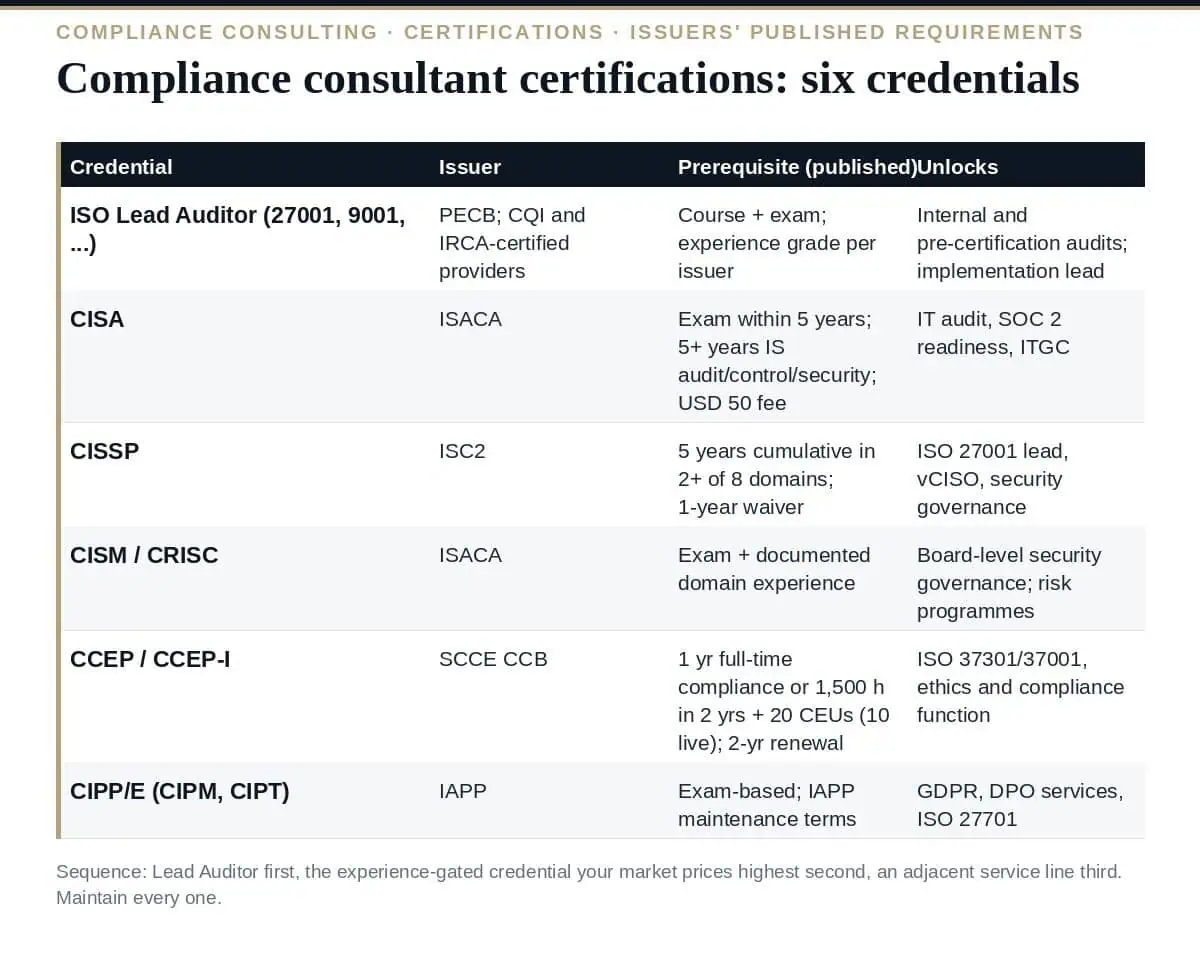
| Credential | Issuer | What it proves | Prerequisite (issuer’s published requirement) | Maintenance | Unlocks |
|---|---|---|---|---|---|
| ISO/IEC 27001 Lead Auditor (and ISO 9001, 14001, 45001, 22301 equivalents) | PECB, and CQI and IRCA-certified course providers, among others | You can plan, lead and report a management system audit against the standard | Typically a five-day course and exam; the full credential grade requires documented professional and audit experience set by the issuer | Annual maintenance fees and continuing development, per issuer | Internal audits, pre-certification audits, implementation lead, supplier audits; the credential certification bodies recognise |
| CISA — Certified Information Systems Auditor | ISACA | Information systems audit, control and assurance competence | Pass the exam within the last five years; five or more years of professional IS auditing, control or security work experience (waivers for education and other experience); US$50 application fee | Annual CPE and fee under ISACA’s policy | IT audit, SOC 2 readiness, ITGC, controls testing, regulator-facing IT assurance |
| CISSP — Certified Information Systems Security Professional | ISC2 | Broad information security design and management competence across eight domains | A minimum of five years cumulative, full-time experience in two or more of the eight domains of the exam outline; a degree or an approved credential may satisfy up to one year | Annual CPE and fee; ISC2 membership | ISO 27001 programme lead, virtual CISO, security architecture and governance advisory |
| CISM or CRISC | ISACA | Security management (CISM) or IT risk and control (CRISC) | Exam plus documented experience in the domain, per ISACA’s requirements | Annual CPE and fee | Board-level security governance; risk programmes; DORA, NIS2 and NIST CSF advisory |
| CCEP / CCEP-I — Certified Compliance & Ethics Professional | SCCE’s Compliance Certification Board (CCB) | Corporate compliance and ethics programme competence | At least one year in a full-time compliance position, or 1,500 hours of direct compliance duties in the two years before applying, plus 20 CCB CEUs (minimum 10 live) to sit the exam | Renewal on a two-year cycle with CEUs, per the CCB handbook | ISO 37301 and ISO 37001 programmes, anti-bribery, ethics and compliance function design; CCEP-I for international practice |
| CIPP/E (and CIPM, CIPT) | IAPP | Knowledge of EU data protection law (CIPP/E); privacy programme management (CIPM); privacy technology (CIPT) | Exam-based; IAPP publishes its own eligibility and maintenance terms | Continuing privacy education and fees per IAPP | GDPR programmes, DPO-as-a-service, DPIAs, ISO 27701, cross-border transfer work |
Two credentials sit just outside the six: PMP for consultants running large multi-site programmes, and a chartered accountancy or CPA qualification for SOC 1 and SOC 2 attestation work, where only a licensed CPA firm can issue the report. Our guide to the virtual CISO covers the service the CISSP and CISM most often front.
| Engagement | Credential the client expects | Why |
|---|---|---|
| ISO management system implementation and internal audit | Lead Auditor in that standard | Certification bodies recognise it; auditors respect it; clients ask for it by name |
| SOC 2 readiness | CISA, often with CISSP | The CPA firm will test what you built; CISA speaks its language |
| ISO 27001 programme lead or vCISO | CISSP and Lead Auditor | Security breadth plus audit method |
| Anti-bribery, compliance management, ethics programmes | CCEP or CCEP-I | The compliance profession’s own credential; boards and general counsel recognise it |
| GDPR, privacy, DPO services | CIPP/E and CIPM | The privacy regulator’s community credential |
| Risk and resilience — DORA, NIS2, NIST CSF, ISO 22301 | CRISC, CISM, ISO 22301 Lead Auditor | Risk vocabulary and the continuity method |
| Regulated sectors — healthcare, medical devices, finance | Sector credentials on top: HITRUST, ISO 13485 Lead Auditor, CAMS for AML | Sector buyers filter on them |
List the credential, the issuer and the year; state the audits led and the certifications achieved under it; link to the issuer’s public register where one exists. Pair every credential with the outcome it produced — “ISO 27001 Lead Auditor; 40 internal audits; 22 clients certified first time” — because the credential opens the conversation and the record closes it. Our guide to compliance consulting rates covers how each credential moves a consultant between rate bands; our guide to the compliance consulting practice covers the six decisions the credentials support.
Which compliance consultant certification should I get first?
A Lead Auditor credential in the standard you sell most — usually ISO 27001 or ISO 9001. It is fastest to obtain, most often requested by clients, and teaches the audit method every other engagement relies on.
How long does CISA or CISSP take?
The exams can be passed in months; the credentials require five or more years of documented experience — CISA in IS audit, control or security, CISSP cumulative in two or more of its eight domains — so most consultants earn them mid-career.
What does the CCEP require?
Per the CCB handbook: at least one year in a full-time compliance position, or 1,500 hours of direct compliance duties in the two years before applying, plus 20 CCB CEUs (at least 10 live) to sit the exam, with renewal on a two-year cycle.
Do certifications raise consulting rates?
Yes, in bands: a Lead Auditor moves a consultant from documentation-contractor to consultant rates; CISA, CISSP and CCEP move senior consultants toward the top band; sector credentials price sector work. Outcomes under the credential matter more than the letters.
Are ISO Lead Auditor courses all equivalent?
No. Courses certified by CQI and IRCA or offered by PECB and similar bodies are recognised by certification bodies; unaccredited five-day courses are not. Check the issuer and whether the credential has an experience grade behind the course certificate.
Choose compliance consultant certifications by the engagements you sell and the risk your clients are pricing: a Lead Auditor first, the experience-gated credential your market values second, the adjacent service line third, and maintain every one of them. Then present each with the outcomes it produced — because the credential gets you shortlisted and the record gets you hired.
Whatever the credential, the delivery library is the other half of the practice: the Consultant Package — 85 toolkits and 7,700+ editable documents licensed for unlimited client engagements, $1,399 one-time — or start with the free templates.

October 11, 2026
October 11, 2026
October 11, 2026
October 11, 2026
October 11, 2026

