CART
IA9100 is the new name for AS9100, and the revision behind the name change is the first substantial rewrite of the aerospace quality standard since Revision D in 2016. The “IA” stands for International Aerospace: one designation replacing the regional AS, EN and JISQ prefixes that have always described the same document.
This guide covers what is known about IA9100 from the IAQG’s own published position, what is expected to change, what the transition is likely to look like, and what is worth doing now rather than waiting.
Free gap assessment
Are you ready for the 2026 edition of ISO 9001?
Score yourself against the new edition, free, including the risk and opportunity split and the clause 10 renumbering that breaks converted checklists.
Run the free ISO 9001 gap assessment → or View premium report sample
The standard has never been three standards. AS9100 in the Americas, EN 9100 in Europe and JISQ 9100 in Japan are regional publications of one IAQG document, which has caused thirty years of avoidable confusion in supply chains that span all three. IA9100 collapses them into a single international designation, and the same treatment applies across the series — the maintenance standard and the distributor standard follow the same naming.
The revision is tied to ISO 9001. AS9100 is ISO 9001 plus aerospace requirements, so it moves when ISO 9001 moves; with the sixth edition of ISO 9001 publishing in 2026, IA9100 follows. The IAQG’s published key-change summary gives a target publication of late 2026, aligned to that.
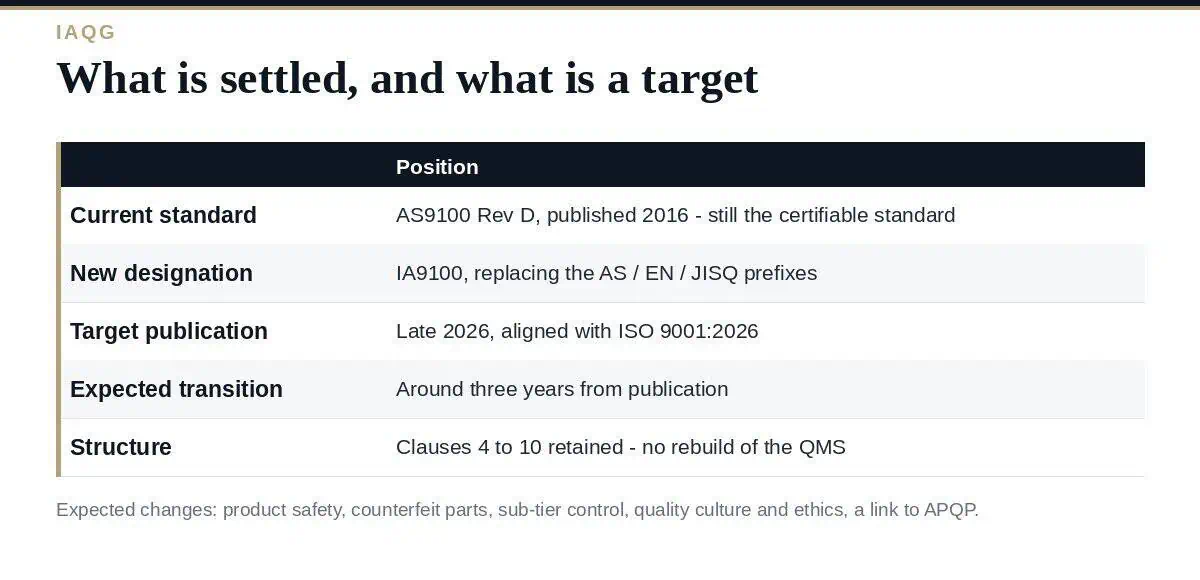
| Position | |
|---|---|
| Current standard | AS9100 Rev D, published 2016 — still the certifiable standard today |
| New designation | IA9100, replacing the AS / EN / JISQ prefixes |
| Target publication | Late 2026, aligned with ISO 9001:2026 |
| Expected transition | Around three years from publication, confirmed by the IAQG on release |
| Structure | Clauses 4 to 10 retained — no rebuild of the QMS |
Everything below the first two rows is a target rather than a commitment. Nothing in a draft is binding until publication, and dates in a standards project of this size have moved before.
The IAQG has published the rationale for the revision, and four themes run through it:
Alongside those, IA9100 is expected to carry the same climate and sustainability context wording that ISO 9001:2026 introduces, which we cover in our guide to the ISO 9001:2026 transition.
The clause structure stays. Organizations transitioning will not be rebuilding a quality management system — they will be reading a revised standard against an existing one, identifying new and strengthened requirements, and closing the difference. The certification scheme, the OASIS database and the auditor model continue as they are.
Nor does the aerospace scope change: first article inspection, configuration management, special requirements and critical items, risk management, and the discipline that separates aerospace from general quality management all remain. Our guides to first article inspection and the AS9100 family stay accurate through the transition.
Is AS9100 being discontinued?
The designation is being replaced by IA9100. AS9100 Rev D remains the current certifiable standard until the revision publishes and the transition period runs.
When will IA9100 be published?
The IAQG’s published target is late 2026, aligned with ISO 9001:2026. Treat it as a target until the standard is on sale.
How long will the transition be?
Around three years is the expectation, consistent with previous aerospace and ISO transitions. The definitive period is set by the certification scheme when the standard publishes.
Will our certificate be invalid?
No. Existing AS9100 Rev D certificates remain valid through the transition period, and organizations move at a surveillance or recertification audit.
Do 9110 and 9120 change too?
Yes — the series follows the same renaming, and the maintenance and distributor standards are revised in step with the base document.
IA9100 is a rename plus a targeted strengthening, not a reinvention. Nothing requires action today: AS9100 Rev D is the standard you certify against, and it will be for some time yet. What is worth doing now is the work the revision points at — product safety, counterfeit parts, sub-tier supplier control — because those are requirements you already hold and the revision is telling you where the industry thinks they are thin. Follow ISO 9001:2026 as the leading indicator, and take dates from the IAQG rather than from anyone summarising it.
Procedures, forms and the aerospace clause mapping are in the AS 9100 Aerospace QMS Toolkit, or start with the free ISO templates.

October 13, 2026
October 12, 2026
October 12, 2026

October 12, 2026

October 12, 2026

