
CART
No products in the cart.
ISO Compliance Insights & Best Practices
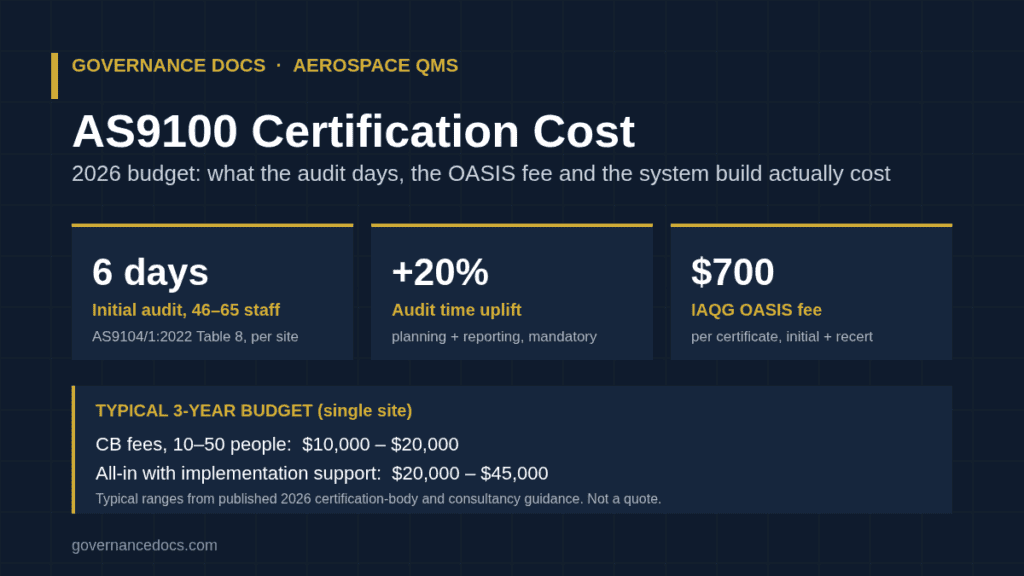
AS9100 certification cost is easier to predict than most aerospace suppliers expect, because the audit that makes up most of the bill is not priced at the certification body’s discretion. The IAQG scheme document AS9104/1:2022 fixes the audit duration for every headcount band, lists the only reductions a certification body may take, and adds a fixed 20% for planning and reporting. Multiply the resulting days by a day rate, add the scheme fee, and you have the registrar’s number. This guide does that arithmetic for you, then adds the implementation costs that sit outside the audit and the 2026 transition line that most cost guides still omit.
The short version: a single-site supplier with 10 to 50 people should budget roughly $10,000 to $20,000 in certification body fees across the first three-year cycle, and $20,000 to $45,000 all-in when implementation support is included. Larger, multi-site or design-responsible organizations pay more, and we show why below.
Free gap assessment
Are you ready for the 2026 edition of ISO 9001?
Score yourself against the new edition, free, including the risk and opportunity split and the clause 10 renumbering that breaks converted checklists.
Run the free ISO 9001 gap assessment → or View premium report sample
The figures below are typical ranges, aggregated from published 2025 and 2026 guidance by accredited certification bodies and aerospace quality consultancies. They are not quotes. Certification body fees are for a single site; multi-site structures are covered further down.
| Cost line | Typical range (USD) | Who sets it |
|---|---|---|
| Stage 1 + Stage 2 initial audit | $4,500–$9,000 (10–50 people) | Days fixed by AS9104/1 Table 8; rate set by the CB |
| Annual surveillance audit (years 2 and 3) | $2,000–$4,000 per year | Days fixed by Table 8; rate set by the CB |
| Recertification audit (year 3 or 4) | $3,000–$5,500 | Days fixed by Table 8; rate set by the CB |
| IAQG OASIS certificate fee | $700 per certified standard, at initial and at each recertification | IAQG fee schedule, invoiced to the CB and passed through |
| Auditor travel and expenses | $500–$2,500 per audit | At cost, varies with location |
| Gap analysis | $1,500–$4,000 | Consultant |
| Full QMS build with consulting support | $8,000–$20,000 | Consultant |
| Internal staff time (DIY implementation) | 200–400+ hours | You |
| Internal auditor training | $500–$2,500 per person | Training provider |
Two things stand out in that AS9100 certification cost table. First, the certification body is usually the smaller half of the total; the system build is the larger half. Second, every audit line traces back to a day count that you can calculate before you ask for a quote, which is the part of AS9100 certification cost that nobody else explains.
ISO 9001 audit time comes from IAF MD 5. Aerospace does not use it directly. The aerospace scheme, run by the International Aerospace Quality Group (IAQG) through the OASIS database, sets audit duration in AS9104/1, the requirements document for aviation, space and defense certification programs. The current edition, AS9104/1:2022, was published on 7 January 2022 with an 18-month transition, so every audit you buy today is priced under it.
Table 8 of that document gives the audit duration per site by number of personnel. The bands below are as reproduced by DEKRA, an accredited aerospace certification body, in its January 2023 client transition briefing:
| Personnel at the site | Initial audit (Stage 1 + 2), days | Annual surveillance, days | Recertification, days |
|---|---|---|---|
| 1–5 | 2 | 1 | 2 |
| 6–10 | 2.5 | 1 | 2 |
| 11–15 | 3 | 1.5 | 2.5 |
| 16–25 | 3.5 | 1.5 | 3 |
| 26–45 | 5 | 2 | 4 |
| 46–65 | 6 | 2.5 | 4.5 |
| 66–85 | 7 | 3 | 5.5 |
| 86–100 | 8 | 3 | 6 |
| 101–125 | 8.5 | 3.5 | 6.5 |
| 126–175 | 9.5 | 4 | 7 |
| 176–275 | 10.5 | 4 | 8 |
| 276–425 | 12 | 5 | 9 |
| 426–625 | 13 | 5.5 | 9.5 |
| 626–875 | 14 | 5.5 | 10.5 |
| 876–1,175 | 15 | 6 | 11 |
Headcount means everyone at the site within the certification scope at the time of the audit, including part-time, temporary and contract personnel; the IAQG’s own FAQ log on 9104-1:2022 makes that explicit. Remote workers attached to a physical site count toward that site.
Four adjustments then apply, and they are the whole reason two suppliers with the same headcount get different AS9100 certification cost quotes:
Up to 50% of an audit may be conducted remotely where a physical site exists, but the days are the same whether the auditor is in your conference room or on a video call. Remote auditing saves travel expenses, not audit fees.
Take a 50-person machine shop with no design responsibility. Table 8 gives 6 days for the initial audit. Design is absent, so 20% comes off: 4.8 days. Medium OCAP risk changes nothing. Add the 20% audit time uplift: 5.76 days, rounded to 6. Surveillance starts at 2.5 days, becomes 2.0 after the design reduction and 2.4 after the uplift, so 2.5. Recertification starts at 4.5 and lands at 4.5 by the same route.
Across the first three-year cycle that is 6 + 2.5 + 2.5 = 11 auditor days. At the $1,200 to $2,000 per auditor day that accredited CBs typically quote in North America, the audit fees come to roughly $13,000 to $22,000 before travel and the $700 OASIS fee. That is our illustration, not a quote; your CB will run the official OCAP tool inside OASIS, and its answer will differ if your process exclusions or risk score differ.
This is the line item most guides get wrong or leave out. The IAQG’s OASIS fee schedule, updated 25 November 2024, charges $700 for each initial certificate and $700 for each recertification certificate, $700 per certificate transfer between CBs, and $300 for a certificate modification such as adding a site, changing scope or a non-postal address change. There is no annual fee, and no fee for a surveillance audit.
Two details matter for budgeting. The fee is per certified standard, not per supplier: a distributor holding both AS9100 and AS9120 pays $1,400 even on a single integrated certificate. And the invoice goes to your certification body, which passes it through, so it appears on the CB’s invoice rather than as a separate bill from Brussels. The IAQG operates a no-refund policy, including if you surrender the certificate.
Accredited aerospace CBs do not publish rate cards, but quotes in 2025 and 2026 cluster between $1,200 and $2,000 per auditor day in the US, with UK and EU rates in the equivalent £900 to £1,500 or €1,100 to €1,700 band. Aerospace-authenticated auditors are scarcer than ISO 9001 auditors, so expect the upper half of that range from the larger registrars. Ask whether the quoted rate covers the 20% off-site audit time or whether it is invoiced on top; both practices exist.
The Table 8 initial duration covers Stage 1 and Stage 2 together. A major non-conformity at Stage 2 typically triggers a follow-up verification, often a half day to one day, billed at the same rate. Under ISO/IEC 17021-1, if the CB cannot verify the corrective action within six months of Stage 2, it must repeat Stage 2 at full duration, so the cheapest insurance against a doubled AS9100 certification cost is a thorough internal audit before the registrar arrives.
The system build is where the range widens. A full consultant-led QMS build for a small shop runs $8,000 to $20,000 in 2026 guidance; a gap analysis alone is $1,500 to $4,000; audit-preparation coaching $2,000 to $5,000. A DIY build costs 200 to 400 staff hours or more, which at a loaded $60 an hour is $12,000 to $24,000 of quality manager time that rarely appears in anyone’s budget. Templates sit between the two: a documentation pack covering the aerospace-specific procedures, such as our AS 9100 Toolkit with 38 templates, removes most of the drafting hours for a fraction of a consulting engagement, provided someone in the business tailors it to your processes rather than filing it as-is.
Internal auditor training is $500 to $2,500 per person depending on format. If you intend to apply for performance-based surveillance later, the scheme requires internal auditor competence that includes a training provider-approved aerospace lead auditor course, which is more expensive. Calibration, measurement equipment and any FAI software are operational costs, not certification costs, but auditors will look for them.
Combining the audit-day arithmetic with the implementation ranges above gives the following three-year budgets. These are our own ranges, built from Table 8 durations at typical day rates plus published consulting figures, and they assume a single site with no majors at Stage 2.
| Organization | Audit days, first 3-year cycle | CB fees + OASIS, 3 years | All-in with implementation support |
|---|---|---|---|
| Up to 25 people, no design | 6–7 | $8,000–$15,000 | $18,000–$35,000 |
| 26–65 people, no design | 9–11 | $11,000–$24,000 | $25,000–$50,000 |
| 66–125 people, with design | 15.5–18 | $19,000–$37,000 | $40,000–$80,000 |
| 176–275 people, with design | 22–23 | $27,000–$46,000 | $60,000–$120,000 |
| Multi-site, 3 sites of 92, 16 and 4 people | 24–29 | $29,000–$59,000 | $55,000–$110,000 |
The multi-site row deserves explanation. AS9104/1:2022 removed the old campus, several-site and complex structures: an organization is now either single-site or multi-site, and duration is calculated per site, then summed, then uplifted. Practitioners on the Elsmar Cove quality forum reported in 2023 that a three-site client with 92, 16 and 4 people went from 5.5 recertification days under the 2012 rules to 9 under the 2022 calculation, and a 375-person, three-site organization from 10.5 to 20. Those are forum reports rather than scheme data, but the direction is right: small satellite sites are expensive under the 2022 rules because each one starts at its own Table 8 minimum.
Time is the other half of AS9100 certification cost, because every month of implementation is a month of quality-manager salary. Consultancies publishing 2025 and 2026 figures put a supported implementation at four to nine months for a small shop and six to ten months for an organization of around 200 people; compressed two-to-three-month programs exist but cost more in consulting fees. Add the CB’s lead time: Stage 1 is typically scheduled four to eight weeks after contract, and the certificate is issued only after the CB’s decision review and the OASIS upload, which is usually two to six weeks after Stage 2 closes.
Customer feedback through OASIS. Prime contractors can feed performance concerns to your CB through the OASIS feedback process, and the CB may extend surveillance duration in response. You are entitled to know the reason; if your CB adds days without explaining, raise it with the CB and, if necessary, its accreditation body.
Late or missing OCAP data. AS9104/1:2022 clause 9.1.10 requires you to supply the OCAP inputs, including internal audit results, management review output, on-time delivery and conformity data, customer feedback and headcount per site, at least 90 days before each audit. The IAQG’s FAQ is blunt: if the data is not received for planning, the audit cannot be performed, and the CB follows its process for missed surveillance or expired certification. A lapsed certificate means a full initial audit at Table 8 initial durations, plus a new $700 OASIS fee.
Adding a standard or a site. Adopting a second standard, for example adding AS9110 to an AS9100 certificate, is priced as an initial certification. Adding a site costs a $300 OASIS modification fee plus the site’s own audit days.
Changing certification body. A transfer costs $700 per certificate in OASIS fees alone, before the new CB’s transfer review. Switching registrars for a marginally lower day rate rarely pays back inside one cycle.
AS9100 Rev D, published in 2016, remains the certifiable standard as of September 2026. ISO 9001:2026 was published this month, and the IAQG’s stated target is to publish the rebased and renamed IA9100 in late 2026, with a transition period expected to run around three years. Until IA9100 publishes and the IAQG confirms the transition rules, no transition audit exists and there is nothing to budget beyond keeping the surveillance cycle on schedule.
When it does arrive, expect the pattern from previous aerospace and ISO transitions: the transition is cheapest at a recertification audit, whose duration already covers every clause; a transition at a surveillance audit typically attracts a surcharge of roughly 0.5 to 1.5 auditor days per site; and a standalone transition audit costs the most. If your recertification falls inside the window, aligning the two is the single biggest saving available. Our IA9100 guide tracks what the IAQG has published on the revision.
For the wider picture of how the AS9100, AS9110 and AS9120 standards fit together, see our guide to aerospace quality management under the AS9100 family; for the base standard’s pricing, see ISO 9001 certification cost; and for the automotive equivalent, whose audit-day tables work on the same logic, see IATF 16949 certification cost.
For a single-site shop with 10 to 50 people and no design responsibility, budget $10,000 to $20,000 in certification body fees over the first three-year cycle, plus the $700 OASIS fee at initial certification and again at recertification. With consulting support for the system build, the all-in figure is typically $20,000 to $45,000. A DIY build replaces the consulting fee with 200 to 400 hours of internal time.
There is no annual scheme fee. The recurring cost is the annual surveillance audit, which Table 8 sets at roughly 40 to 50% of the initial audit duration, plus the auditor’s travel. The $700 IAQG OASIS fee applies at initial certification and at each three-year recertification, not annually.
AS9104/1:2022 replaced the 2012 scheme rules, added a mandatory 20% for audit planning and reporting, introduced the OCAP risk adjustment, and calculates multi-site organizations site by site. Organizations that previously benefited from campus or several-site structures saw the largest increases.
Yes. AS9100 contains the full text of ISO 9001 plus aerospace requirements, and an AS9100 certificate demonstrates ISO 9001 conformity. Holding both certificates separately doubles the certificate fees without adding anything a customer needs.
No. AS9100 Rev D certificates remain valid through the transition period the IAQG sets when IA9100 publishes, and organizations move at a scheduled surveillance or recertification audit. Plan the transition into your existing cycle rather than buying a separate audit.
AS9100 certification cost has two halves. The certification body’s half is arithmetic: Table 8 days, adjusted by process exclusions and OCAP risk, plus 20%, times a day rate, plus $700 to the IAQG. You can run that calculation today and challenge any quote that does not reconcile to it. The implementation half is where money is actually saved or wasted, and it turns on how much of the aerospace-specific documentation you build from scratch. If you want the procedures, registers and records for configuration management, product safety, counterfeit parts, FAI and FOD prevention as a starting point rather than a blank page, the AS 9100 Toolkit covers AS9100D, AS9110C and AS9120B for $99.

October 12, 2026
October 12, 2026
October 12, 2026
October 12, 2026
October 12, 2026
