CART
BRCGS high risk high care is the zoning decision at clause 4.3.1 of BRCGS Issue 9: which production risk zones does your product need, applying the definitions in Appendix 2? Get it right and section 8 tells you what to build and run. Get it wrong and you either overspend or risk a non-conformity under fundamental section 4.3. This guide explains the criteria, what BRCGS section 8 asks for, and the point that catches ambient high care sites out.
Clause 4.3 is one of the twelve fundamental clauses. The toolkit mentioned at the end is independent of BRCGS.
BRCGS Appendix 2 sorts open product areas into high risk, high care, ambient high care and low risk. Enclosed product areas (warehouses, store rooms) and non-product areas (canteens, laundries, offices) are separate. The decision is about the products you make, not about how modern your building is.
Two rules make it easier to use. First, the criteria for each zone are cumulative: a product must meet all of them for that zone. Second, the zone follows the product, so one site can hold several.
The BRCGS high risk high care question is therefore a product question first and a building question second.
Low risk is not the same as low standards. Appendix 2 says some low-risk products still need strict microbiological control, such as products where spoilage organisms matter, or susceptible products that have no cook or reduction step and so sit outside the strict zone definitions. Your assessment should say so where it applies.
| High risk | High care | Ambient high care | |
|---|---|---|---|
| Storage of finished product | Chilled or frozen to preserve safety | Chilled or frozen to preserve safety | Ambient, not deliberately temperature-controlled |
| Treatment of components before entry | All components fully cooked: 70°C for 2 minutes or equivalent | Susceptible components treated to reduce microbial load, typically a 1 to 2 log reduction | A raw material prone to a vegetative pathogen such as Salmonella, and a step in the process that removes or reduces it |
| Product vulnerability | Pathogens can grow or survive and grow in normal storage or use | Same | Vegetative pathogens could survive and grow in use, or very low contamination can cause illness (fatty foods are the example) |
| Intended use | Ready to eat, ready to heat, or likely eaten without adequate cooking | Same | Same |
| Examples in Appendix 2 | Cooked sliced meats, fully cooked prepared meals | Sandwiches, prepared salads | Chocolate from raw cocoa beans, milk powder from raw liquid milk, peanut butter from raw peanuts |
| Physical barrier | A “shall” (8.1.2); full wall is the ideal; time segregation is not acceptable | A “should” (8.1.3); without a barrier, a documented risk assessment and validated protective processes | Risk-assessed controls such as segregation or flow management (8.1.4) |
Look at the cook step when you compare BRCGS high risk high care. High risk needs a full cook, which Appendix 2 describes as normally a 6 log kill of Listeria monocytogenes, equal to 70°C for 2 minutes. Other processes that reach the same reduction, such as irradiation or high pressure, are treated the same way. High care needs only the susceptible components to be treated. Do not swap the two.
Appendix 3 gives time and temperature equivalents to 70°C for 2 minutes, but it is illustrative and the z value varies. If you use an alternative combination, validate it under clause 2.9.2 and put it in your process specifications under 6.1.1.
Two special cases need care. Cooked crustaceans are always high risk, wherever the cooking happened, even when the pack carries cooking instructions. Appendix 2 gives the reason: consumers often eat them cold, and they look ready to eat. Partial heating that falls short of a 6 log reduction leaves a crustacean product in high care.
For other products, validated consumer cooking instructions that amount to a full cook can make a product low risk. The site needs a full validation the auditor can read, under clause 5.2.4. Instructions without validation do not move a product down a zone.
This is the trap. The Standard contains only two clauses specific to ambient high care: 8.1.1 and 8.1.4. Appendix 2 says clauses that refer only to high risk or high care are not applicable to ambient high care. That does not mean section 8 barely applies to you.
Sections 1 to 7 still apply in full. Clause 8.1.4 asks for a documented risk assessment of pathogen cross-contamination, covering raw materials and products, flows of packaging, materials, people, equipment and waste, air quality and flow, and where utilities such as drains are provided. It asks for effective processes, such as segregation or flow management, to protect the final product. Appendix 2 adds that, depending on the product, the controls may resemble those of the stricter zones, and the controls and the risk assessment showing they are right must be documented. Clause 8.1.1 adds the location of each pathogen control step to your site map.
One more limit decides which side of the line you sit on. Ambient high care covers hazards that are controlled at your site. If the vegetative pathogen risk was dealt with earlier in the supply chain, you are not in ambient high care. The Appendix 2 example is a biscuit made from bought chocolate (out), against chocolate made from raw beans (in). The biscuit maker still needs a proper raw material risk assessment.
BRCGS section 8 applies when the 4.3.1 assessment finds that ambient high-care, high-care or high-risk zones are needed. Sections 1 to 7 still apply. In outline:
Note the plain traps in BRCGS high risk high care design. The 8.1.3 “should” for high care physical segregation is not a licence to skip it: the fallback is a documented risk assessment and validated protective processes. And the “shall” for high risk is not relaxed by the “should” next to it.
An auditor will want to see the reasoning, not just the walls.
Environmental monitoring under clause 4.11.8 backs all of this up. Our HACCP principles guide covers the hazard analysis behind the zone choice, and the post on BRCGS fundamental clauses explains what happens when a fundamental statement of intent fails.
Back to the BRCGS certification guide for how these requirements sit in the whole audit, and the BRCGS site for the Standard and its guideline on production risk zoning.
For ready documents, the BRCGS Food Safety Toolkit includes a Production Risk Zone Assessment, a High-Care and Ambient High-Care Risk Assessment, a Drain Map and Air Handling Record and a Zone Cleaning Procedure and Limits, within 123 templates (78 Word and 45 Excel) for $149.
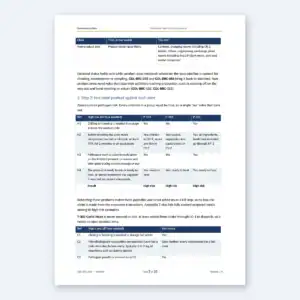
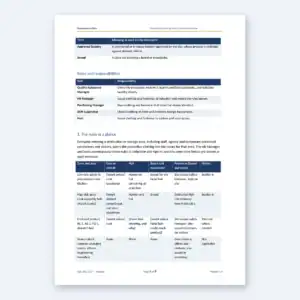

Sample pages from the toolkit: Production risk zone assessment; Protective clothing and laundry; Environmental monitoring programme.
High risk products have had every component fully cooked before entry, to at least 70°C for 2 minutes or equivalent. High care products have had only their susceptible components treated, typically a 1 to 2 log reduction. High risk also rules out time segregation.
Clauses 8.1.1 and 8.1.4 are the two specific to ambient high care, and sections 1 to 7 still apply. Clauses naming only high risk or high care do not apply to it.
No. It applies when the clause 4.3.1 assessment finds that ambient high-care, high-care or high-risk zones are needed.
Yes, if they amount to a full cook and have been validated under clause 5.2.4. Cooked crustaceans are the exception: they remain high risk.

November 7, 2026
November 6, 2026
November 6, 2026
November 6, 2026
November 6, 2026

