CART

The energy baseline is the reference against which every claim of improved energy performance under ISO 50001 is measured, and clause 6.5 makes it more than a number: the organisation establishes the baseline using the information from the energy review, over a suitable data period; normalises it where relevant variables significantly affect energy performance; revises it only when the EnPIs no longer reflect performance, when major changes to static factors occur, or according to a predetermined method; and retains the baseline, the normalisation and the revisions as documented information.
Because ISO 50003 requires the certification body to verify energy performance improvement before issuing a certificate, the baseline is the single document on which certification turns. This guide sets out what clause 6.5 requires, how to choose the baseline period, the three forms a baseline takes and when each fits, how normalisation works with a worked example, the three permitted reasons to revise, the record an auditor asks for, and the errors that make an improvement claim unverifiable.
| Requirement | What it means | Evidence |
|---|---|---|
| Established using information from the energy review | The baseline covers the energy uses the review analysed — the significant energy uses and the whole scope | Traceability from the energy review to each baseline |
| A suitable data period | Long enough to capture the normal cycle of operations and variables — a year for most organisations | The period stated and justified |
| Normalised where relevant variables significantly affect energy performance | Production, weather, occupancy, operating hours adjusted for, so the comparison is like for like | The normalisation method, the variables and the data |
| Revised only for defined reasons | EnPIs no longer reflect performance; major changes to static factors; a predetermined method | A revision record with reason, date, approval and the retained old series |
| Retained as documented information | The baseline, the method and the revisions | Baseline register and calculation files under document control |
The baseline has no meaning apart from the EnPIs measured against it; clause 6.4 and 6.5 are designed together, with ISO 50006 as the guidance for both. Our guide to energy performance indicators covers the other half.
| Form | How it works | Fits when | Fails when |
|---|---|---|---|
| Absolute consumption | Total kWh, GJ or litres for the baseline period, compared with the same for the reporting period | Consumption is not driven by variables that change — a lighting circuit on fixed hours, a constant-load process | Output, weather or occupancy vary — almost always, so almost always |
| Ratio (specific energy consumption) | kWh per unit of output, per m², per degree day, per bed-night | One variable dominates and the relationship is roughly proportional | There is a fixed base load (the ratio improves with volume regardless of performance) or several variables act at once |
| Regression model | Expected consumption modelled from the relevant variables — E = a + b×production + c×degree days — from baseline-period data; performance is actual minus expected | Several variables move at once; base load is material; the improvement claim has to survive an auditor | Data is too sparse to fit a model, or the variables were not measured |
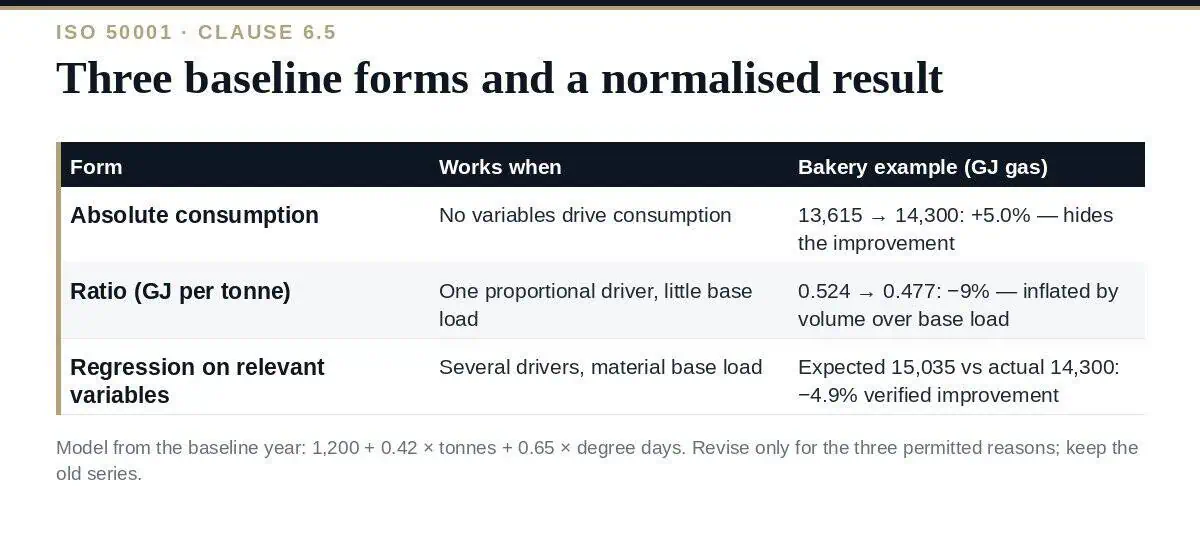
A bakery’s gas consumption depends on production (tonnes baked) and on heating degree days. The baseline year’s data, fitted by regression, gives expected gas = 1,200 GJ + 0.42 GJ per tonne + 0.65 GJ per degree day. The reporting year is warmer and busier: 30,000 tonnes against 26,000, and 1,900 degree days against 2,300. Expected consumption for the reporting year is 1,200 + 0.42 × 30,000 + 0.65 × 1,900 = 15,035 GJ. Actual consumption was 14,300 GJ.
Normalised energy performance improvement is 735 GJ, or 4.9%. Compared on absolute consumption, the reporting year (14,300 GJ) against the baseline year’s actual (13,615 GJ) shows a 5.0% increase — the extra production hides the real improvement; compared on GJ per tonne (0.477 against 0.524) it shows a 9% reduction that the higher volume over a fixed base load inflates. The regression is the number the auditor can verify, and clause 6.5 requires the method behind it to be documented.
| Permitted reason (6.5) | Example | What must be recorded |
|---|---|---|
| The EnPIs no longer reflect the organisation’s energy performance | A ratio baseline set on tonnes when the product mix has shifted to a different energy intensity | Why the indicator failed; the new method; the date |
| Major changes to static factors | A new production line; a building extension; a fuel switch; a change in operating pattern | The change, its date, the like-for-like comparison before it, the new baseline period |
| According to a predetermined method | A policy that resets the baseline every three years at recertification, written in advance | The method as documented before it was applied |
Two things are not reasons: a bad year, and a wish to show improvement. Auditors read the revision history first; a baseline revised every time performance dipped is the clearest possible evidence that the improvement claim is manufactured. Keep the old series when revising, so the improvement before the change and after it are both shown.
Our guide to the energy review covers where the baseline’s inputs come from; significant energy uses covers the SEU-level baselines that sit beneath the site baseline.
What is an energy baseline in ISO 50001?
The quantitative reference, established under clause 6.5 from the energy review over a suitable data period, against which energy performance is compared — normalised for relevant variables such as production and weather where they significantly affect performance, revised only for defined reasons, and retained as documented information with its method and revisions.
How long should the baseline period be?
Long enough to include the normal cycle of operations and the variation in relevant variables — twelve months for most organisations — and starting only when the measurement in the data plan exists. The period and its justification are documented before the reporting period begins.
What is normalisation?
Adjusting the baseline for relevant variables — production volume, degree days, occupancy, operating hours — so that the reporting period is compared like for like. A ratio (kWh per tonne) is the simplest form; a regression model on several variables is the form that survives an audit when base load or multiple drivers are material. ISO 50006:2023 is the guidance.
When can we change the baseline?
Only when the EnPIs no longer reflect energy performance, when major changes to static factors occur — new lines, extensions, fuel switches — or under a method predetermined in writing. Each revision is recorded with its reason, date and approval, and the old series is kept.
Why does the baseline matter so much for certification?
Because ISO 50003 requires the certification body to verify energy performance improvement before issuing a certificate, and the baseline with its normalisation is the only thing that turns consumption data into a verifiable improvement.
Build the energy baseline the way clause 6.5 describes it: from the energy review, over a full operating cycle, in a form that matches the drivers — regression where several act — with the normalisation method written down, the data plan behind it, SEU baselines beneath the site one, and a revision rule you set before you need it. The certificate is issued on the improvement this document lets an auditor verify.
The energy baseline register, the normalisation and regression method template, the EnPI comparison workbook, the data collection plan and the baseline revision record are in the ISO 50001 Energy Management Toolkit, or start with the free templates.


September 21, 2026

September 20, 2026

September 20, 2026

September 19, 2026

September 19, 2026

