CART

ISO 50001 vs ISO 14001 is a comparison between two standards that share a structure, an auditor and usually a manager, and differ in what they demand at the end. ISO 14001:2026 asks an organisation to manage its environmental aspects — energy among them — through a system that improves its environmental performance; ISO 50001:2018 asks it to improve a single physical quantity, energy performance, and to prove the improvement with a baseline, indicators and data before a certificate is issued. The first is broad and outcome-agnostic within its commitments; the second is narrow and outcome-demanding.
That is why organisations with a mature environmental management system are often surprised by an ISO 50001 audit: the management clauses transfer, the energy clauses — review, significant energy uses, baseline, indicators, data plan, design and procurement — do not exist in ISO 14001 and cannot be inherited from it. This guide sets the two standards side by side on ten points, walks the five differences that decide the work, shows what carries over and what has to be built, and answers the sequencing question: which first, or both at once.
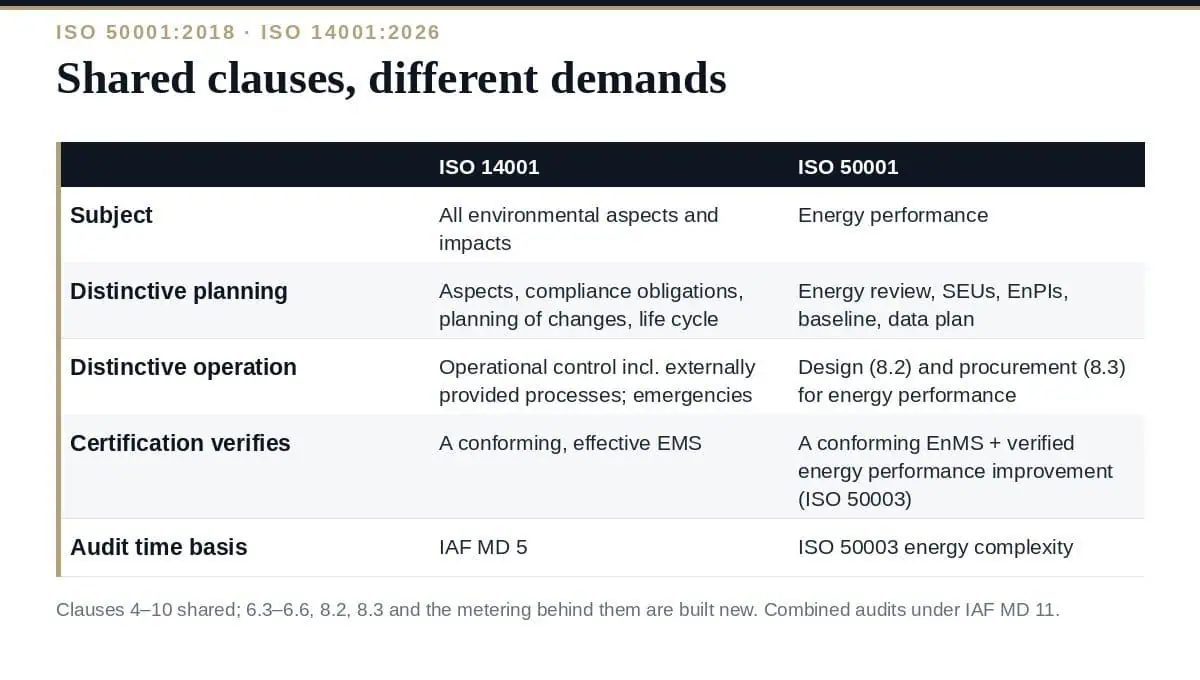
| ISO 14001:2026 | ISO 50001:2018 (with Amd 1:2024) | |
|---|---|---|
| Subject | The organisation’s environmental aspects and impacts, compliance obligations and environmental performance | Energy performance — energy use, consumption and efficiency — and the system that improves it |
| Edition | Fourth edition, April 2026, replacing 2015; 36-month transition | Second edition, August 2018, confirmed at stage 90.93; climate amendment 2024 |
| Structure | Harmonized structure, clauses 4–10 | Harmonized structure, clauses 4–10 |
| Distinctive planning clauses | Environmental aspects; compliance obligations; planning of changes (new 6.3); life-cycle perspective | 6.3 energy review; 6.4 energy performance indicators; 6.5 energy baseline; 6.6 planning for collection of energy data |
| Distinctive operation clauses | Operational control extended to externally provided processes, products and services; emergency preparedness | 8.2 design; 8.3 procurement — energy performance considered in specifying equipment, services and energy |
| Performance evaluation | Monitoring, evaluation of compliance, internal audit, restructured management review | 9.1.1 monitoring of EnPIs against baselines; demonstrated improvement |
| What certification verifies | A conforming, effective EMS | A conforming EMS plus verified energy performance improvement — ISO 50003 requires it before a certificate is issued |
| Audit time basis | IAF MD 5 (personnel and complexity) | ISO 50003 (energy sources, SEUs, consumption, effective personnel) |
| Who asks for it | Customers, regulators, investors; near-universal in supply chains | Energy-intensive industry, public sector, organisations with decarbonisation commitments; procurement in some sectors |
| Neighbouring standards | ISO 14004 guidance; ISO 14064 GHG | ISO 50002 energy audits; ISO 50003 certification; ISO 50006 EnPIs and baselines; ISO 50005 phased implementation; ISO 50100:2026 decarbonisation requirements |
Our guides to the energy review, the energy baseline and energy performance indicators cover the three clauses that carry the difference.
| Element | Carries over? | Note |
|---|---|---|
| Context, interested parties, scope (4) | Yes, extended | Energy-relevant issues and parties added; scope defines the energy boundaries |
| Leadership and policy (5) | Largely | ISO 50001 5.2 requires commitments to continual improvement of energy performance and the EnMS, to information and resources, to compliance, and to supporting energy-efficient design and procurement — an integrated policy can carry them |
| Risks and opportunities, objectives (6.1, 6.2) | Method yes; content no | Energy objectives and targets tied to EnPIs |
| Energy review, EnPIs, baseline, data plan (6.3–6.6) | No | Built from scratch; the metering behind them is the largest cost |
| Competence, awareness, communication, documents (7) | Yes, extended | SEU operators’ competence; awareness of energy performance impact |
| Operational control (8.1) | Partly | Criteria for operating and maintaining SEUs added |
| Design and procurement (8.2, 8.3) | No | New |
| Monitoring and analysis (9.1) | Method yes; content no | EnPIs against baselines; key characteristics of operations affecting energy performance |
| Internal audit, management review (9.2, 9.3) | Yes, extended | Energy performance and EnPI results as review inputs |
| Nonconformity and improvement (10) | Yes | Plus continual improvement of energy performance |
| Situation | Recommendation | Why |
|---|---|---|
| Neither certified; energy is a major cost (industrial, data centre, cold chain) | ISO 50001 first, or both integrated | The energy review and baseline pay for themselves; ISO 14001 can be added on the same management clauses |
| Neither certified; energy is minor and environmental obligations broad | ISO 14001 first | Wider coverage; ISO 50001 later if energy becomes material |
| ISO 14001 held; energy costs or decarbonisation commitments rising | Add ISO 50001 as a scope extension with a combined audit | The management clauses exist; build 6.3–6.6, 8.2, 8.3 and the metering |
| ISO 50001 held; customers ask for environmental certification | Add ISO 14001 | Aspects, compliance obligations and life cycle are new; the system is not |
| Regulatory energy audit obligation (e.g. EU Energy Efficiency Directive Article 11 for large enterprises) | ISO 50001 satisfies the obligation in most member states | A certified EnMS with an energy audit typically exempts from the four-yearly audit |
Our guide to ISO 14001:2026 transition covers the edition an integrated system now has to meet; ISO 55001, 41001 and 50001 covers the other estate standards ISO 50001 is compared with.
What is the difference in ISO 50001 vs ISO 14001?
ISO 14001 is the environmental management system standard: aspects, compliance obligations, life cycle and environmental performance across all impacts. ISO 50001 is the energy management system standard: it requires an energy review, significant energy uses, a baseline, energy performance indicators, a data collection plan, energy-conscious design and procurement — and verified energy performance improvement before certification. They share clauses 4 to 10.
Does ISO 14001 cover energy?
Energy is an environmental aspect under ISO 14001, so an EMS manages it, but at the level of an aspect with objectives. It does not require the energy review, baseline, EnPIs, data plan or design and procurement clauses that ISO 50001 does, and its certification does not verify energy performance improvement.
Can we integrate the two?
Yes — the harmonized structure was designed for it. One context, leadership, policy, document control, competence, internal audit and management review; the energy-specific clauses added; a combined audit under IAF MD 11 with time reduced accordingly.
Which is harder to certify?
ISO 50001 for most organisations, because the certification body must verify energy performance improvement under ISO 50003, which requires a baseline period, a reporting period, defensible normalisation and the metering behind them. ISO 14001 verifies the system.
Does ISO 50001 satisfy the EU energy audit obligation?
In most member states an ISO 50001-certified energy management system that includes an energy audit meets the Energy Efficiency Directive’s Article 11 obligation for large enterprises; confirm the national transposition.
Read ISO 50001 vs ISO 14001 as breadth against proof: the environmental standard manages every aspect through a system; the energy standard demands a measured improvement in one and makes the auditor verify it. Share the management clauses, build the energy clauses and the metering behind them, and choose the order by where the money and the obligations are.
The integrated energy and environmental policy, the energy review and SEU register, the baseline and EnPI method documents, the design and procurement procedures and the combined internal audit checklist are in the ISO 50001 Energy Management Toolkit, or start with the free templates.

September 22, 2026
September 21, 2026
September 21, 2026
September 20, 2026
September 20, 2026

