CART
A QHSE manager runs three management systems as one — quality under ISO 9001, environment under ISO 14001, occupational health and safety under ISO 45001 — and the role exists because the three standards share a structure that makes a single owner efficient, and differ in content enough that the owner has to know all of it. The job is not, in the standards’ terms, to be responsible for quality, environmental and safety performance; that accountability stays with top management under clause 5.1 of each. The job is to design, run, measure and improve the system through which top management discharges it. That distinction shapes everything in this guide: the six duties the role carries and where each sits in the harmonized structure, the competences a QHSE manager needs across three disciplines, how the role relates to top management, line managers and workers, what the 2026 editions of ISO 9001 and ISO 14001 added to the brief, how the role scales with the organisation, and the ways it fails.
| Responsibility | Top management (clause 5.1) | QHSE manager |
|---|---|---|
| Accountability for the effectiveness of the management systems | Retains it — ISO 45001 5.1 a) says so in terms; ISO 9001 and ISO 14001 5.1 the same | Reports on it |
| The policy (5.2) | Establishes and signs it | Drafts it, consults workers, communicates it |
| Roles, responsibilities and authorities (5.3) | Assigns them | Proposes the structure; holds the authority to report on performance and to ensure conformity |
| Resources (7.1) | Provides them | Specifies what is needed and justifies it |
| Objectives (6.2) | Sets or approves them | Proposes, measures and reports them |
| Management review (9.3) | Conducts it and decides | Prepares the inputs, records the outputs, tracks the actions |
| Consultation and participation of workers (ISO 45001 5.4) | Ensures it happens | Runs the mechanisms — committees, representatives, briefings |
The standards removed the “management representative” title from the harmonized structure in 2015, precisely so that responsibility could not be delegated to one person; the manager is the person clause 5.3 assigns the responsibility for ensuring the system conforms and for reporting on its performance, not the person who owns the outcomes. Our guide to the QHSE management system covers the structure the role runs.
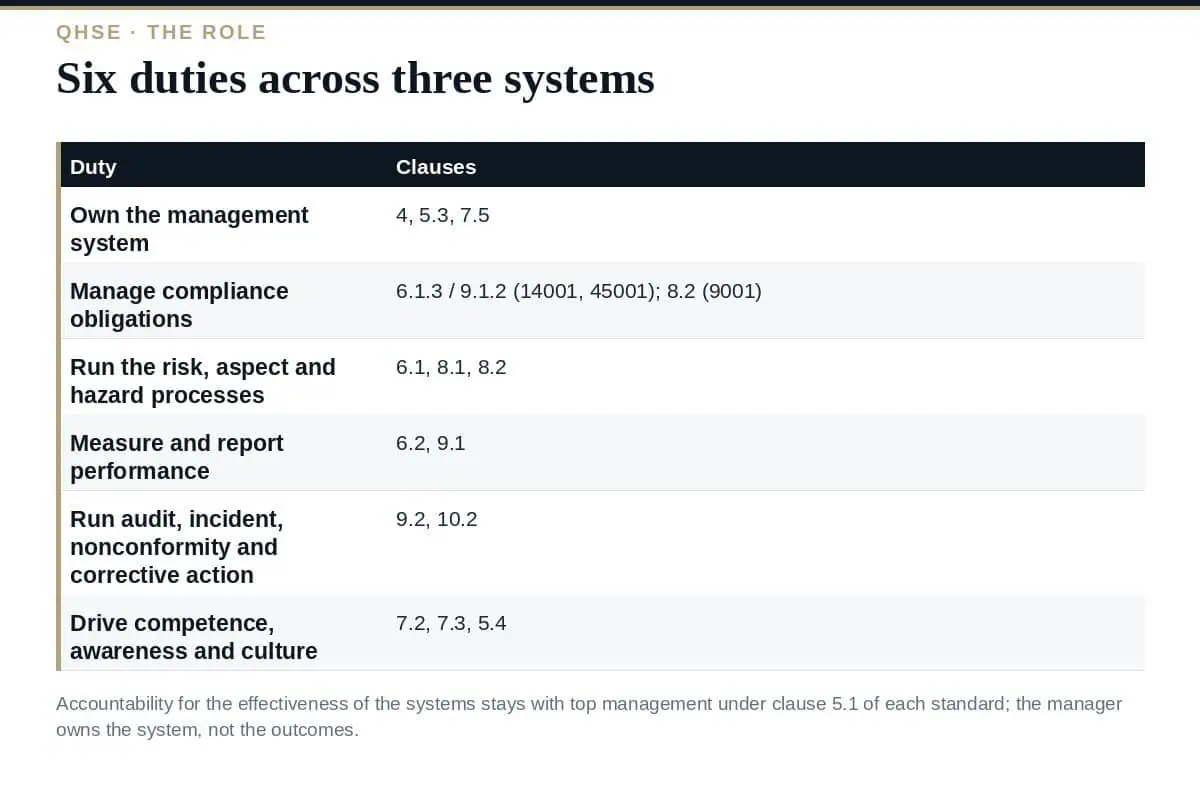
| Duty | Clauses | What it involves across the three systems |
|---|---|---|
| 1. Own the management system | 4, 5.3, 7.5 | Scope, context and interested parties kept current; the document hierarchy controlled; the integrated manual and procedures maintained; the systems’ certification status managed with the certification body |
| 2. Manage compliance obligations | 6.1.3 / 6.1 (14001), 6.1.3 (45001), 8.2 (9001) | The legal and other requirements register for environment and OH&S; customer and statutory requirements for products; evaluation of compliance (9.1.2 in 14001 and 45001) and the evidence for it |
| 3. Run the risk, aspect and hazard processes | 6.1, 8.1 | Quality risks and opportunities; environmental aspects and impacts; hazard identification and OH&S risk assessment; operational controls, permits, method statements and emergency preparedness (8.2) |
| 4. Measure and report performance | 6.2, 9.1 | Objectives and KPIs across the three systems; monitoring, measurement, analysis and evaluation; reporting to top management and, where required, to regulators and customers |
| 5. Run audit, incident, nonconformity and corrective action | 9.2, 10.2 | The integrated internal audit programme; incident investigation (ISO 45001 10.2 names incidents specifically); nonconformity and corrective action across all three; root cause discipline |
| 6. Drive competence, awareness and culture | 7.2, 7.3, 5.4 | Training matrices, inductions, toolbox talks; awareness of the policy, of significant aspects and hazards, and — under ISO 9001:2026 — of quality culture and ethical behaviour; worker consultation and participation mechanisms |
| Area | Competence | Typical evidence |
|---|---|---|
| Management systems | The harmonized structure; the three standards’ clause-level requirements; integrated audit practice | Lead auditor training in at least one standard; internal auditor in the others; IRCA or equivalent |
| Quality | Process approach, risk-based thinking, measurement and statistical basics, customer requirements, supplier control | ISO 9001 lead auditor or quality professional membership |
| Environment | Aspects and impacts, compliance obligations in the operating jurisdictions, life-cycle perspective, emissions and waste basics, emergency planning | ISO 14001 training; environmental practitioner membership where available |
| Health and safety | Hazard identification and risk assessment, hierarchy of controls, incident investigation, legal duties, worker consultation | A recognised OH&S qualification — NEBOSH General Certificate or Diploma in the UK, equivalents elsewhere — is the common baseline |
| Legal and regulatory | The environmental and OH&S law of every jurisdiction in scope, and how to keep the register current | Subscription services, legal update training |
| Data and reporting | KPI design, trend analysis, presenting to a board | Demonstrated in management review packs |
| Influence | Getting line managers to own controls they did not design | The hardest to evidence and the one that decides whether the role works |
Our guide to QHSE KPIs covers the measures the reporting duty produces.
| Organisation | Typical arrangement | Risk |
|---|---|---|
| Under 50 staff, single site | A part-time QHSE lead — often the operations or technical manager — with external support for audits and legal updates | The role becomes a filing job; controls exist on paper |
| 50–250 staff | One QHSE manager, sometimes with a coordinator; line managers own the controls | The manager owns everything and the line owns nothing |
| 250–1,000 staff or multi-site | A QHSE manager with site or discipline leads (H&S advisor, environmental officer, quality engineer) | Three sub-systems reform inside the integrated one |
| 1,000+ or high-hazard | A head of QHSE with a team and, often, separate process-safety or product-quality functions reporting alongside | Integration at the system level, separation at the technical level — which is correct, if the interfaces are defined |
What does a QHSE manager do?
Designs, runs, measures and improves the integrated quality, environmental and occupational health and safety management system: the document set, compliance obligations, risk and aspect processes, KPIs and reporting, audit and corrective action, and competence and culture — while accountability for performance stays with top management under clause 5.1 of each standard.
Is the QHSE manager responsible for safety performance?
Not in the standards’ terms. ISO 45001 5.1 makes top management accountable for preventing work-related injury and ill health; the QHSE manager is responsible for the system and for reporting on it. Line managers own the controls in their areas.
What qualifications does a QHSE manager need?
Management-system competence across ISO 9001, ISO 14001 and ISO 45001 — lead auditor in at least one — plus a recognised OH&S qualification such as the NEBOSH General Certificate or Diploma in the UK, and enough environmental and quality depth to run the aspects register and the process controls. Legal knowledge for every jurisdiction in scope is not optional.
Does a small company need a QHSE manager?
It needs the duties performed; whether that is a full-time role depends on size and hazard. Under 50 staff a part-time lead with external audit and legal support is common, provided the controls are owned by the line.
What changed for the role in 2026?
ISO 9001:2026 and ISO 14001:2026 both published — quality culture and ethics, risk and opportunity split, planning of changes, climate context, supplier operational control and a restructured management review. Transition is the QHSE manager’s project for the next three years; ISO 45001 is unchanged.
Define the QHSE manager as the owner of the system, not the outcomes: six duties across three standards, the competence to run all three, the authority to report without filtering, and a relationship with top management and the line that leaves accountability where the standards put it. Then give the role the 2026 transitions as its first measurable objective.
The QHSE roles and responsibilities matrix, the job description template, the integrated manual and procedure set, the legal register, the training matrix and the management review pack are in the QHSE Documentation Bundles, or start with the free templates.

September 21, 2026
September 20, 2026
September 20, 2026
September 19, 2026
September 19, 2026

