CART

Third-party risk management is the only compliance discipline where four different regimes ask about the same suppliers, in four different formats, on four different timetables — and most organisations answer each one from scratch.
The obligations genuinely differ. The supplier population does not. That gap is where the wasted effort lives.
Free gap assessment
Where do you actually stand against ISO 27001?
Score every management system clause and all 93 Annex A controls, free, and get a prioritised gap list back.
Run the free ISO 27001 gap assessment → or View premium report sample
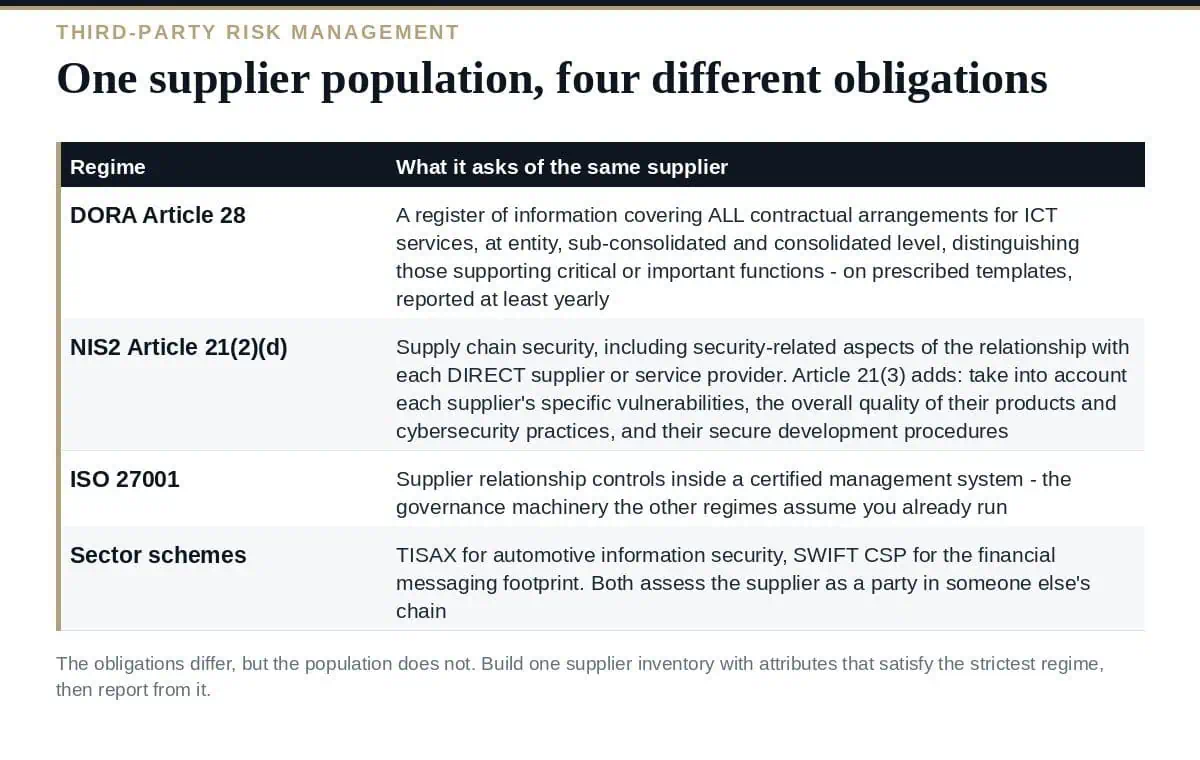
DORA is the most prescriptive. Article 28(3) requires financial entities to maintain a register of information covering all contractual arrangements for ICT services — at entity, sub-consolidated and consolidated level — distinguishing those that support critical or important functions, on templates fixed by implementing technical standards, reported at least yearly.
NIS2 is narrower in one respect and broader in another. Article 21(2)(d) requires supply chain security “including security-related aspects concerning the relationships between each entity and its direct suppliers or service providers”.
Direct. NIS2 does not push you down the chain indefinitely — but Article 21(3) then tells you what to weigh for each of those direct relationships: the vulnerabilities specific to each supplier, the overall quality of their products and cybersecurity practices, and their secure development procedures. That is a substantive assessment, not a questionnaire score.
ISO 27001 supplies the management system the other two assume — supplier relationship controls, governance, audit and review — without prescribing any register format.
Sector schemes approach it from the other end. TISAX and SWIFT CSP assess you as a party in somebody else’s supply chain, which means your own assurance work and your suppliers’ are the same activity viewed from opposite directions.
Most third-party risk management programmes are the wrong size because one of these was never settled.
What counts as a third party. DORA is explicit about ICT service providers under contractual arrangements. NIS2 speaks of direct suppliers and service providers. Neither definition matches a typical procurement vendor master, which contains cleaners and stationery suppliers alongside the cloud platform running your core system.
What counts as critical. DORA’s “critical or important functions” test drives contract content, exit planning and supervisory notification. It is a determination about your functions, not about the supplier’s size — a small provider inside a critical process outranks a large one at the periphery.
How far down the chain you go. NIS2 says direct. DORA reaches subcontracting through its contractual requirements. Deciding your own depth, and writing the reasoning down, is better than discovering the question during an assessment.
Free third-party risk assessment
How much risk does this vendor bring?
Tier the vendor, check the evidence, rate the risks from 30 third-party scenarios and choose controls referenced to ISO 27001, NIST CSF 2.0 and DORA. You get a tier, a heat map and the findings an auditor would raise, free.
Start the free vendor risk assessment → or View premium report sample
Third-party risk management does not fail at the assessment. It fails at the joins.
The practical answer to third-party risk management is a single supplier inventory carrying the union of what the regimes need, with reporting drawn from it rather than assembled per deadline.
At minimum, per supplier: legal entity and identifiers that resolve across the group; the contract and its key terms; the services provided; the business functions those services support; the criticality determination and its reasoning; data categories and locations; subprocessors; the assurance evidence held and its expiry; and the exit position.
That last set is where this meets your other obligations. The same supplier record answers a DORA register field, a NIS2 supply chain measure, an ISO 27001 supplier control, a records of processing recipient entry and an international transfer question — if it was designed to.
| Obligation | What it takes from the supplier inventory |
|---|---|
| DORA | The register of information, the pre-contractual assessment under Article 28(4), and concentration risk |
| NIS2 | Direct supplier assessment against vulnerabilities, product quality, cybersecurity practices and secure development |
| Supply chain security | The technical control side of the same relationships |
| CSA STAR | Where suppliers are cloud services, a published CAIQ answers much of the assessment without a questionnaire |
This guide reflects Regulation (EU) 2022/2554 and Directive (EU) 2022/2555 as published on EUR-Lex, read at 16 August 2026. NIS2 is transposed nationally — check your Member State’s implementation.
Where the programme itself needs building, the TPRM Toolkit ships the one inventory, the tiering method, three ready-written questionnaires, the contract requirements checklist and the exit plans as 86 templates, mapped to these four regimes and eight more; our guide to what TPRM is sets out the lifecycle it follows. The regime-specific packs remain the right choice where one regime is the whole question: the TPRM Toolkit sits across them rather than replacing them.
The DORA Toolkit covers the ICT third-party framework and register, the NIS2 Toolkit covers the supply chain measures, and the ISO 27001 Toolkit provides the supplier relationship controls and assessment records underneath both.

October 15, 2026
October 15, 2026
October 14, 2026
October 14, 2026
October 14, 2026

