CART
ISO 50001 is the most stable of the estate standards and the one whose surrounding landscape has changed most. Both statements are true, and missing the second is how energy programmes end up two years behind.
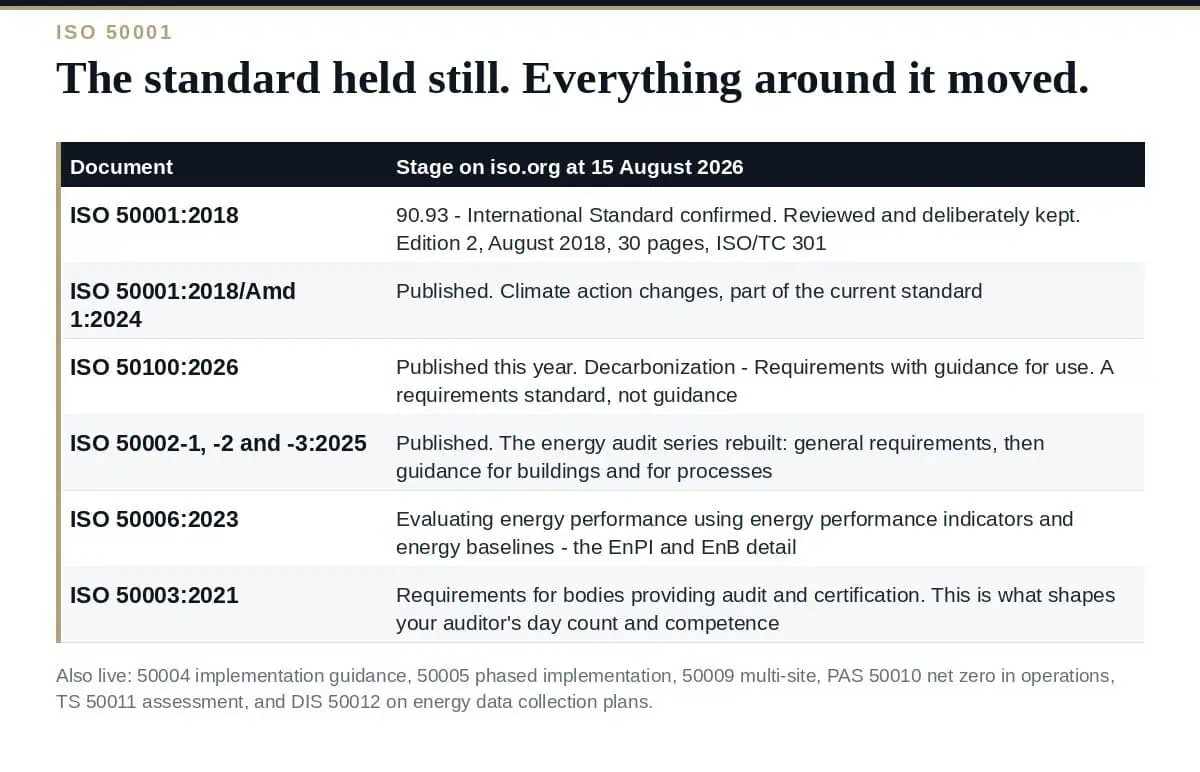
The standard itself sits at stage 90.93 — International Standard confirmed, reviewed and deliberately kept as it is. Meanwhile the committee has published a new decarbonization requirements standard, rebuilt the energy audit series, and issued a climate amendment.
Free gap assessment
Are you ready for the 2026 edition of ISO 14001?
Score every clause of the new edition, free, including the aspects, life cycle and compliance evaluation work that carries most of the findings.
Run the free ISO 14001 gap assessment → or View premium report sample
ISO 50001:2018 — Energy management systems — Requirements with guidance for use — is the second edition, published August 2018, 30 pages, under ISO/TC 301.
What separates it from every other management system standard is that it demands measurable improvement in a physical quantity. Most standards ask you to set objectives and improve the system. This one asks you to improve energy performance and to prove it with numbers.
That produces requirements the others do not have:
The baseline is where implementations succeed or fail. A baseline that is not normalised for production volume, occupancy or weather will show improvement in a mild year and failure in a cold one, and no auditor will accept it as evidence of anything.
Three developments matter more than anything in the requirements text.
ISO 50100:2026 was published this year — Energy management systems and energy savings — Decarbonization — Requirements with guidance for use. Note the wording: requirements, not guidance. Decarbonisation now has its own requirements standard sitting alongside ISO 50001 rather than being a theme inside it.
The energy audit series was rebuilt in 2025. ISO 50002-1 carries the general requirements, with ISO 50002-2 and ISO 50002-3 giving guidance for audits in buildings and in processes respectively. If your audit methodology cites the older single-part standard, it is out of date.
There is a climate amendment. ISO 50001:2018/Amd 1:2024 covers climate action changes and forms part of the current standard.
ISO also records ISO 50001 as contributing directly to climate action — to greenhouse gas mitigation and to integrating climate action into corporate governance. That is not decoration; it is why the standard increasingly appears in disclosure and procurement conversations rather than only in facilities budgets.
ISO 50003 sets the requirements for bodies providing audit and certification of energy management systems, and it is worth reading even though it is not addressed to you.
It shapes how audit duration is determined, what competence your auditor must hold, and how energy performance improvement must be verified before a certificate is issued. Organisations regularly discover late that a certification body cannot simply accept their EnPI story — because ISO 50003 tells it what evidence to require.
Alongside it, ISO 50006:2023 is the practical companion for building EnPIs and baselines properly, and ISO 50005 offers a phased implementation route for organisations not ready to certify in one step.
| Standard | Relationship |
|---|---|
| ISO 55001 and ISO 41001 | Asset management and facility management. Same estate, different questions — compared directly in that guide |
| ISO 14001 | The environmental management system. Energy is one aspect within it; ISO 50001 goes far deeper on performance measurement. Most organisations run both and share the audit machinery |
| ESG reporting | Energy and emissions data feeds sustainability disclosure. A certified system produces numbers with a defensible baseline rather than estimates |
| ISO 31000 | One risk method underneath, rather than a separate energy risk scale |
This guide reflects the ISO 50001 record and the ISO/TC 301 catalogue at 15 August 2026.
The ISO 50001 Energy Management Toolkit provides editable templates covering the energy policy, the energy review and significant energy uses, the baselines and performance indicators, the objectives and action plans, and the monitoring, audit and management review records.

October 15, 2026
October 15, 2026
October 14, 2026
October 14, 2026
October 14, 2026

