CART
ISO 31000 is the standard organisations most often cite and least often read. It is sixteen pages long, it contains no requirements, and nobody can certify you against it — three facts that between them explain most of the confusion around it.
Used properly it is the best available description of what risk management is supposed to look like when it works. Used badly it becomes a logo on a policy nobody follows.
Free gap assessment
Is risk management actually changing decisions?
A maturity assessment against all eight principles, the framework and the process, free. Nobody can certify you to ISO 31000, so this scores distance from good practice instead.
Run the free ISO 31000 maturity assessment → or View premium report sample
ISO 31000:2018 — Risk management — Guidelines — is the second edition, published in February 2018 and confirmed on review in 2023. It is developed by ISO/TC 262 and runs to sixteen pages.
The word in the title is Guidelines, and it is doing real work. A requirements standard uses “shall” and can be audited. A guidelines standard uses “should” and cannot. That is why:
Techniques live in the companion standard, IEC 31010:2019 — Risk assessment techniques — which is where you go when you want to know how to actually run a bow-tie analysis or a Monte Carlo simulation. Vocabulary lives in ISO 31073.
Free enterprise risk assessment
Which of your business risks sit above your appetite?
Set your criteria and appetite, pick from 36 strategic, financial, operational and compliance scenarios, rate them and decide how to treat each. Built to ISO 31000, and free.
Run the free enterprise risk assessment → or View premium report sample
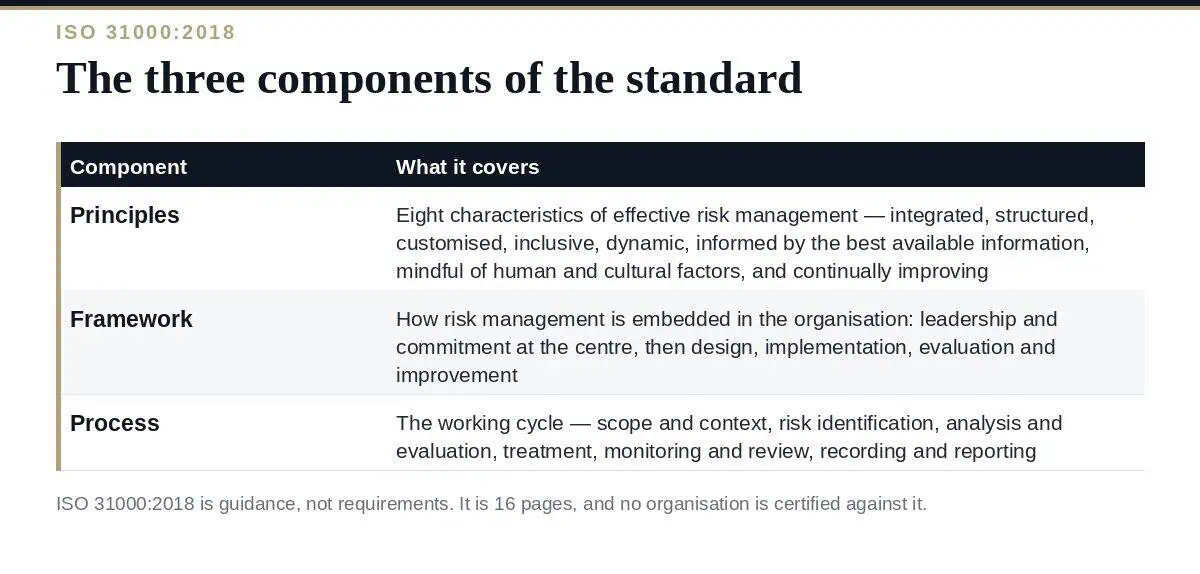
ISO 31000 is built from three parts, and the relationship between them is the whole design.
Principles describe what effective risk management looks like: integrated, structured and comprehensive, customised, inclusive, dynamic, based on the best available information, alive to human and cultural factors, and continually improving. They are characteristics to test yourself against, not steps to follow.
Framework is how risk management gets embedded in the organisation — leadership and commitment at the centre, surrounded by design, implementation, evaluation and improvement. This is the part organisations skip, and skipping it is why so many risk registers exist without changing any decision.
Process is the working cycle most people already recognise: establish scope, context and criteria; identify, analyse and evaluate risk; treat it; monitor and review; record and report. Communication and consultation run alongside all of it rather than at the end.
The first edition dated from 2009. The revision cut the length roughly in half, simplified the language, and moved leadership from a supporting role to the centre of the framework.
The intent behind that reordering is the single most useful idea in the standard: risk management is meant to be part of governance and decision-making, not a parallel activity that produces its own documents. A risk process that runs monthly and never touches a strategy meeting is not what ISO 31000 describes, however well the register is maintained.
Worth knowing before you build anything durable on the current text: ISO has recorded the 2018 edition at stage 90.92 — International Standard to be revised, and a revision is genuinely under way. ISO/CD 31000 sits at stage 30.60, meaning a committee draft has been circulated and its comment period closed.
Two sensible conclusions. First, 2018 remains the current standard and will be for some time — a committee draft still has to pass DIS and FDIS stages before publication, and that is measured in years, not months. Second, do not architect a risk framework around specific clause numbers when the clause numbering is being revisited. Structure it around the three components, which are very unlikely to change.
| Standard | Relationship |
|---|---|
| ISO 27001 | Requires a risk assessment and treatment process but does not mandate a method. ISO 31000 is the most common answer to “which method?” — and clause 6.1.2 is written so that a 31000-aligned process satisfies it cleanly |
| ISO 9001 | Uses risk-based thinking throughout without requiring a formal risk process. The guidelines give you one if you want it |
| ISO 22301 | Business continuity sits downstream of risk assessment. A shared risk approach stops the continuity and security teams maintaining two incompatible registers |
| ISO 37301, ISO 45001, ISO 14001 | Every modern management system standard has a risk clause. Running one method underneath all of them is the practical reason to adopt ISO 31000 at all |
That last row is the real business case. The value is not in the standard itself — it is in having one definition of risk, one set of criteria and one register, rather than four teams grading the same exposure differently.
None of that requires a tool, and none of it is what people expect ISO 31000 to be about. It requires agreement on criteria and somebody senior who reads the output.
This guide reflects the position on iso.org at 15 August 2026: ISO 31000:2018 published and current, and ISO/CD 31000 under development at stage 30.60. Check the standard’s page before citing a stage in anything formal.
The ISO 31000 Risk Management Toolkit provides 30 editable documents covering the risk management policy and framework, the criteria definitions, the register and treatment plans, and the review and reporting records — the artefacts that turn sixteen pages of guidance into a process a board can see.

October 15, 2026

October 15, 2026
October 14, 2026
October 14, 2026
October 14, 2026

