CART
CMMC compliance stopped being a future problem on 10 November 2025. That is the day the DFARS acquisition rule took effect and Phase 1 began — and it started a clock that most defense contractors are reading a year late.
Update, 17 September 2026: Phase 2 has been suspended. On 13 July 2026 the Department of War suspended the transition to Phase 2 — which was scheduled for 10 November 2026 — and all pending and future CMMC implementation milestones, pending a review of the program; a class deviation of 3 September 2026 binds contracting officers to that suspension. Phase 1 self-assessment requirements, DFARS 252.204-7012 and SPRS affirmations are unaffected. The phase schedule below is the one 32 CFR 170.3(e) still contains; the dates for Phases 2 to 4 are no longer operative. See our guide to the CMMC Phase 2 suspension and what still applies.
Free gap assessment
What is your CMMC Level 2 readiness, really?
Score all 110 practices, free, plus the scoping and POA&M questions that decide whether your SPRS score is usable.
Run the free CMMC gap assessment → or View premium report sample
The Cybersecurity Maturity Model Certification Program is set out in 32 CFR Part 170. It does not invent new security requirements. It is a verification regime bolted onto requirements that already existed — principally NIST SP 800-171 — because DoD concluded that self-attestation alone was not producing the security it had been paying for.
That distinction matters for how you plan. The controls are not new. What is new is that somebody else now checks them, and that a contract award can turn on the result.
| Level | Applies to | How it is assessed |
|---|---|---|
| Level 1 | Federal Contract Information (FCI) | Annual self-assessment, with an annual affirmation |
| Level 2 | Controlled Unclassified Information (CUI) | Self-assessment or C3PAO certification every three years, depending on the contract — this is the level Phase 2 changes |
| Level 3 | CUI in programs at highest risk | Assessed by DIBCAC, the government’s own assessment centre |
Most of the defense industrial base lands at Level 2. That is also where the cost and the lead time sit, because a C3PAO assessment has to be booked, paid for and passed.
Free ISO 27001 risk assessment
Which of your risks sit above your appetite line?
Set your own risk criteria, pick from 61 information security risk scenarios, rate likelihood and impact, and decide how to treat each one. You get a heat map, a process score and the findings an auditor would raise, free.
Run the free risk assessment → or View premium report sample
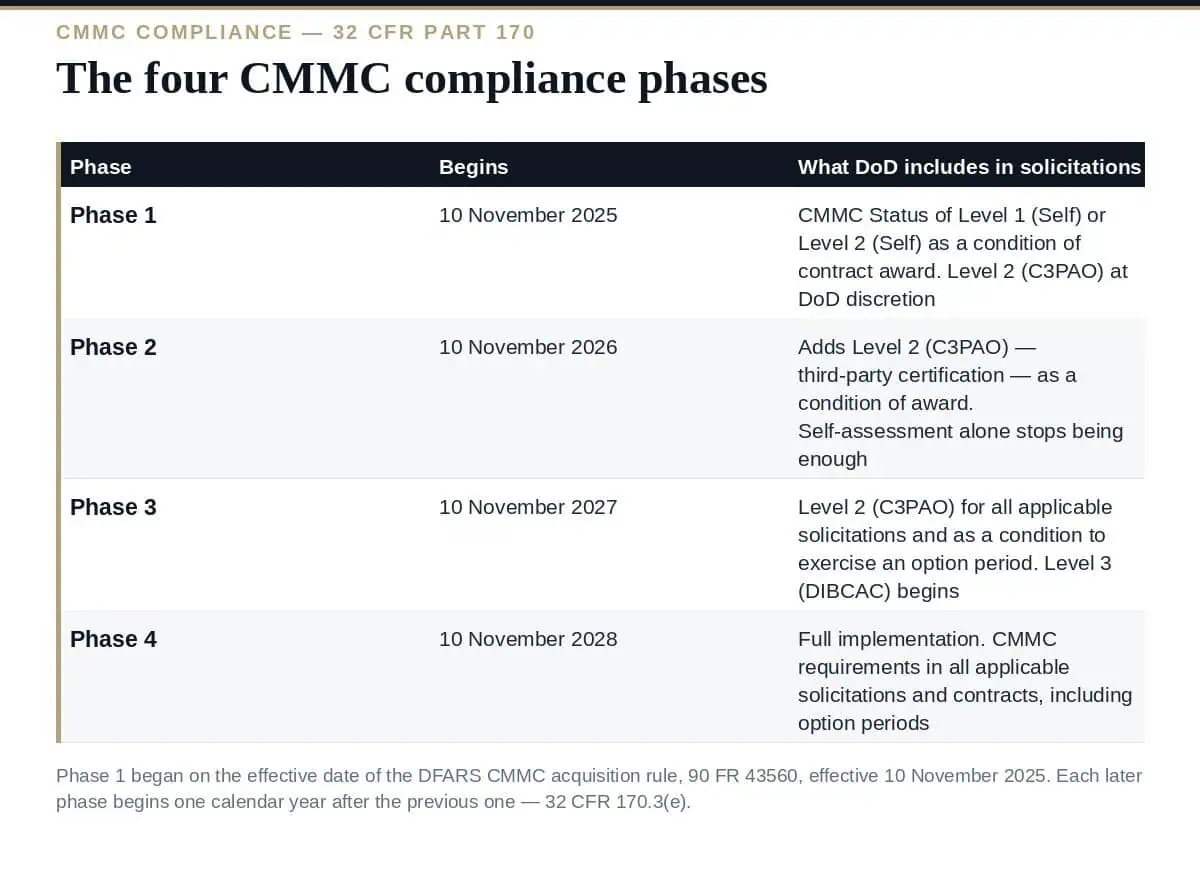
32 CFR 170.3(e) sets out a four-phase rollout. Phase 1 began on the effective date of the DFARS acquisition rule; each later phase begins one calendar year after the one before it.
| Phase | Begins | What changes |
|---|---|---|
| Phase 1 | 10 November 2025 | Level 1 (Self) or Level 2 (Self) as a condition of award. Level 2 (C3PAO) at DoD’s discretion |
| Phase 2 | 10 November 2026 | Level 2 (C3PAO) as a condition of award. Level 3 (DIBCAC) at DoD’s discretion |
| Phase 3 | 10 November 2027 | Level 2 (C3PAO) for all applicable solicitations and to exercise an option period. Level 3 (DIBCAC) as a condition of award |
| Phase 4 | 10 November 2028 | Full implementation across all applicable solicitations and contracts |
Two things about that table are worth stating plainly.
The dates are derived, not published as a list. 32 CFR 170.3(e) says Phase 1 begins on the effective date of the complementary 48 CFR Part 204 acquisition rule, and that each subsequent phase begins one calendar year later. That rule is 90 FR 43560, effective 10 November 2025. Everything else follows from that one date.
“DoD intends to” is not “DoD must”. The regulation describes intent and reserves discretion throughout — DoD may include a higher requirement earlier, or defer one to an option period. Planning to the phase boundary is planning to the latest possible date, not the earliest.
Phases 1, 3 and 4 broaden something already happening. Phase 2 changes the kind of evidence you need.
Under Phase 1, a Level 2 contractor can self-assess, submit the score, affirm it, and bid. Under Phase 2, DoD intends to make Level 2 (C3PAO) — an assessment by an accredited third party — a condition of award for applicable contracts.
The practical consequences are the ones organisations underestimate:
At Level 2, the substance is NIST SP 800-171: 110 controls across fourteen families. Around that sits the CMMC-specific machinery.
The last one is where most first assessments fail. A policy stating that access is reviewed quarterly is not evidence; four dated review records are.
CMMC compliance follows CUI down the supply chain. If you pass CUI to a subcontractor, that subcontractor needs its own CMMC status — and § 170.23 governs how that is determined.
Two failure modes recur. Primes discover late that a critical small supplier cannot certify in time and has no plan to. And subcontractors discover that they were sent CUI they never asked for, which put them in scope without a conversation.
Both are supply chain problems with a procurement fix, and both are cheaper to solve twelve months out than three.
If you already run an information security programme, you are not starting from zero — but do not assume equivalence.
| If you have | What it buys you |
|---|---|
| ISO 27001 | Risk assessment, asset management, access control and incident practice that maps substantially onto 800-171 — but ISO 27001 certification is not a CMMC status and does not substitute for an assessment |
| NIST CSF | A governance structure and a common vocabulary. CSF is outcome-based; 800-171 is control-based and prescriptive |
| FedRAMP-authorised cloud | Helps where CUI sits in that cloud, and matters for the external service provider question — but does not cover your own boundary |
The gap in every case is the same: those frameworks tell you how to run security. CMMC asks you to prove a specific control set, for a specific boundary, to somebody else’s satisfaction, on a schedule.
The sequence Phase 2 would have forced is still the right preparation, in order:
Steps 3 and 5 are the ones with lead times measured in months. Start there.
The phase dates in this guide are derived from 32 CFR 170.3(e) and the effective date of 90 FR 43560. They were the operative dates until 13 July 2026, when the Department of War suspended the Phase 2 transition and subsequent milestones; as at 17 September 2026 no replacement schedule has been published and the rule itself is unamended. Check the DoD CIO CMMC page and your contracting officer before making a contractual commitment on the strength of a date.
The CMMC Toolkit provides 107 editable documents covering the Level 2 control set, the System Security Plan, the POA&M, the affirmation record and the flow-down assessment — the artefacts a C3PAO asks for, in the order they ask for them. If your programme also touches NIST SP 800-171 directly, the NIST SP 800-171 Toolkit covers the underlying control set.


October 15, 2026

October 15, 2026
October 14, 2026
October 14, 2026
October 14, 2026

