CART
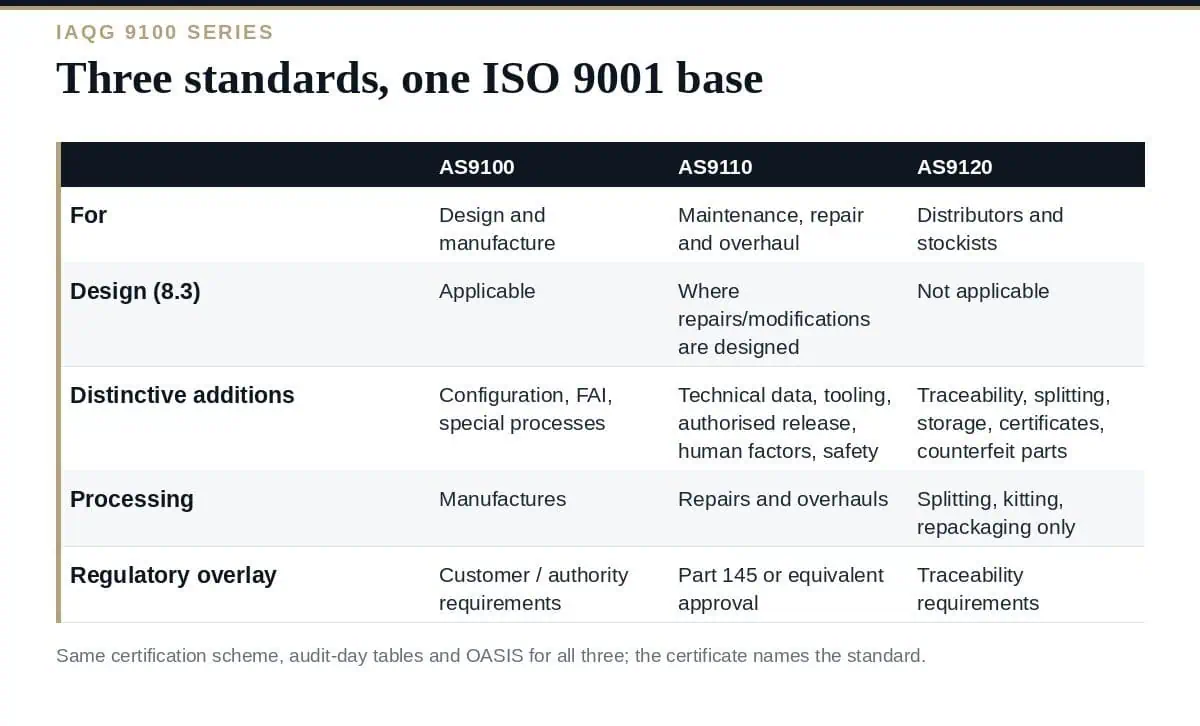
AS9110 vs AS9120 is the question an aerospace organisation asks when it has realised that AS9100 does not describe what it does. The IAQG’s 9100 series has three quality management system standards on the same ISO 9001 base, each for a different position in the supply chain: AS9100 for organisations that design, develop and manufacture aviation, space and defence products; AS9110 for maintenance, repair and overhaul organisations working on aircraft and their components; and AS9120 for stockists and distributors that buy parts and sell them on without altering them.
The three share clauses 4 to 10, the certification scheme, the OASIS database and the authenticated auditors — and differ in the requirements inserted into the ISO 9001 text, because a repair station’s risks (technical data, tooling, release to service, human error) and a distributor’s risks (traceability, splitting, storage, counterfeit parts) are not a manufacturer’s. This guide sets the two apart on scope, structure and the requirements each adds, shows how to decide which applies to a mixed organisation, and explains what the pending IA-series revision changes for both.
Free gap assessment
Are you ready for the 2026 edition of ISO 9001?
Score yourself against the new edition, free, including the risk and opportunity split and the clause 10 renumbering that breaks converted checklists.
Run the free ISO 9001 gap assessment → or View premium report sample
| AS9110 Rev C (2016) | AS9120 Rev B (2016) | |
|---|---|---|
| Title | Quality Management Systems — Requirements for Aviation Maintenance Organizations | Quality Management Systems — Requirements for Aviation, Space, and Defense Distributors |
| Who it is for | Organisations whose primary business is providing maintenance, repair and overhaul services for civil or military aviation articles and products — repair stations, MRO providers, OEM service centres | Organisations that procure parts, materials and assemblies and resell them to customers, including those that split, repackage or kit — stockists, distributors, brokers |
| Base | ISO 9001:2015 in full, plus maintenance requirements | ISO 9001:2015 in full, plus distribution requirements |
| Design and development (8.3) | Applicable where the organisation designs repairs or modifications | Not applicable — distributors do not design |
| Manufacturing | Repair, overhaul and modification processes controlled as production | Not permitted beyond splitting, repackaging, kitting and similar — a distributor that machines a part is a manufacturer |
| Regulatory overlay | Airworthiness regulation — FAA Part 145, EASA Part-145 and equivalents — sits beside the QMS | No airworthiness approval as such; customer and regulatory traceability requirements apply |
| Certification scheme | IAQG ICOP; OASIS; AS9104/1 audit days; aerospace auditors | Same |
AS9110 takes AS9100’s aerospace additions and replaces the manufacturing-specific ones with maintenance-specific ones. The requirements that distinguish it:
AS9120 assumes the organisation adds no value to the part except availability, and builds its requirements around keeping the part and its identity intact from the manufacturer to the customer:
Our guide to counterfeit parts prevention covers the process that is central to AS9120 and present in all three standards.
| What the organisation does | Standard | Note |
|---|---|---|
| Repairs, overhauls or modifies aircraft, engines or components under an airworthiness approval | AS9110 | The QMS complements Part 145 approval; it does not replace it |
| Buys aerospace parts and resells them, with splitting, kitting or repackaging at most | AS9120 | Any manufacturing step changes the answer |
| Manufactures parts and also holds a repair station approval | AS9100 and AS9110, or AS9100 with the maintenance scope included where the CB agrees | Many OEMs and their service centres hold both |
| Distributes parts and also performs value-added machining or assembly | AS9100 — the manufacturing activity governs | AS9120 excludes processing |
| Distributes parts and also repairs them | AS9120 and AS9110 | Two scopes, one management system |
| Provides maintenance services without an airworthiness approval (e.g. ground support equipment) | AS9110 may still apply; confirm with the CB and the customer | Scope is defined with the certification body |
The certification body agrees the standard and scope before the audit, and OASIS records which standard each certificate is issued against, so a mismatch is visible to every customer who checks. Our guide to AS9100 vs ISO 9001 covers the manufacturing standard the two variants branch from; AS9100 certification cost covers the fixed audit days that apply to all three.
The IAQG’s renaming applies across the family: AS/EN/JISQ 9110 and 9120 become IA9110 and IA9120, rebased on ISO 9001:2026 alongside IA9100 and targeted for the same late-2026 publication, with a transition period the IAQG will confirm on release. The published key-change themes — expanded product safety, counterfeit parts and sub-tier control, quality culture and ethics, an APQP link — land differently in each: counterfeit parts and sub-tier control weigh on distributors; product safety, culture and human factors on maintenance organisations. Until publication, Rev C and Rev B remain the certifiable editions. Our guide to IA9100 tracks the revision.
What is the difference in AS9110 vs AS9120?
AS9110 is the aerospace QMS standard for maintenance, repair and overhaul organisations, adding requirements on technical data, tooling, authorised release personnel, human factors and safety; AS9120 is the standard for distributors and stockists, adding traceability, splitting, storage, counterfeit-part and certificate controls and excluding design and manufacturing. Both contain ISO 9001:2015 in full.
Can a distributor certify to AS9100 instead?
It can, but AS9120 is the standard written for its activity and the one customers expect on a distributor’s certificate. A distributor that performs manufacturing or processing beyond splitting, kitting and repackaging has left AS9120’s scope and needs AS9100.
Does AS9110 replace FAA Part 145 or EASA Part-145 approval?
No. The regulatory approval is the licence to perform maintenance; AS9110 is the quality management system around it. Most repair stations hold both, and customers and primes require the AS9110 certificate on top of the approval.
Are the audits different?
The scheme is the same — IAQG ICOP, AS9104/1 audit days, authenticated aerospace auditors, results in OASIS — but auditors are authenticated for the standard they audit, and the audit tests the variant’s specific requirements.
What happens with IA9110 and IA9120?
They follow IA9100: renamed, rebased on ISO 9001:2026, targeted for late 2026 with a transition period announced on publication. Rev C and Rev B remain certifiable until then.
Settle AS9110 vs AS9120 by what the organisation does to the part: if it repairs, overhauls or modifies under an airworthiness approval, AS9110; if it buys and resells without altering, AS9120; if it manufactures, AS9100 — and where it does more than one, more than one scope on the same system. The ISO 9001 core and the IAQG scheme are shared; the inserted requirements are what the certificate actually says about you.
The quality manual with the AS9100, AS9110 and AS9120 variants marked, the maintenance and distribution procedures, the traceability and splitting records, the tool control and technical data procedures and the counterfeit parts process are in the AS 9100/9110/9120 Aerospace QMS Toolkit, or start with the free templates.

October 12, 2026
October 12, 2026

October 12, 2026

October 12, 2026
October 12, 2026

