CART
NIST SP 800-30 is the risk assessment methodology that most organisations quote and few actually run as written — because it asks for something harder than a spreadsheet of system vulnerabilities.
It asks you to assess risk at three levels of the organisation, and to produce something a senior executive can act on. Skip either and you get a register nobody reads.
Free gap assessment
How far through the RMF are you really?
Walk all 47 tasks across the seven steps, free, with the organisation-level answers separated so they carry over to your next system.
Run the free NIST RMF gap assessment → or View premium report sample
Guide for Conducting Risk Assessments, Revision 1, was published in September 2012 by the Joint Task Force Transformation Initiative, superseding the 2002 original.
Free ISO 27001 risk assessment
Which of your risks sit above your appetite line?
Set your own risk criteria, pick from 61 information security risk scenarios, rate likelihood and impact, and decide how to treat each one. You get a heat map, a process score and the findings an auditor would raise, free.
Run the free risk assessment → or View premium report sample
Fourteen years on it has not been revised, and that is worth reading correctly. This is not a neglected document — it is a stable one. The methodology it describes has not needed reworking, which is more than can be said for most risk guidance of the same vintage.
Its stated purpose is precise: to provide guidance for conducting risk assessments, amplifying the guidance in SP 800-39. That relationship matters. SP 800-39 describes managing information security risk across an organisation; SP 800-30 is the assessment component within it. Reading 800-30 alone gives you a method without the frame it was designed to sit in.
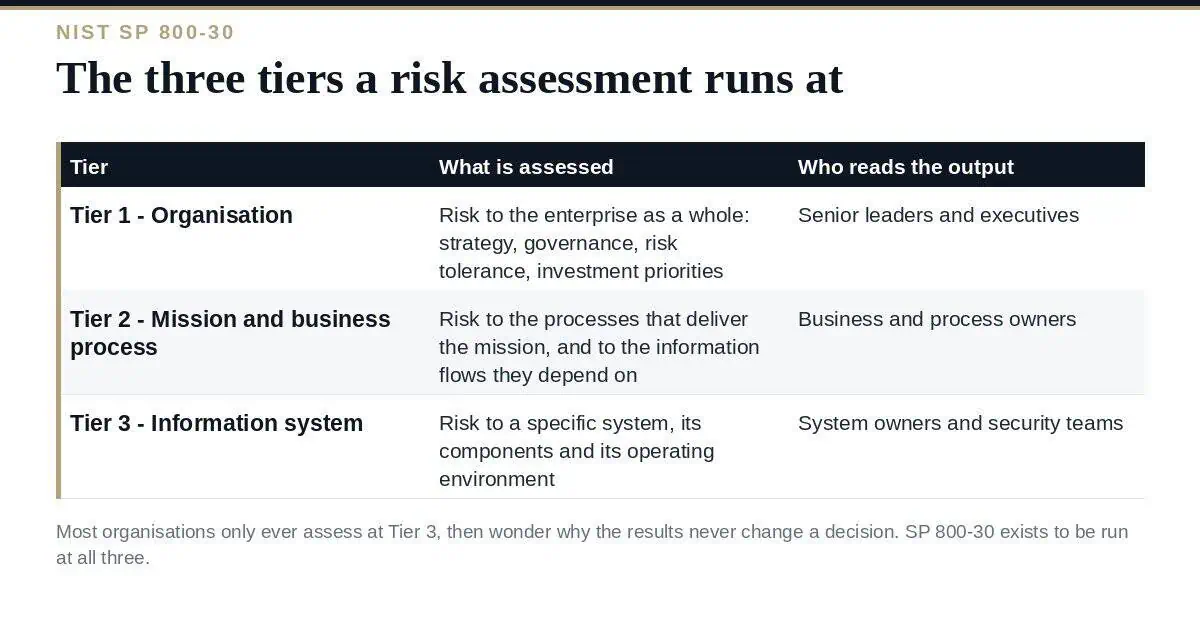
The single most important line in the publication is that risk assessments are carried out at all three tiers in the risk management hierarchy, as part of an overall risk management process, to give senior leaders and executives the information they need to determine appropriate courses of action.
Almost every failed risk programme fails at this point, and it is the clearest sign a team has read NIST SP 800-30 without running it. The assessment happens at Tier 3 — this system, these vulnerabilities, this patch level — and the output is a technical list. It is accurate, it is diligent, and it cannot answer a question a board actually asks, because board questions live at Tier 1.
Running the assessment at Tier 1 and Tier 2 as well is what turns a vulnerability list into a decision-support document. It is also the part that requires talking to people outside the security team.
The NIST SP 800-30 method itself is deliberately simple, and the value is in the discipline rather than the complexity:
Two of the four are routinely skipped. Prepare gets skipped because it feels like paperwork before the real work, and its absence is why two assessments in the same organisation cannot be compared. Maintain gets skipped because nothing forces it, and an assessment that is eighteen months stale describes a system that no longer exists.
NIST SP 800-30 separates concepts that most risk registers merge, and the separation is the analytical value.
A threat source is who or what initiates — an adversary with capability and intent, but also human error, a structural failure or a natural event. A threat event is what happens. A vulnerability is the weakness exploited. A predisposing condition is a property of the organisation that makes an event more likely to have an adverse effect, regardless of any specific weakness.
Keeping those apart lets you see that one predisposing condition — a flat network, a single supplier, an unclear ownership model — sits underneath a dozen apparently unrelated risks. Merging them into a single “risk” line loses that entirely.
| Framework | Relationship |
|---|---|
| NIST CSF | CSF tells you which outcomes to pursue; SP 800-30 tells you how to work out which ones matter most here. They are commonly run together |
| SP 800-53 | The control catalog you select from once the assessment has told you what you are treating |
| ISO 31000 | The international general risk management standard. ISO 31000 is broader and sector-neutral; SP 800-30 is deeper and specific to information security risk. If you run both, use ISO 31000 for criteria and governance and 800-30 for the assessment method |
| ISO 27001 | Clause 6.1.2 requires a risk assessment process without mandating one. SP 800-30 is a defensible answer, particularly for organisations with a US federal footprint |
This guide reflects csrc.nist.gov at 15 August 2026, on which SP 800-30 Rev. 1 remains the current revision.
The NIST Cyber Risk Management Toolkit provides 50+ editable files covering the risk assessment methodology, the threat and vulnerability catalogues, the risk register and treatment records, and the reporting artefacts that carry results to the people who decide.


October 15, 2026
October 15, 2026
October 14, 2026
October 14, 2026
October 14, 2026

