CART
NIS2 management liability is the provision that gets cybersecurity budgets approved, and it is the one most summaries reduce to a single vague sentence about “management accountability”.
The Directive is more specific than that. It places three named duties on management bodies, requires them personally to be trained, and — for essential entities — puts a temporary ban on holding managerial office in the enforcement toolkit.
Free gap assessment
Where do you stand on the Article 21 measures?
Score scope, all ten measures, the management-body duties and the reporting clocks, free.
Run the free NIS2 gap assessment → or View premium report sample
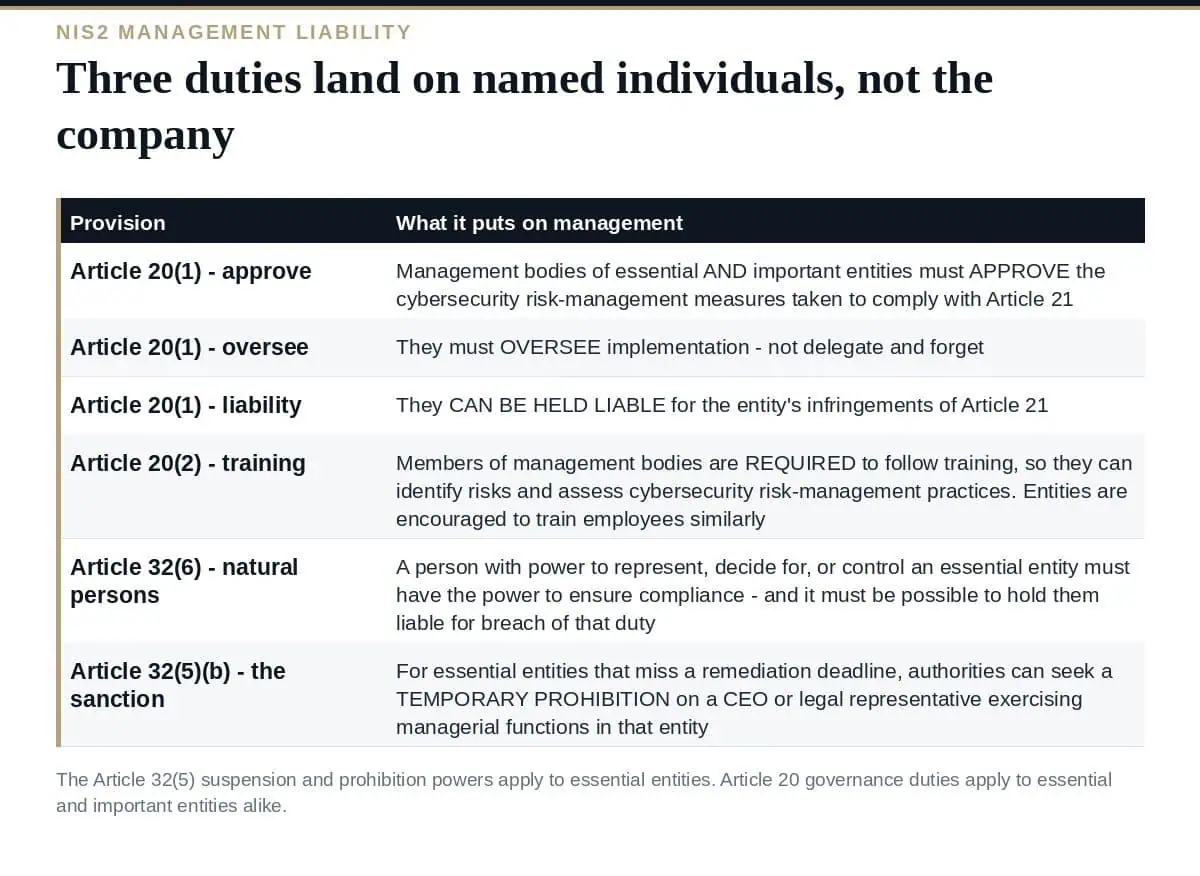
Article 20(1) requires Member States to ensure that the management bodies of essential and important entities:
Three verbs, three different obligations, and together they are what NIS2 management liability rests on. Approve is a decision that has to be recorded. Oversee is a continuing duty that survives the approval — a management body that signed off a programme in 2025 and never asked about it again has approved but not overseen. And liable is the consequence attaching to both.
Note the scope: this applies to essential and important entities alike. The distinction between the two categories changes the supervisory regime, not these governance duties.
Article 20(2) is the part that surprises boards. Member States shall ensure that members of the management bodies are required to follow training — so they gain sufficient knowledge and skills to identify risks and assess cybersecurity risk-management practices and their impact on the services the entity provides.
Two things follow.
It is required for them, and encouraged for everyone else. The Directive requires training for management bodies and separately says Member States shall encourage entities to offer similar training to employees on a regular basis. The mandatory limb points at the top of the organisation.
The purpose is stated, which sets the standard. The training exists so directors can identify risks and assess practices — that is, form their own view rather than accept a report. An hour of generic awareness content does not obviously produce that capability, and the wording gives a supervisor something concrete to probe.
Free ISO 27001 risk assessment
Which of your risks sit above your appetite line?
Set your own risk criteria, pick from 61 information security risk scenarios, rate likelihood and impact, and decide how to treat each one. You get a heat map, a process score and the findings an auditor would raise, free.
Run the free risk assessment → or View premium report sample
Article 32(5) applies where an essential entity has been given a deadline to remedy deficiencies and has not met it. Competent authorities then have the power to:
That second power is the part of NIS2 management liability worth reading aloud to a board. It is not a fine paid by the company. It removes a named individual from managerial functions for a period.
It applies to essential entities. Important entities face a different enforcement regime, and conflating the two overstates the position for a large part of the market — which is worth getting right rather than using as a scare tactic.
Separately, Article 32(6) requires Member States to ensure that any natural person who is responsible for, or acts as legal representative of, an essential entity — on the basis of power to represent it, authority to take decisions on its behalf, or authority to exercise control of it — has the power to ensure its compliance with the Directive. And that it is possible to hold such persons liable for breach of their duties to ensure compliance.
The first half is easy to skim past and is the more useful one internally: the person carrying the duty must actually have the power to discharge it. A named accountable executive without budget, authority or access to the risk picture is a governance defect the Directive implicitly identifies.
Both Article 20(1) and Article 32(6) carve out national liability rules for public administration entities, public servants and elected or appointed officials.
NIS2 management liability turns three ordinary governance habits into evidence you need to be able to produce.
That last point reframes the risk. The trigger for the harshest measures is not having a weakness — it is being told to fix it and not doing so in time.
| Area | Connection |
|---|---|
| NIS2 requirements | Article 21 is what management approves and oversees — including the supply chain measures in 21(2)(d) |
| NIS2 penalties | The financial side. Article 32(5) sits alongside it and reaches individuals rather than balance sheets |
| Who NIS2 applies to | Essential or important matters here: the Article 32(5) powers are an essential-entity regime |
| ISO 27001 | Clause 5 leadership, management review and the audit programme produce exactly the approval and oversight evidence Article 20 expects |
This guide reflects Directive (EU) 2022/2555 as published on EUR-Lex, read at 16 August 2026. NIS2 is transposed into national law — the applicable liability regime is your Member State’s.
The NIS2 Toolkit provides 75+ editable templates covering the Article 21 measures, the governance and approval records, the training and awareness artefacts and the incident and remediation documentation.


October 15, 2026
October 15, 2026
October 14, 2026
October 14, 2026
October 14, 2026

