CART

Learner satisfaction is one of three satisfaction measures ISO 21001:2025 expects an educational organization to run, and the fact that there are three is the point most survey programmes miss. Clause 1 states the standard’s aim as enhancing “satisfaction of learners, other beneficiaries and staff”, and clause 9.1 — monitoring, measurement, analysis and evaluation — is where that aim becomes a requirement to decide what to monitor, how, when, and how to analyse and act on the results.
A learner is defined as a “beneficiary acquiring and developing competence using an educational service”; a beneficiary is a person or group “whom the educational organization is obliged to serve by virtue of its mission” — a parent, an employer, a funder, a community; staff are “persons who work for and within an organization”. One end-of-course questionnaire cannot serve all three. This guide explains what clause 9.1 requires, how to design a learner satisfaction programme that also covers the other two groups, which measures go beyond satisfaction, how to analyse and close the loop so the evidence survives an audit, and the five findings auditors raise most often.
| Requirement (9.1, harmonized structure) | Applied to learner satisfaction | Evidence |
|---|---|---|
| Determine what needs to be monitored and measured | Satisfaction of learners, of other beneficiaries and of staff; plus educational outcomes | A measurement plan naming the three groups and the outcome measures |
| Determine the methods | Surveys, interviews, focus groups, complaints and appeals data, progression and completion data | Instrument design per group; sampling rules |
| Determine when monitoring and measuring is performed | Points in the learner journey: induction, mid-programme, completion, post-completion | Calendar in the plan |
| Determine when results are analysed and evaluated | Per cohort, per programme, per year; before management review | Analysis reports dated before the review |
| Evaluate performance and effectiveness of the EOMS | Are learners, beneficiaries and staff more satisfied, and are outcomes improving? | Trend analysis; conclusions recorded |
| Retain documented information as evidence of the results | Raw data, analysis, actions | Records under 7.5 |
Clause 9.1’s demand is the loop, not the questionnaire. An auditor reads the survey once and spends the rest of the hour following the results into analysis, into management review and into a change a learner would notice. Our guide to ISO 21001 mandatory documents lists the 9.1 record among the retained evidence.
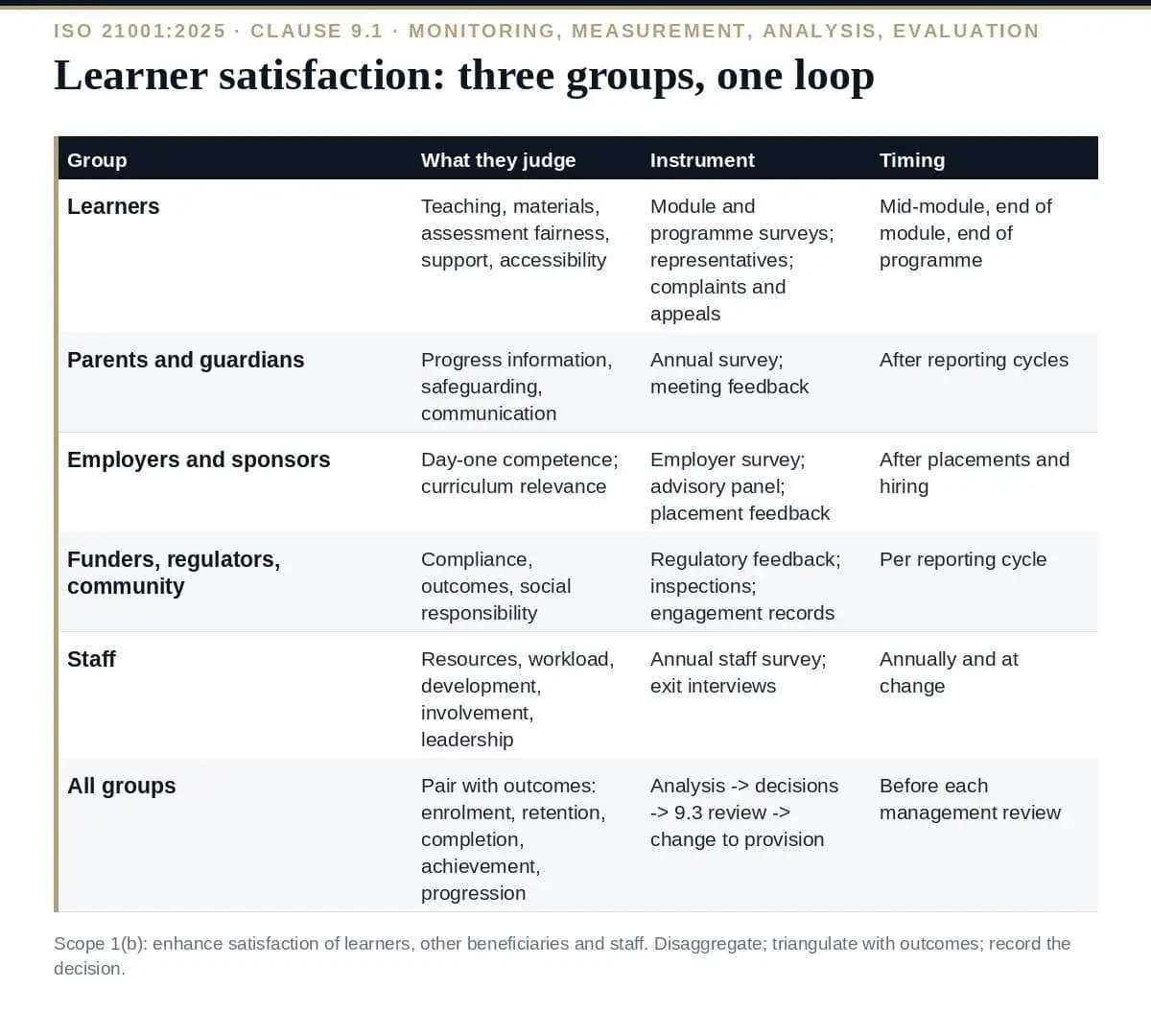
| Group | What they judge | Instrument | Timing | Trap |
|---|---|---|---|---|
| Learners | Teaching, materials, assessment fairness and feedback, support, accessibility, facilities and platforms | Short module and programme surveys; learner representative meetings; complaints and appeals data | Mid-module (in time to act), end of module, end of programme | One survey for everybody; ignoring learners with special needs, whose experience the standard singles out |
| Other beneficiaries: parents, guardians | Progress information, safeguarding, communication, responsiveness | Annual survey; meeting feedback | After reporting cycles | Measuring parents as if they were learners |
| Other beneficiaries: employers and sponsors | Competence of graduates on day one; relevance of the curriculum; reporting | Employer survey; advisory panel minutes; placement feedback | After placements and at graduate hiring | No instrument at all — the most common gap |
| Other beneficiaries: funders, regulators, community | Compliance, outcomes, social responsibility | Regulatory feedback; inspection outcomes; community engagement records | Per reporting cycle | Treating inspection findings as outside the EOMS |
| Staff (educators and support) | Resources, workload, development, involvement in design, leadership | Annual staff survey; exit interviews; consultation records | Annually and at change | Confusing an HR engagement survey with EOMS evidence — it can be the same survey if the results enter 9.1 and 9.3 |
Satisfaction is not attainment, and ISO 21001 expects the EOMS to demonstrate “its ability to support the acquisition and development of competence”. A learner satisfaction score of 4.6 on a programme with 40% completion is a warning, not a result. Pair every satisfaction measure with outcome measures per programme and per beneficiary group: enrolment against plan, retention and completion, achievement against learning outcomes (formative and summative assessment results, defined in 3.45 and 3.46), progression to the next stage or employment, and the number and outcome of complaints and appeals.
Where the organisation defines an objective under 6.2 — “improve completion on programme X to 85%” — the 9.1 measure is what proves it. Our guide to the ISO 21001 internal audit covers the question every auditor asks: can you show learning happened?
Does ISO 21001 require a learner satisfaction survey?
It requires the organisation to determine what to monitor and measure under clause 9.1, and its scope names satisfaction of learners, other beneficiaries and staff as an aim. A survey is the usual method for learners; the requirement is the measurement, analysis, evaluation and retained results, not a particular instrument.
Who are the other beneficiaries?
Persons or groups the organisation is obliged to serve by virtue of its mission (3.26) — parents and guardians, employers and sponsors, funders, regulators and the community. Annex C classifies interested parties in educational organisations.
How often should we measure?
At points where the result can still change something for the cohort — mid-module — and at completion, with analysis before each management review. Annual is the minimum for beneficiary and staff groups.
Is staff satisfaction really part of an EOMS?
Yes. Clause 1(b) names satisfaction of learners, other beneficiaries and staff, and engagement of people is one of the eleven EOMS principles. An HR survey can serve if its results enter clause 9.1 analysis and 9.3 review.
What does an auditor want to see?
The plan (what, how, when), the instruments per group, the analysis with conclusions, the decisions and actions, the management review discussion, and at least one change to provision that came from the data.
Run learner satisfaction as one of three measures under clause 9.1, disaggregate it, pair it with outcome data, record the decisions it produces and carry them into management review. The standard’s test is whether learners, other beneficiaries and staff are more satisfied and whether competence is being developed — and whether you can show both from your own records.
The Learner Satisfaction Survey, the Beneficiary and Employer Feedback templates, the Staff Survey, the Monitoring and Measurement Plan and the Analysis and Evaluation Report are in the ISO 21001 Educational Management Toolkit, or start with the free templates.

October 11, 2026
October 11, 2026
October 11, 2026
October 11, 2026
October 11, 2026

