CART
ISO 21001 implementation is mostly a familiar management system project with one unfamiliar idea at its centre: the organization serves learners and other beneficiaries, and those are not the same party. Get that distinction into the documentation and the rest follows; miss it and you have built ISO 9001 with the word “learner” pasted over “customer”.
This guide sets out the implementation sequence for a school, university or training provider, what has to be documented, and the mistakes that produce a certificate nobody in the classroom notices.
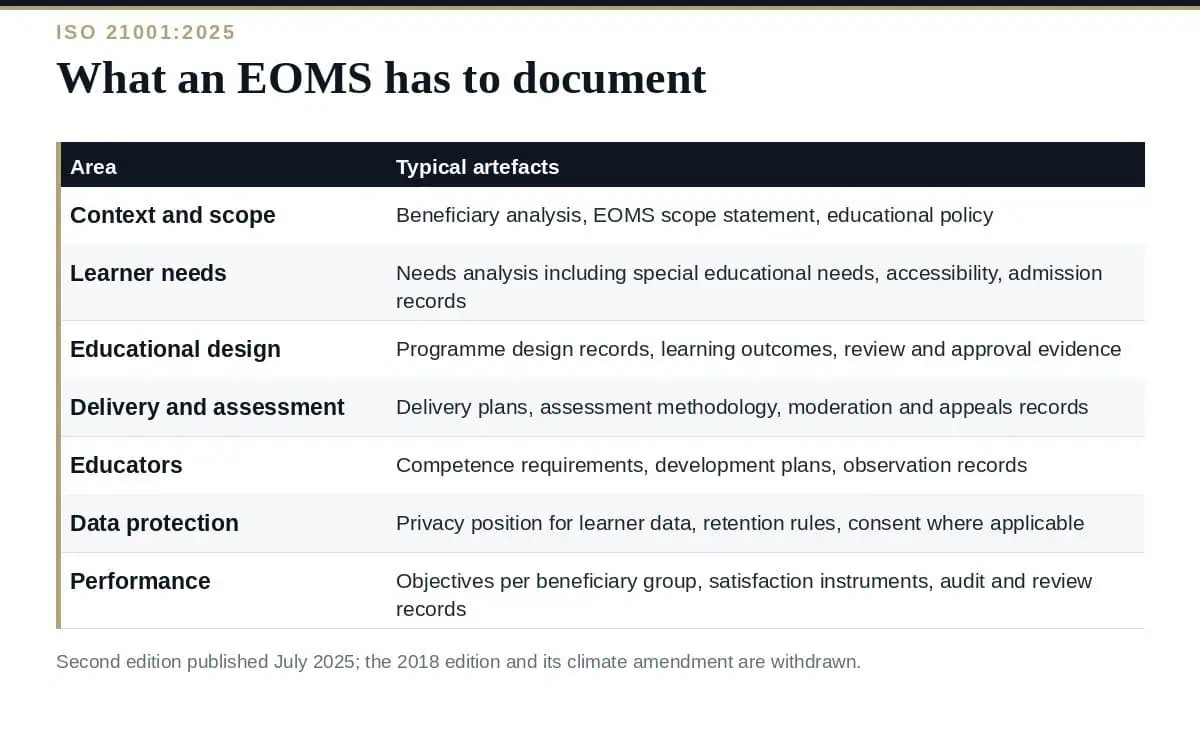
ISO 21001:2025 is the current text — the second edition, published in July 2025, replacing the 2018 first edition and absorbing its separate climate action amendment. Most guidance online still describes the withdrawn document, which is a problem when the guidance is what your consultant is working from. Confirm the edition before anything else, and retire internal documents that cite 2018.
| Area | Typical artefacts |
|---|---|
| Context and scope | Beneficiary and interested-party analysis, EOMS scope statement, educational policy |
| Learner needs | Needs analysis including special educational needs, accessibility provisions, admission and induction records |
| Educational design | Curriculum and programme design records, learning outcomes, review and approval evidence |
| Delivery and assessment | Delivery plans, assessment methodology, moderation and appeals records |
| Educators | Competence requirements, development plans, observation and evaluation records |
| Data protection | Privacy position for learner data, retention rules, consent where applicable |
| Performance | Objectives and measures per beneficiary group, satisfaction instruments, audit and review records |
The data protection row is easy to under-scope and hard to defend if you do. An education provider typically holds some of the most sensitive personal data in any sector — health, safeguarding, family circumstances, assessment history — often on minors. Check the privacy position against the data you actually hold rather than the data the system was designed for.
Treating learners as customers. A customer buys and can walk away; a learner is often required to attend, may not be the payer, and cannot easily switch. Satisfaction data collected on a customer model misses the learners with the least choice, who are usually the ones the system should serve hardest.
One satisfaction survey for everybody. Beneficiary groups have different needs, so a single instrument produces an average that describes nobody. Employers care about competence on the first day of work; parents care about safeguarding and progress; learners care about teaching and support.
Improvement that never reaches a learner. An auditor will look for what changed for a learner who needed something different. If the improvement log is full of document revisions and process tweaks with no line reaching provision, the EOMS is administrative rather than educational.
If you run ISO 9001, roughly the whole management-system frame carries over and the educational processes are the addition. If you hold sector accreditation from an education regulator, ISO 21001 does not replace it — accreditation is about permission to operate and award, while the EOMS is about how you manage the organization delivering it. The two coexist and the evidence overlaps substantially.
Our guide to ISO 21001:2025 and what makes it different covers the standard itself, including the edition change and where implementations go wrong.
Which edition should we implement?
ISO 21001:2025, the second edition published in July 2025. The 2018 edition and its separate climate amendment are withdrawn.
Who is ISO 21001 for?
Any organization that provides education — schools, colleges, universities, training providers, corporate learning functions and online course providers.
Do we need ISO 9001 first?
No. ISO 21001 is a standalone management system standard. Holding ISO 9001 makes implementation faster because the shared clauses are already in place.
How long does implementation take?
For a provider with existing quality processes, a few months to build and evidence; for one starting from nothing, longer — the constraint is usually generating enough records to demonstrate the system operating, not writing the documents.
Does certification improve outcomes?
Only if the improvement loop reaches provision. The standard gives you a structure for noticing what is not working for particular learners; whether anything changes is a management question, not a certification one.
Run ISO 21001 implementation in beneficiary order: map who you serve and how their needs differ, determine learner needs including those requiring something different, then build design, delivery, assessment and educator competence around what that analysis found. Measure per group rather than in aggregate, hold the privacy position to the data you actually keep, and make sure the improvement log contains at least some entries a learner would notice. Confirm you are on the 2025 edition before you write a single document.
The EOMS policy, beneficiary analysis, educational design records and audit artefacts are in the ISO 21001 Educational Management Toolkit, or start with the free ISO templates.

October 13, 2026
October 12, 2026
October 12, 2026
October 12, 2026
October 12, 2026

