CART
ISO 55001 certification cost is set less by the size of the organisation than by the size and diversity of the asset portfolio it puts in scope, and the 2024 edition sharpened the point: ISO 55001:2024 is 18 pages of requirements that expect almost everything — the strategic asset management plan, the decision-making criteria, the life-cycle approach, the data and knowledge requirements — to come from the organisation’s own context, which is where the implementation money goes. A single-site utility with one asset class and an existing ISO 9001 or 14001 system can certify for $15,000 to $40,000 in the first year; an infrastructure owner with several asset classes, no management system and a data problem can spend ten times that before an auditor arrives. This guide breaks the ISO 55001 certification cost into its components, explains how certification bodies price the audit, what the 2024 edition adds for organisations certified to 2014, and the four places asset management budgets overrun.
Split the spend into three buckets. Implementation: buying the standard and its guidance, the gap analysis, building the strategic asset management plan and the asset management plans, fixing the asset data, and the internal time to run the system for long enough to have records. Certification: the Stage 1 and Stage 2 audits by an accredited certification body, priced in audit days. Maintenance: surveillance audits in years one and two, recertification in year three, and the internal audit and management review every year. Quoting only the second bucket is the most common budgeting error; for a first-time certifier it is usually a fifth to a third of the total. Our guide to ISO 55001:2024 covers what the standard requires.
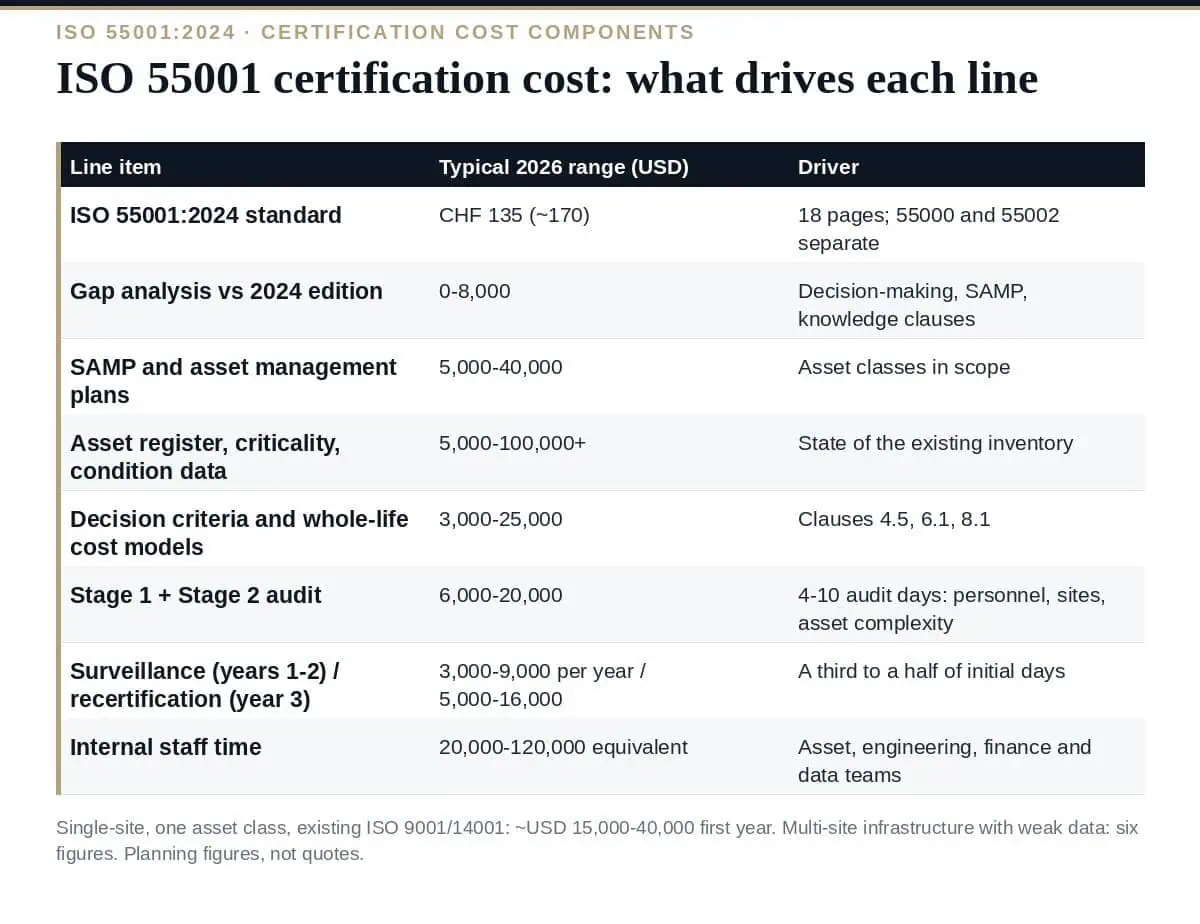
| Line item | Typical 2026 range (USD) | Notes |
|---|---|---|
| ISO 55001:2024 standard | CHF 135 (about $170) | 18 pages; ISO 55000:2024 vocabulary and ISO 55002:2018 guidance are separate purchases |
| Gap analysis against the 2024 edition | $0 to $8,000 | Internal, or two to four consultant days; the decision-making, SAMP and knowledge clauses are new |
| Strategic asset management plan and asset management plans | $5,000 to $40,000 | The SAMP is the artefact most implementations lack; plans per asset class follow |
| Asset register, criticality and condition data | $5,000 to $100,000+ | The widest item: an inventory that cannot support life-cycle decisions has to be rebuilt or cleaned |
| Decision-making criteria, risk and whole-life-cost methods | $3,000 to $25,000 | Clause 4.5 decision-making and clause 6.1 risk and opportunity criteria, with the cost models behind them |
| Documentation set: policy, procedures, registers | $99 to $15,000 | Template toolkit against consultant-written |
| Internal audit and management review | $2,000 to $8,000 | Must run at least once before Stage 2 |
| Stage 1 + Stage 2 certification audit | $6,000 to $20,000 | Accredited body, typically 4 to 10 audit days set by personnel in scope, sites and asset complexity |
| Surveillance audits, years 1 and 2 | $3,000 to $9,000 per year | Roughly a third to a half of the initial audit days |
| Recertification, year 3 | $5,000 to $16,000 | Somewhat less than the initial audit |
| Internal staff time | $20,000 to $120,000 equivalent | Asset managers, engineers, finance and data teams; the real cost |
All figures are planning ranges, not quotes; audit pricing varies by region and body, and implementation ranges depend on the state of the asset data more than anything else. Anyone who quotes an ISO 55001 certification cost without asking how many asset classes and sites are in scope, and whether an asset register exists, is guessing.
Certification bodies set ISO 55001 audit time from the number of personnel involved in the asset management system, adjusted for complexity — the number of sites, the number and diversity of asset classes, the criticality of the assets and whether the organisation already holds a certified management system. A water utility with treatment works, a network and a fleet is more complex than a single manufacturing site with one asset class, whatever the headcount. Three levers reduce the days: an existing ISO 9001, 14001 or 45001 certificate with the same body, which shares the clause 4 to 7 and 9 to 10 audit; a defined scope that names the asset portfolio and excludes what is not managed under the system; and a SAMP and asset management plans that are current, because the auditor samples the line of sight from organisational objectives to work orders and a broken chain costs a nonconformity and a re-visit. Our guide to the strategic asset management plan covers that chain.
ISO 55001:2024 replaced the 2014 edition in July 2024. Its foreword lists the changes: the Harmonized Structure applied; new subclauses on asset management decision-making (4.5), the strategic asset management plan and knowledge (7.7); operational planning and control made explicit about life-cycle management (8.1); a clear distinction between risk and opportunities; preventive action renamed and rewritten as predictive action (10.3); and a stronger emphasis on leadership. For an organisation certified to 2014, the transition is a documented decision-making framework, a knowledge clause, a predictive-action process and a SAMP that meets the new subclause — typically two to six consultant days or the equivalent in staff time, plus the transition audit the certification body schedules within the IAF transition window.
How much does ISO 55001 certification cost?
For a single-site organisation with one asset class and an existing management system, typically $15,000 to $40,000 in the first year including the Stage 1 and Stage 2 audit; multi-site infrastructure owners with several asset classes and weak asset data can spend well into six figures, most of it on data, plans and staff time rather than the audit.
What does the audit itself cost?
Typically $6,000 to $20,000 for Stage 1 plus Stage 2 — 4 to 10 audit days at accredited-body rates — then $3,000 to $9,000 a year in surveillance and a recertification in year three.
What drives the price most?
The asset portfolio: number and diversity of asset classes, number of sites, criticality, and the state of the asset data. Headcount matters less than in ISO 9001 or ISO 27001.
Is the 2024 edition more expensive?
It adds a documented decision-making framework, a knowledge clause, predictive action and a SAMP subclause; for existing certificate holders that is a modest transition project plus a transition audit.
Can we integrate with ISO 9001 or ISO 14001?
Yes. ISO 55001:2024 uses the Harmonized Structure, so the shared clauses can be audited together by the same body, which is the largest single saving on audit days.
Budget ISO 55001 certification cost from the portfolio, not the payroll: count the asset classes and sites, assess the state of the register, build the SAMP and the decision criteria first, and price the audit as 4 to 10 days plus surveillance. The certification body’s invoice is the smallest bucket; the data and the plans are where the money — and the value — actually sit.
The Asset Management Manual, the Strategic Asset Management Plan and Asset Management Plan templates, the Asset Register, the Criticality Register, the Whole-Life Cost Calculator and the Implementation Roadmap are in the ISO 55001 Asset Management Toolkit, or start with the free templates.

October 12, 2026
October 12, 2026
October 12, 2026
October 12, 2026
October 12, 2026

