CART
The strategic asset management plan is the document ISO 55001 puts between the organizational plan and everything that happens to the assets. It is where corporate objectives become asset management objectives — and if it is missing, every decision below it is being made on judgement that nobody can trace upward.
This guide covers what the SAMP contains, how it differs from an asset management plan, who writes it, and why the line of sight it creates is the whole point.
ISO 55001 requires documented information that specifies how organizational objectives are converted into asset management objectives, the approach for developing asset management plans, and the role of the asset management system in supporting them. That documented information is the strategic asset management plan.
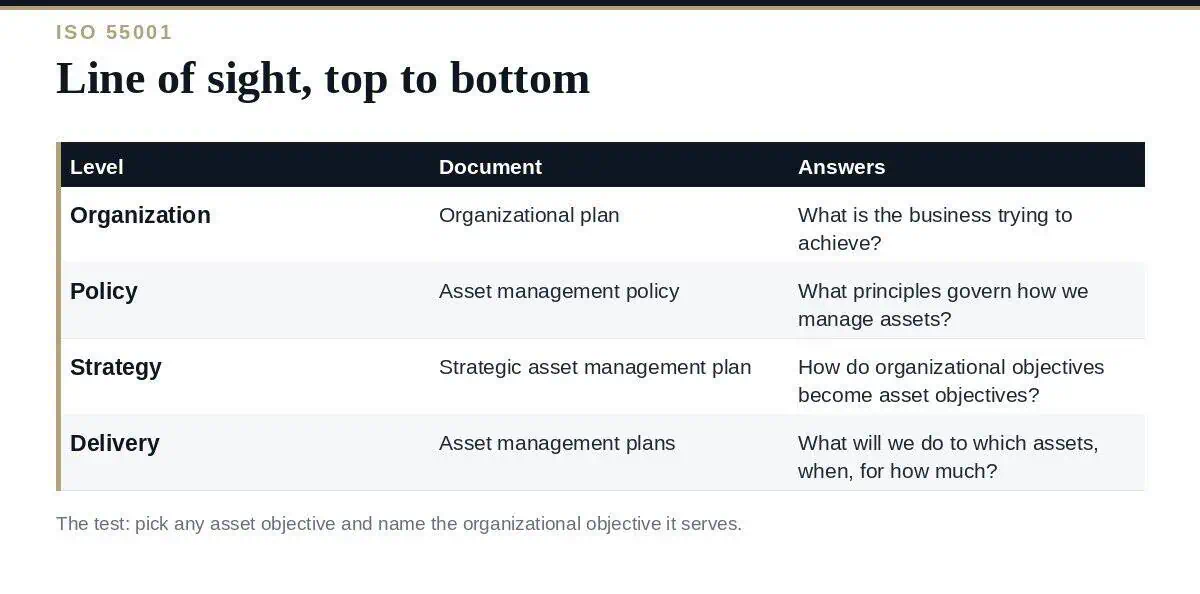
It sits at the top of a hierarchy that is easy to state and frequently muddled in practice:
| Level | Document | Answers |
|---|---|---|
| Organization | Organizational plan | What is the business trying to achieve? |
| Policy | Asset management policy | What principles govern how we manage assets? |
| Strategy | Strategic asset management plan | How do organizational objectives become asset objectives? |
| Delivery | Asset management plans | What will we do to which assets, when, and for how much? |
The SAMP is strategic and organization-wide; asset management plans are operational and portfolio-specific. A document listing planned maintenance by asset class is an asset management plan wearing the wrong title.
Most asset organizations already know their condition data and their maintenance backlog. What they usually cannot produce is a written basis for choosing between renewing a substation and refurbishing a depot. Setting those criteria out — including how risk and service consequence are traded against cost — is what converts a strategic asset management plan from a summary into a decision instrument.
Ownership belongs with someone accountable for assets across the organization, not with a maintenance function and not with finance alone. Input has to come from operations, engineering, finance, risk and whoever holds the organizational plan — the SAMP’s authority comes from having been agreed by all of them.
Length is a design decision. Thirty pages that engineers and the board both read beats two hundred that only the author has finished. Push the detail down into the asset management plans, where it belongs and where it can be updated without reopening the strategy. Our guide to ISO 55001:2024 covers what the current edition expects around it.
No line of sight. Asset objectives that cannot be traced to an organizational objective are the most common finding, and the easiest to test: pick any objective in the plan and ask which corporate goal it serves.
Written for the certificate. A SAMP produced for an audit and then shelved describes intentions nobody acts on. The test is whether an investment decision has ever been changed by it.
Condition data mistaken for strategy. Knowing the state of your assets is an input. The plan is about what you will do about it and why.
Never reviewed against outcomes. If nobody checks whether the asset objectives were met, the plan is a forecast that is never scored.
Finance and engineering in different documents. A strategic asset management plan with no funding reality behind it produces a delivery plan that fails in year one.
Is a strategic asset management plan mandatory under ISO 55001?
The documented information it contains is required. Most organizations meet that requirement with a single document called a SAMP, which is the term the standards family uses.
How is it different from an asset management plan?
The SAMP is organization-wide and strategic, setting objectives and decision criteria. Asset management plans are operational, specifying activities, timescales and resources for particular assets or portfolios.
How long should the planning horizon be?
Long enough to cover the assets’ lifecycle decisions — often ten years or more for infrastructure — with shorter delivery plans beneath it.
Who approves it?
Top management, since it commits resources and expresses the organization’s asset priorities. Approval below that level is a signal the plan will not bind anybody.
How often should it be reviewed?
Annually as a minimum, and whenever the organizational plan, funding position or asset base changes materially.
Build the strategic asset management plan around two things: a traceable line from every asset objective to an organizational objective, and written criteria for choosing between competing investments. Keep it short, push the activity detail into the asset management plans below it, and get it approved by top management with finance in the room. Then review it against outcomes each year — a SAMP whose objectives are never scored is a document, and the one test that matters is whether it has ever changed a decision.
SAMP templates, objective trees and decision criteria worksheets are in the ISO 55001 Asset Management Toolkit, or start with the free ISO templates.

October 13, 2026
October 12, 2026
October 12, 2026
October 12, 2026

October 12, 2026

