CART
Whole life cost is the total cost of an asset from the decision to acquire it to the decision to dispose of it — acquisition, operation, maintenance, renewal, downtime and end of life — discounted to a common basis so that options with different cost profiles can be compared. It is the arithmetic behind the value principle in ISO 55000:2024 and the decision-making clause ISO 55001:2024 added at 4.5: an organisation that must document how it decides between investing, maintaining, deferring and disposing needs a cost model that runs over the asset’s life, not over the current budget year.
It is also where asset management and finance most often talk past each other, which is why ISO/TS 55010:2024 exists. This guide sets out the seven cost elements a whole life cost model needs, how to build one for a decision, the discounting and horizon choices that change the answer, where the model connects to ISO 55001’s clauses, and the five errors that make whole-life comparisons wrong.
ISO 55001:2024’s foreword lists among its changes a new subclause on asset management decision-making and the clarification that operational planning and control includes life cycle management. Clause 4.5 asks for a documented approach to decisions with criteria; clause 8.1 asks for the life cycle to be managed; clause 6.2 asks for objectives that balance cost, risk and performance.
None of those can be met with initial-cost comparisons, because the cheapest asset to buy is frequently the most expensive to own. Whole life cost is the method that lets the criteria in 4.5 be applied consistently, and it is the language finance recognises once the two functions are aligned. Our guide to ISO 55001:2024 covers the clauses; this guide covers the model.
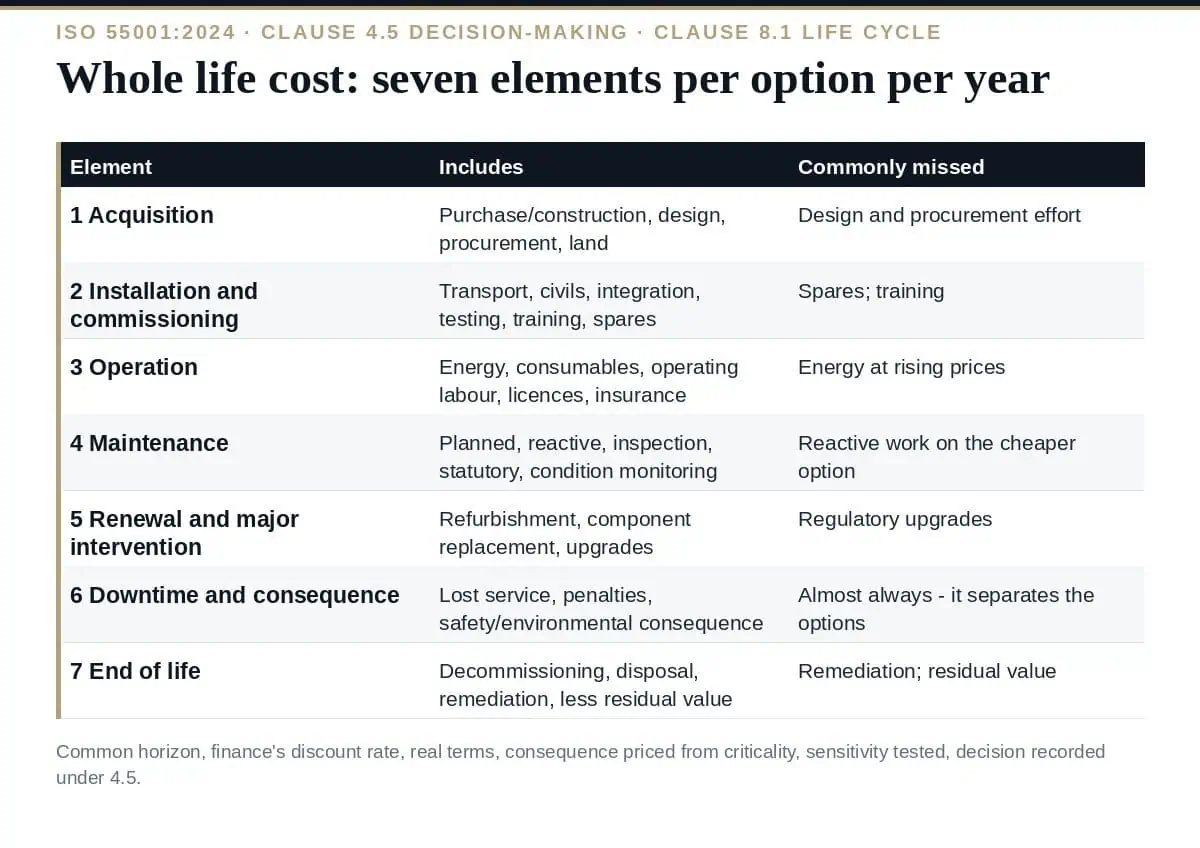
| Element | What it includes | Where the data comes from | Commonly missed |
|---|---|---|---|
| 1. Acquisition | Purchase or construction price, design, procurement, land and rights | Capital budget, contracts | Design and procurement effort |
| 2. Installation and commissioning | Transport, civil works, integration, testing, training, spares | Project accounts | Spares holding; training |
| 3. Operation | Energy, consumables, labour to operate, licences, insurance | Operating budget, metering | Energy over life at rising prices |
| 4. Maintenance | Planned and reactive maintenance, inspection, statutory testing, condition monitoring | CMMS history, contracts | Reactive maintenance for the cheaper option |
| 5. Renewal and major intervention | Mid-life refurbishment, component replacement, upgrades to meet new requirements | Engineering plans, OEM guidance | Regulatory upgrades |
| 6. Downtime and consequence | Lost production or service, penalties, safety and environmental consequence of failure, reputational cost | Reliability data, service agreements | Almost always — it is the element that separates options |
| 7. End of life | Decommissioning, removal, disposal, remediation, less residual or resale value | Disposal contracts, regulations | Remediation; residual value as a negative cost |
Element 6 is the one that turns whole life cost from an accounting exercise into an asset management one. Two pumps with identical purchase, operating and maintenance costs but different failure rates have different whole-life costs only if the consequence of failure is priced — which requires the criticality assessment the register holds. Our guide to asset criticality covers that input.
| Choice | Effect | What to do |
|---|---|---|
| Discount rate | A high rate favours options with low initial cost and high later cost; a low rate favours durable, expensive-to-buy options | Use finance’s rate; show the result at a second rate |
| Horizon | Truncating at the shorter option’s life hides the renewal the longer option avoids | Common study period with residual values, or lowest common multiple of lives |
| Inflation treatment | Mixing real and nominal cash flows with a real discount rate misprices energy and labour | Model in real terms with real escalation where an element outpaces general inflation |
| Consequence pricing | Leaving element 6 out makes reliability worthless in the model | Price downtime from service levels and contracts; price safety and environmental consequence by the organisation’s risk criteria |
| Residual value | Ignoring it penalises options with life remaining at the horizon | Straight-line or market residual, stated |
Finance measures assets by book value, depreciation and capital versus operating spend; asset management measures them by condition, criticality, performance and whole-life cost. ISO/TS 55010:2024 gives guidance on aligning the two — shared asset registers, capital investment planning and long-term financial planning that draw on the same data. In practice the alignment needs three agreements: a shared asset identifier and hierarchy, an agreed discount rate and horizon convention, and a rule that capital approval papers show whole-life cost alongside initial cost. Without the third, the policy commitment to value is contradicted by the approval form. Our guide to the asset register covers the shared identifier.
What is whole life cost?
The total cost of an asset over its life — acquisition, installation, operation, maintenance, renewal, downtime and consequence, and end of life less residual value — discounted to present value so that options with different cost profiles can be compared. It is the method behind ISO 55001:2024’s decision-making clause 4.5 and life-cycle management under 8.1.
Is it the same as life-cycle costing?
The terms are used interchangeably in asset management; some conventions treat life-cycle cost as the owner’s costs and whole life cost as adding wider consequence and externalities. State which elements the model includes.
What discount rate should we use?
The organisation’s cost of capital or, in the public sector, the mandated test rate; agree it with finance and show sensitivity to a second rate.
How does it relate to the asset register?
The register supplies age, condition, criticality, value and history; the model consumes them. ISO/TS 55010:2024 recommends aligning the financial and non-financial registers so the model and the capital plan use the same data.
Does ISO 55001 require a specific method?
No. It requires a documented decision-making approach with criteria (4.5) and life-cycle management (8.1); whole life cost is the established method for meeting both.
Build whole life cost as the engine of ISO 55001 decisions: seven elements per option per year, a common horizon, finance’s discount rate, consequence priced from criticality, sensitivity tested, and the result recorded under clause 4.5. Then get the capital approval form to show it, because the model only changes decisions if the people approving spend can see it.
The Whole-Life Costing procedure, the Whole-Life Cost Calculator, the Asset Management Decision-Making procedure, the Renewal Forecast and the Capital Acquisition procedure are in the ISO 55001 Asset Management Toolkit, or start with the free templates.

October 12, 2026
October 12, 2026
October 12, 2026

October 12, 2026
October 12, 2026

