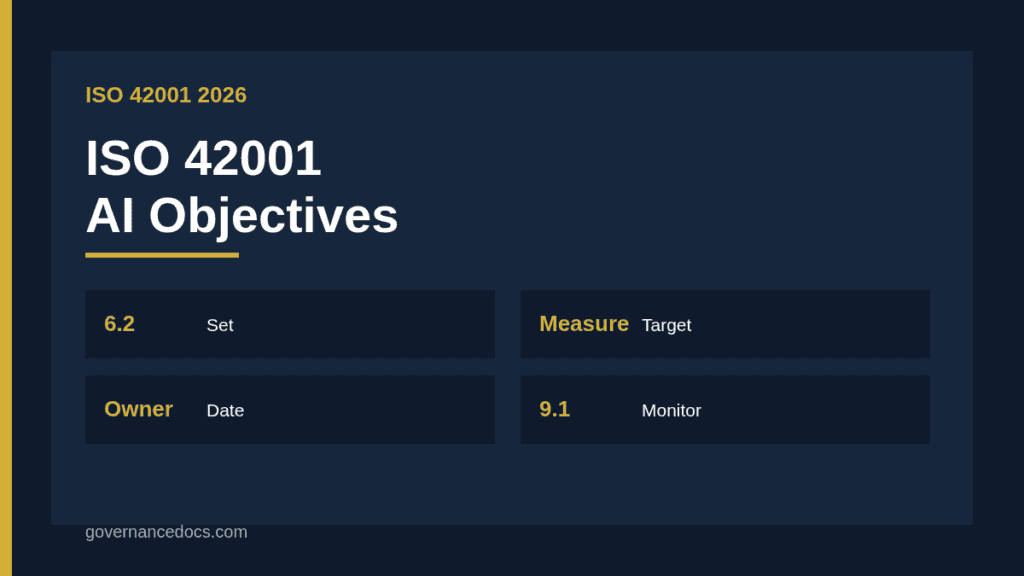
ISO 42001 AI objectives are the measurable goals your AI management system exists to achieve. Clause 6.2 requires them, and auditors test them early, because weak objectives usually mean the rest of the system has no direction.
The common failure is an objective like “use AI responsibly”. It cannot be measured, so nobody can prove it was met. A good objective names a result, a measure, a target, an owner and a date.
This guide explains what clause 6.2 requires, shows 12 examples you can adapt and walks through the evidence an auditor will ask to see. For the surrounding clause, read clause 6 planning.
Free gap assessment
How much of ISO 42001 could you evidence today?
Score every clause and Annex A control of the AI management standard, free, and see where the programme really sits.
What clause 6.2 requires from ISO 42001 AI objectives
The organization must establish AI objectives at relevant functions and levels. They must be consistent with the AI policy, measurable where practicable, take account of applicable requirements, be monitored, be communicated and be updated as appropriate.
The clause also requires you to plan how to achieve them: what will be done, what resources are needed, who is responsible, when it will be completed and how results will be evaluated. Documented information about the objectives must be kept.
In other words, ISO 42001 AI objectives are not slogans. Each one needs a plan behind it, and the plan needs to show up in your records.
Read the clause wording in ISO/IEC 42001:2023 and quote it in your objectives procedure.
How objectives connect to the AI policy and risk work
Start from the AI policy. If your policy commits to fairness, transparency and security, your objectives should turn those commitments into outcomes you can check.
Then look at your risk and impact work. The highest risks in your AI risk assessment and the most serious findings in your impact assessment are strong candidates for objectives, because they show where improvement matters.
Free AI risk assessment
Which of your AI systems could harm people, or you?
List your AI systems, models and data, pick from 38 AI risk scenarios, rate them for the people affected and for you, and plan treatment with ISO 42001 Annex A controls. You get a heat map, a process score and the findings an auditor would raise, free.
This traceability is what auditors look for. Each objective should point back to a policy commitment or a risk, so nobody can call it arbitrary.
Using Annex C as an idea bank
Annex C of the standard lists AI-related organizational objectives and risk sources. The objective themes include accountability, AI expertise, availability and quality of training and test data, environmental impact, fairness, maintainability, privacy, robustness, safety, security, and transparency and explainability.
Treat the list as a prompt, not a checklist. Pick the themes that match your systems and users, then translate each into a measure. A lending model will weight fairness differently from a logistics optimizer.
Annex C is informative, so you are free to define objectives that fit your business. Just be ready to explain why you chose them.
How to write a measurable objective
Use a simple formula: outcome, measure, target, owner, date. For example, reduce the share of production models without a current impact assessment to zero by the end of the year, owned by the head of AI governance.
Prefer measures you already collect. A metric that needs a new data pipeline will slip, and a slipping objective is a finding. Choose leading indicators you can report monthly.
Keep the count modest. Five to eight well-resourced objectives beat twenty that nobody tracks.
Our toolkit includes an objectives register template, so the ISO 42001 Toolkit gets you started quickly.
Test every draft of your ISO 42001 AI objectives by asking how you would prove it was met.
Twelve ISO 42001 AI objectives examples to adapt
Fairness: complete bias testing for every high-impact model before release. Transparency: publish plain-language information for every customer-facing AI feature. Security: remediate critical AI-related vulnerabilities within a set number of days.
Privacy: complete a privacy review for every new training dataset. Robustness: run drift monitoring on every production model with alerts reviewed weekly. Accountability: assign a named owner to every AI system in the inventory.
Competence: train all AI developers and reviewers on the AI policy each year. Data quality: document provenance for every training dataset. Supplier assurance: assess every third-party AI supplier before onboarding.
Incident response: test the AI incident procedure at least once a year. Human oversight: define and test override procedures for high-impact systems. Environmental impact: record compute and energy use for the largest training runs.
Theme (Annex C)
Example objective
Possible measure
Fairness
Test high-impact models for bias before release
Percentage tested
Transparency
Explain AI use to customers
Features with published notices
Security
Fix critical AI vulnerabilities quickly
Days to remediate
Robustness
Monitor production models for drift
Models with active monitoring
Accountability
Assign an owner to every AI system
Systems with named owner
Assigning owners, targets and resources
An objective without an owner is a wish. Name one person for each, and make sure they have the authority and time to deliver. Clause 6.2 specifically asks what resources are needed.
Set targets that stretch but do not mislead. Reporting a 100 percent target that is met by a narrow definition invites questions. Define each measure precisely in writing.
Record the plan in a simple register: objective, measure, baseline, target, owner, due date, status. This is the artifact auditors will ask for.
Review your ISO 42001 AI objectives owners at least yearly, because people change roles.
Monitoring ISO 42001 AI objectives through the year
Clause 9.1 requires monitoring and measurement, so your objectives feed straight into performance evaluation. Report progress at least quarterly to the AI governance group.
Use traffic lights sparingly and explain every red item. Auditors prefer an honest red with an action plan over a wall of green with no evidence.
Bring the summary into the management review, where leaders decide whether to adjust targets or add resources.
Evidence auditors ask for
Expect to be asked for the objectives register, the plan behind each objective and recent monitoring results. They may sample two or three objectives and trace them back to the policy and forward to management review.
They will also check communication: do the people responsible know the objectives? A short interview with an engineer often reveals whether the objectives live in practice.
Keep dated evidence for each objective, such as reports, dashboards and meeting records. Our internal audit guide shows how to test this before the external auditor does.
Common mistakes with ISO 42001 AI objectives
Typical mistakes include vague wording, no baseline, no owner and objectives copied from a template without adapting them. Another is setting objectives once and never updating them as systems and regulation change.
A subtler mistake is choosing objectives that are easy to meet. If the target is already achieved on day one, the objective drives no improvement and an experienced auditor will say so.
Finally, do not separate AI objectives from business goals. Link them to outcomes executives care about, such as customer trust, regulatory readiness and fewer incidents.
Communicating objectives to the people who deliver them
Clause 6.2 requires objectives to be communicated. Post them where teams work: the AI governance wiki, team dashboards and onboarding material. A document that only the compliance lead has read is not communicated.
Explain the why behind each objective in one sentence. Engineers respond better to “we test for bias before release because three customers asked for evidence” than to a bare target.
Ask team leads to repeat the objectives in their own words at your next internal check. It is a quick test of whether communication worked.
Linking objectives to your wider AI controls
Objectives often point to specific controls. A fairness objective leads to testing procedures, while a transparency objective leads to documentation and user information. Our ISO 42001 controls guide shows how the areas map.
The same logic applies to risk treatment. When a treatment plan lowers a risk, the matching objective measures whether it worked. See how an AI risk treatment plan connects the two.
Keeping this chain visible makes your Statement of Applicability, objectives and monitoring consistent. Auditors tend to trust a system where each piece supports the others.
A quick start for your first set of ISO 42001 AI objectives
Run a one-hour workshop with the AI governance lead, a technical lead, risk and legal. Start with the policy commitments and the top five risks, then draft one objective for each.
Score each draft against the formula: outcome, measure, target, owner, date. Anything missing a part goes back for rework. Aim to finish with five to eight objectives and a clear reporting rhythm.
Approve the final list through top management, publish it, and schedule the first progress report. Within a quarter you will have the monitoring evidence that Stage 2 expects.
Then keep it alive. Objectives are most useful when leaders ask about them every month, not only before an audit.
ISO 42001 AI objectives FAQ
How many AI objectives do we need?
The standard sets no number. Five to eight tracked objectives is a sensible range for most organizations, as long as each has an owner and a measure.
Do the objectives have to be numeric?
Measurable where practicable. Some objectives are best measured by a yes or no outcome, such as completing a procedure. Numeric measures are easier to defend.
Can we reuse our information security objectives?
You can align them, but AI objectives should cover AI-specific outcomes such as fairness, transparency and human oversight that security objectives do not address.
How often should we update the objectives?
At least annually, and whenever your systems, risks or regulatory obligations change. Review them in the management review.