An AI risk treatment plan is the document that turns a list of scored AI risks into decisions, owners and dates. Without it, an ISO 42001 risk assessment is just a register of worries. ISO/IEC 42001:2023 requires the plan under clause 6.1.3, and clause 8.3 requires you to carry it out, keep it current and record what you did.
This guide shows what the plan must contain, how to choose a treatment for each risk, how the plan connects to Annex A and your Statement of Applicability, and what auditors look for when they read it. It is written for the person who has finished the risk assessment and now has to decide what to do about the results.
Free gap assessment
How much of ISO 42001 could you evidence today?
Score every clause and Annex A control of the AI management standard, free, and see where the programme really sits.
What an AI risk treatment plan must do under ISO 42001
Clause 6.1.3 asks you to select appropriate treatments for the AI risks you identified, work out which controls are necessary, compare those controls with the reference controls in Annex A, and add any that Annex A does not cover. You then document the plan and get management approval for it, including acceptance of any residual risk. Clause 8.3 is the operating half: you implement the plan, review it at planned intervals, update it when new risks appear and keep records of what was done.
Free AI risk assessment
Which of your AI systems could harm people, or you?
List your AI systems, models and data, pick from 38 AI risk scenarios, rate them for the people affected and for you, and plan treatment with ISO 42001 Annex A controls. You get a heat map, a process score and the findings an auditor would raise, free.
Annex A of ISO 42001 contains 38 controls. You are not obliged to adopt them all, but you must be able to justify every exclusion. Your AI risk treatment plan is where that logic lives, because each risk points to the controls chosen for it, and the Statement of Applicability then summarizes those choices across the whole system. For the standard itself, see the official listing for ISO/IEC 42001:2023 on iso.org, which gives December 2023 as the publication date.
If you have not completed the assessment step yet, start with our guide to the ISO 42001 risk assessment under clause 6.1.2, because the plan is only as good as the register that feeds it.
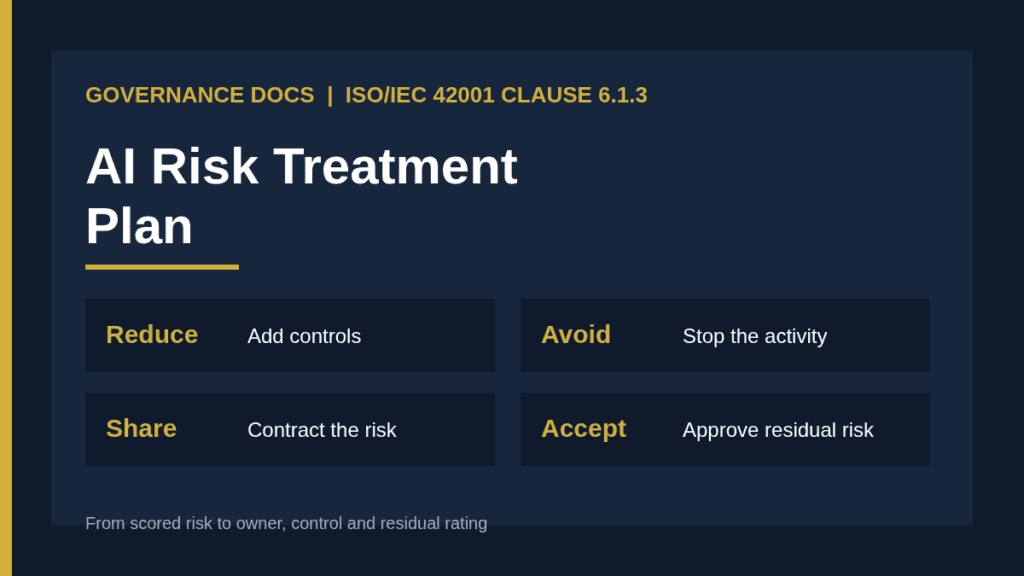
The four treatment options for every AI risk
The standard requires you to select suitable treatment options but does not force a specific list. Most organizations use the four options familiar from general risk management practice, which keeps the plan readable for auditors and executives alike.
Option
What it means
AI example
Evidence to keep
Reduce
Add controls to lower likelihood or impact
Human review of every automated loan decline
Procedure, reviewer log, sample of reviewed cases
Avoid
Stop the activity that creates the risk
Withdraw a facial-analysis feature from a hiring tool
Decision record, change ticket, removal date
Share
Move part of the risk to another party
Contractual warranties and indemnities from a model supplier
Signed contract clauses, supplier assurance report
Accept
Knowingly tolerate the remaining risk
Minor drift in an internal summarization tool
Named approver, rationale, review date
Reduction is the most common choice for AI systems, but it is not always enough. Some risks, such as using a system outside its tested context, are better avoided than mitigated. Sharing risk through a supplier contract is useful but never removes your own accountability for outcomes affecting people, so record the residual exposure even when a contract covers part of it.
How to build an AI risk treatment plan, column by column
A spreadsheet is enough, provided it has the right columns. Auditors will read across a row from risk to control to owner, so each row must tell a complete story.
Risk ID and description. Copy from the register so the two documents stay linked.
Inherent rating. The score before any treatment.
Treatment option. Reduce, avoid, share or accept.
Controls selected. Name each control and cite the Annex A reference where one applies. Mark any control that comes from outside Annex A.
Owner. A named person, not a department.
Target date and status. Planned, in progress, implemented or verified.
Residual rating. The score you expect once controls operate.
Approval. Who accepted the residual risk, and when.
Two columns are worth adding beyond the minimum. A “verification method” column records how you will prove the control works, such as testing, sampling or monitoring metrics. A “linked impact” column ties the row to your impact assessment so that harm to people is not lost when the register is translated into controls. Our AI risk register guide covers the fields that should exist before you start treating.
Choosing controls that fit the risk
Match the control to the cause of the risk, not to a generic list. If the risk is biased output from unrepresentative training data, a policy statement will not fix it. Data quality checks, representative test sets, fairness testing and human review will. If the risk is a supplier model changing without notice, the control lives in contracts, change notifications and regression testing. Write down why each control addresses the cause, since that explanation is what convinces an auditor the choice was deliberate.
Connecting the AI risk treatment plan to Annex A and the SoA
After you select controls, compare them against Annex A and record the outcome for every one of the 38 controls in the Statement of Applicability: included or excluded, why, and where it is implemented. Any control you chose that is not in Annex A should also be recorded, so nothing operates outside the documented system.
The clean way to do this is to build the plan first and the Statement of Applicability second. Teams that work in the opposite order often tick controls to look complete and then struggle to show which risk each one addresses. Read our guide to the ISO 42001 Statement of Applicability for the full layout and common exclusions.
Residual risk and management approval
Every plan ends with a decision: is the risk that remains acceptable? Define your risk appetite before the exercise, with a threshold such as “residual risks rated high need executive approval”. Then apply it consistently. A plan where every residual risk is accepted at the same level by the same person looks suspicious, while one that shows some risks escalated, some sent back for more controls and some accepted with conditions looks like a working process.
Approval should come from someone with authority over the AI system and its consequences, not only from the security team. Record conditions attached to acceptance, for example “accepted until the next model release” or “accepted provided monitoring alerts remain below the agreed threshold”. Conditional approvals are normal, but they must have an expiry or a trigger.
Keeping the plan alive under clause 8.3
The plan is not finished when it is signed. Clause 8.3 expects you to carry it out and update it, so build the routine into normal operations. Review open actions monthly or quarterly, update ratings when controls go live, and reopen rows when something changes: a new model version, a new data source, an incident or a supplier change. Keep the evidence trail simple, with links from each row to tickets, test results or monitoring dashboards.
Track overdue actions visibly. A treatment plan with many past-due dates and no explanation is one of the fastest ways to raise an audit finding. If a date must slip, record why, who agreed and the new date.
Common mistakes in an AI risk treatment plan
Treating everything as “reduce”. Some risks should be avoided or accepted, and the plan should show that choice.
Controls with no owner. “The AI team” is not an owner.
No residual rating. Without one, nobody can tell whether the treatment worked.
Annex A copied wholesale. Listing all 38 controls as implemented without evidence is easy to challenge.
Approval by silence. A sign-off with no name or date does not count as management approval.
Ignoring impact on people. Risks to individuals and society belong in the plan even when the organization itself faces little loss.
Start from a finished AI risk treatment plan structure
Building the register, heat maps and treatment plan from scratch takes time, and the layout is the part most teams get wrong. The AI Risk Assessment Report and Workbook gives you a ready structure with a risk register, heat maps, an ISO 42001 treatment plan and a live workbook you can adapt to your own systems. Use it or build your own, but keep one consistent format across every AI system you assess.
AI risk treatment plan FAQ
Is an AI risk treatment plan mandatory for ISO 42001?
Yes. Clause 6.1.3 requires a documented plan with management approval, and clause 8.3 requires you to implement and review it.
Do I have to use all 38 Annex A controls?
No, but you must compare your chosen controls with Annex A and justify any exclusions in the Statement of Applicability. You may also add controls that Annex A does not contain.
Can I accept a high AI risk?
You can if your risk criteria allow it and the right level of management approves it, ideally with conditions and a review date. Auditors will look for the reasoning, not just the signature.
How often should the plan be reviewed?
Review it at planned intervals and whenever something material changes, such as a new model, new data or an incident. Quarterly is a common starting point.
What is the difference between the risk register and the treatment plan?
The register records the risks and their ratings. The AI risk treatment plan records what you will do about each one, who owns it, by when and what risk remains.