CART
An ISO 42001 internal audit is the check you run on your own AI management system before a certification body runs theirs. Clause 9.2 of ISO/IEC 42001:2023 requires it, a stage 2 auditor will refuse to proceed without evidence of it, and — done properly — it is the single cheapest way to find out whether your AI governance works or merely exists on paper.
This guide covers what clause 9.2 actually asks for, how an AI management system audit differs from the ISO 27001 audits most teams already know, what to sample, and the findings that come up again and again in first-year systems.
Free gap assessment
How much of ISO 42001 could you evidence today?
Score every clause and Annex A control of the AI management standard, free, and see where the programme really sits.
Run the free ISO 42001 gap assessment → or View premium report sample
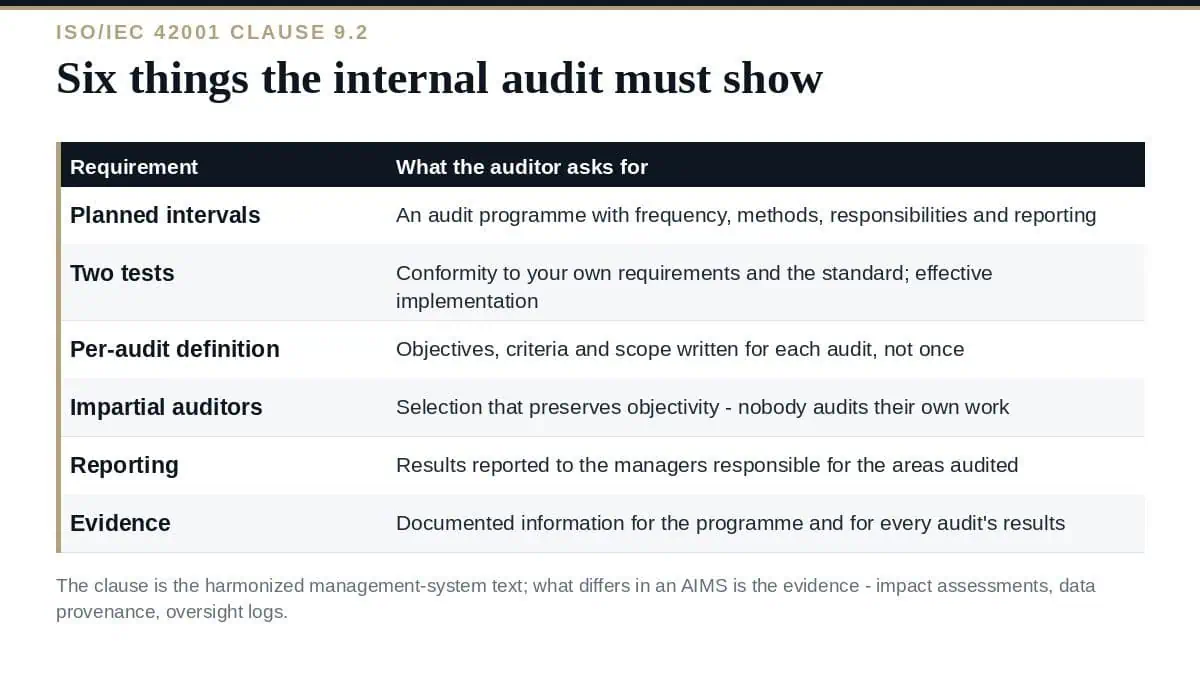
Clause 9.2.1 says the organization shall conduct internal audits at planned intervals to provide information on whether the AI management system conforms to the organization’s own requirements and to the requirements of the standard, and whether it is effectively implemented and maintained. Clause 9.2.2 then asks for an audit programme covering frequency, methods, responsibilities, planning requirements and reporting, and says the programme shall consider the importance of the processes concerned and the results of previous audits.
Three further requirements sit inside 9.2.2 and are the ones certification auditors check first:
The wording of the ISO 42001 internal audit clause is deliberately generic — it is the harmonized management-system text that ISO 27001, ISO 9001 and the rest also use. What makes an ISO 42001 internal audit different is not the clause; it is what you have to look at to satisfy it.
If your organization already runs an information security management system, the temptation is to bolt AI onto the existing audit programme and reuse the checklist. That works for the shared clauses (4 to 10) and fails for everything that makes 42001 its own standard.
| Area | ISO 27001 audit looks at | ISO 42001 internal audit looks at |
|---|---|---|
| Unit of scope | Information assets and the controls around them | AI systems — each one, across its life cycle, plus the data and models behind it |
| Risk artefact | Information security risk assessment (6.1.2) | AI risk assessment (6.1.2) and AI system impact assessment (6.1.4, 8.4) — two documents, two subjects |
| Control reference | Annex A, 93 controls in 4 themes | Annex A, 38 controls in 9 sections (A.2–A.10), with Annex B implementation guidance |
| Who is affected | The organization and its interested parties | Individuals, groups and societies outside the organization — explicitly |
| Typical evidence | Access logs, change records, incident tickets | Impact assessments, data provenance records, verification and validation results, human oversight logs, event logs from the AI system |
| Hardest question | Is the control operating? | Is the AI system doing what the impact assessment said it would — and to whom? |
The practical consequence: a combined audit is fine, but the AI portion needs its own working papers, its own sampling of AI systems, and at least one auditor who understands what a model card or a validation report is supposed to contain. Our guide to ISO 27001 vs ISO 42001 sets out the structural overlap in more detail.
Free AI risk assessment
Which of your AI systems could harm people, or you?
List your AI systems, models and data, pick from 38 AI risk scenarios, rate them for the people affected and for you, and plan treatment with ISO 42001 Annex A controls. You get a heat map, a process score and the findings an auditor would raise, free.
Run the free AI risk assessment → or View premium report sample
Clause 9.2.2 wants a programme, and the standard tells you what should drive it: the importance of the processes and the results of previous audits. For an AI management system, importance is not evenly distributed, so a flat “audit every clause once a year” plan is defensible but wasteful. A better programme is built around your AI system inventory:
ISO 19011 remains the reference for audit method; ISO 42001 cites it directly in its definition of audit. You do not need a separate methodology for AI, only AI-specific criteria and evidence.
A clause-by-clause checklist is a starting point for an ISO 42001 internal audit, not the audit itself. The following is what an experienced auditor actually pulls, grouped by where first-year systems fail.
| Finding | Why it happens | What closes it |
|---|---|---|
| Impact assessment lists ‘users’ as the only affected group | The assessment was written by the product team about the product | Re-run it with someone outside the team naming the people decided about, excluded or displaced |
| Risk assessment and impact assessment are the same document with two titles | Teams conflate organizational risk with impact on others | Split them: 6.1.2 is risk to objectives, 6.1.4 is consequence to individuals and societies; 6.1.4 feeds 6.1.2, not the other way round |
| Statement of Applicability marks all 38 controls as applicable with no justification | Copied from an ISO 27001 SoA habit | Justify each inclusion against the risk treatment plan; exclusions are allowed if the risk assessment does not need the control |
| No re-assessment after a model change | Change control lives in engineering; the AIMS never hears of it | Add a trigger in the change procedure: material model, vendor or use change → impact assessment review (8.4) |
| Human oversight is described in policy but nobody can produce a record of it happening | Oversight was designed as a principle, not a process | Define the review points, log them, and sample the log in the audit |
| Auditor is the AIMS manager | Small teams, one competent person | Use a trained auditor from another function, or an external auditor for the AI-specific parts — 9.2.2 b) is explicit about impartiality |
The ISO 42001 internal audit report goes to the managers responsible for the areas audited — 9.2.2 c) says so — and its findings become inputs to the management review under 9.3.2 d) 3). Classify findings as major nonconformity (a requirement is missing or systemically failing), minor nonconformity (an isolated lapse) or observation, and write each against the specific clause or Annex A control so the corrective action owner does not have to interpret it.
Then run the corrective action process in clause 10.2 on every ISO 42001 internal audit finding: react, evaluate the cause, act, review effectiveness, and keep the record. Certification auditors read your internal audit report and your corrective action log together; a report with no follow-through is worse than no report, because it shows the system does not respond to its own evidence.
Is an ISO 42001 internal audit mandatory before certification?
Yes. Clause 9.2 is a requirement of the standard, and certification bodies expect at least one complete internal audit and a management review before the stage 2 audit.
Can we use our ISO 27001 internal auditors?
For the shared management-system clauses, yes. For the AI-specific evidence — impact assessments, data provenance, verification and validation, human oversight — they need training in what those artefacts should contain, or you pair them with someone who has it.
How often should the ISO 42001 internal audit run?
The standard says planned intervals and leaves the interval to you. Annual full coverage is the common practice, with higher-impact AI systems audited more often and every clause covered within the three-year certification cycle.
Does the internal audit have to cover every AI system?
Every system in scope should be covered over the cycle. Within a single audit, sample by impact: high-impact systems end to end, lower-impact ones by rotation.
Can an external consultant perform it?
Yes. ISO 42001’s own definition of audit notes that an internal audit can be conducted by an external party on the organization’s behalf. It remains a first-party audit, and the impartiality requirement still applies.
Treat the ISO 42001 internal audit as a rehearsal for the questions a certification auditor will ask, run by someone who is allowed to give you bad news. Build the programme around your AI system inventory rather than the clause list, sample the life cycle of at least one high-impact system end to end, and make sure the findings reach management review and the corrective action log. That closes the loop the standard is really testing: not whether the documents exist, but whether the organization acts on what they reveal.
An internal audit procedure, annual audit plan, audit summary report, action log and nonconformity report for the AIMS are included in the ISO 42001 Toolkit (68 templates), or start with the free ISO templates.

October 11, 2026
October 11, 2026
October 11, 2026
October 11, 2026
October 11, 2026

