ISO 13485 process validation is the requirement to prove that a manufacturing or service process consistently produces conforming output when you cannot fully verify that output afterwards. Clause 7.5.6 sets the rule, and sterilization, sealing and welding are classic examples.
This guide explains when validation is required, how installation, operational and performance qualification work, how to justify sample sizes and when to revalidate. It connects with design transfer and software validation.
Free gap assessment
How much of ISO 13485 could you evidence today?
Score clauses 4 to 8, free, with the FDA QMSR and EU MDR duties kept separate so you can see what is the standard and what is the regulator.
Clause 7.5.6 requires validation of any production and service processes where the output cannot be verified by subsequent monitoring or measurement, and deficiencies would become apparent only after the product is in use.
If you can inspect or test 100 percent of units without destroying them, verification may be enough. If testing is destructive or incomplete, validate the process.
Common examples are sterilization, sterile barrier sealing, welding, adhesive bonding, molding of critical features, cleaning, passivation and some coating or assembly steps. Software that controls these processes also falls under validation.
Make a list of every process in your flow and decide, with a documented rationale, whether each is verified or validated.
Reviewers will check that the rationale is reasoned and that high-risk processes are not left unvalidated.
What the documented procedure must cover
Clause 7.5.6 requires documented procedures for validation. They must cover criteria for review and approval of the processes, approval of equipment and qualification of personnel, use of specific methods and procedures, and acceptance criteria.
They must also cover statistical techniques with rationale for sample sizes where appropriate, records, revalidation criteria and approval of changes to the processes.
Write the procedure around those items, and your validation protocols will inherit a consistent structure. Keep this in mind for every ISO 13485 process validation.
ISO 13485 process validation step by step
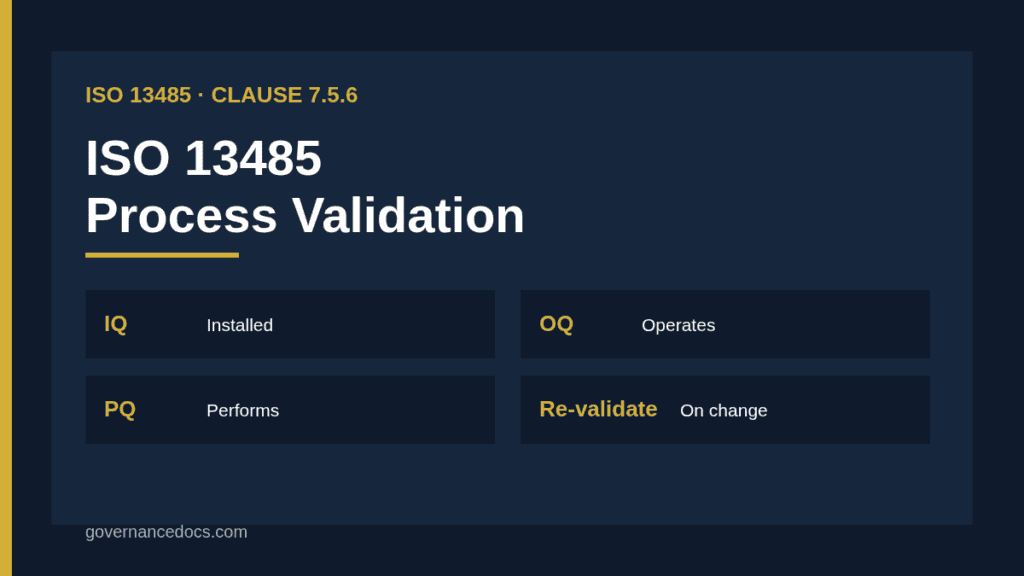
A workable sequence is: define the process and its requirements, assess risk, write a validation plan, perform installation, operational and performance qualification, review results and approve.
Each step has a record. The plan is approved before execution, and the report is approved after, both by people with the right authority.
This sequence is not copied from the standard word for word, but it is the widely used pattern that satisfies it.
Installation qualification
Installation qualification confirms that equipment is installed correctly and matches specifications. Records include equipment identification, utilities, calibration status and documentation checks.
For software controlled equipment, note version and configuration at installation. This feeds later change control.
Keep manuals and supplier documentation with the record, since auditors often ask for them. This is where a ISO 13485 process validation is won or lost.
Operational qualification
Operational qualification shows that the process works across its defined operating range. You challenge the upper and lower limits of parameters to find where output stays within specification.
Use designed experiments or structured tests, and define acceptance criteria in advance. Record the parameter windows you will use in production.
The outcome is a validated operating range, not a single magic setting.
Performance qualification
Performance qualification demonstrates that the process consistently produces conforming product under normal production conditions. It typically uses multiple consecutive runs or lots with real materials and trained operators.
Define the number of runs and the acceptance criteria in the plan. Many companies use three consecutive successful runs as a starting point, but the number must be justified by risk and variability.
Include inspection and test results for each run, along with any deviations and how they were resolved. Auditors judge your ISO 13485 process validation on exactly this point.
Stage
Purpose
Typical evidence
IQ
Equipment installed correctly
Installation checklist, calibration
OQ
Process works across its range
Parameter challenge results
PQ
Consistent output in production conditions
Multiple run results, acceptance data
Sample size
Confidence matches risk
Statistical rationale
Revalidation
Process stays validated
Trigger criteria, change records
Justifying sample sizes
The standard asks for statistical techniques with rationale for sample sizes where appropriate. Document why your sample size gives enough confidence for the risk of the failure mode.
Higher-risk failures need higher confidence and reliability levels. Many teams link confidence levels to the severity ratings in their risk file.
Explain the method plainly in the protocol, for example a confidence and reliability table or an operating characteristic curve.
Sterilization and sterile barrier systems
Clause 7.5.7 requires documented procedures for validation of sterilization and sterile barrier systems. Validate them before implementation and after changes, and keep records.
Sterilization methods follow specific standards, and sterile barrier packaging has its own validation expectations including seal strength and integrity.
Involve specialists early. These validations take months and often depend on third-party laboratories. Treat it as a standing rule for your ISO 13485 process validation.
Revalidation criteria
Define in advance what triggers revalidation: equipment relocation or major repair, changes in materials or suppliers, trends showing drift, process parameter changes and failures.
Some processes also need periodic revalidation, such as annual sterilization dose audits. Set intervals by risk.
Document change assessments even when you decide not to revalidate. The reasoning is the evidence.
Personnel qualification
The standard requires qualification of personnel who operate validated processes. Training records, competence assessments and supervised runs all count.
Operators who perform a critical step, such as sealing, should be listed with their qualification date and refresh interval.
Linking to design transfer and risk
Process validation is the bridge between design and production. Design outputs define the specifications, and validation proves the process can meet them consistently.
Risk management should identify process-related hazards, and validation provides the evidence that controls work. Read about how risk files link to production in ISO 13485 risk management.
A strong ISO 13485 process validation file ties these together.
Common mistakes
Typical mistakes are validating the wrong parameters, skipping operational qualification, using too few runs, ignoring supplier-provided processes and failing to define revalidation triggers.
Another is treating validation as a one-time project. Processes drift, equipment ages and materials change, so ongoing monitoring matters.
Outsourced processes are especially risky. Your supplier validates, but you remain responsible for confirming the evidence.
Outsourced processes
Clause 4.1.5 requires you to monitor and maintain control over outsourced processes. If a contractor performs a process that needs validation, review their protocol and report and keep a copy.
Include validation expectations in the supplier agreement. See the ISO 13485 purchasing guide for supplier controls.
Audit critical suppliers on site when risk justifies it.
US and EU context
The FDA Quality Management System Regulation, effective 2 February 2026, incorporates ISO 13485:2016, so clause 7.5.6 sits at the center of US expectations. See QMSR vs ISO 13485 for the comparison.
Notified bodies under EU MDR also review validation evidence during audits and technical documentation review.
A validation master plan, protocol and report template, equipment qualification forms and a revalidation log cover most needs. The ISO 13485 Toolkit includes templates you can adapt to your processes.
Start with the highest-risk process in your flow, then work down the list.
Use the gap analysis to see where validation evidence is missing.
A short example
A company seals pouches that hold a sterile device. Seal quality cannot be fully tested without destroying the pouch, so sealing is validated.
Installation qualification checks the sealer and its calibration. Operational qualification tests temperature, pressure and dwell time limits. Performance qualification runs three lots at the chosen settings with seal strength and integrity tests.
The report sets the validated window and the monitoring plan, and any later change to pouch material triggers a documented revalidation decision.
Monitoring validated processes
Validation is a snapshot. After release, monitor key parameters and output data to confirm the process stays in control, using trend charts or simple control limits.
Set alert limits inside the validated window, so you act before output goes out of specification. Record excursions and the actions taken.