CART
ISO 13485 purchasing is where a medical device manufacturer’s quality system meets everybody else’s. Clause 7.4 makes you responsible for what your suppliers do — their evaluation, the information you give them, and the verification of what arrives — and it scales all three to the risk the purchased product carries into the finished device.
This guide covers the three parts of clause 7.4, the written agreement that catches most organizations out, and how to make supplier controls proportionate without making them meaningless.
Free gap assessment
How much of ISO 13485 could you evidence today?
Score clauses 4 to 8, free, with the FDA QMSR and EU MDR duties kept separate so you can see what is the standard and what is the regulator.
Run the free ISO 13485 gap assessment → or View premium report sample
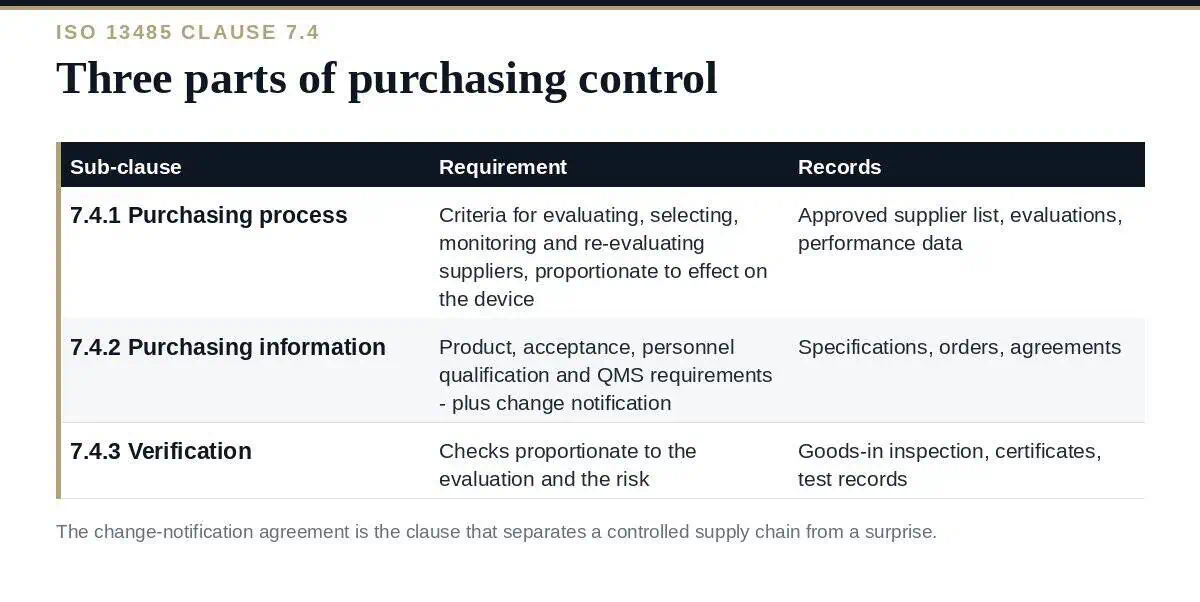
| Sub-clause | Requirement | Records it produces |
|---|---|---|
| 7.4.1 Purchasing process | Criteria for evaluating and selecting suppliers, monitoring and re-evaluating them, proportionate to the effect on the device | Approved supplier list, evaluation records, performance monitoring, re-evaluation |
| 7.4.2 Purchasing information | What you specify to the supplier — product, acceptance requirements, personnel qualification, quality system requirements | Specifications, drawings, purchase orders and the change-notification agreement |
| 7.4.3 Verification of purchased product | Checks that what arrived meets the specification, with extent based on the supplier evaluation and the risk | Goods-in inspection, certificates of analysis, test records, nonconformity records |
7.4.2 expects the purchasing information to include, so far as practicable, a written agreement that the supplier will notify you of changes to the purchased product before they are implemented. That single sentence is the difference between a controlled supply chain and a surprise.
Suppliers change resin grades, move a moulding tool to a second site, requalify a sub-supplier, or update firmware — all reasonable business decisions, none of which they will mention unless the contract says they must. For a device manufacturer, any of those can invalidate a validation, a biocompatibility position or a design verification. Get the notification clause into the agreement, and keep a record of the agreements you hold.
ISO 13485 purchasing scales the control to the effect of the purchased product on the medical device. In practice that means banding suppliers and applying a defined level of control to each band, rather than treating a sterile-barrier supplier and an office stationery vendor identically.
A workable three-band approach:
Write the banding criteria down and apply them consistently. The audit finding is almost never “your banding is wrong”; it is that no criteria exist and the bands were assigned by whoever set up the vendor record.
Where you outsource a process that affects product conformity — sterilization, contract manufacturing, some testing — the standard expects a quality agreement setting out the responsibilities of each party. Treat this as a distinct document rather than terms on a purchase order, because a regulator or notified body will ask which party is responsible for which control, and an inconsistent answer between you and your supplier is a finding on both sides.
ISO 13485 purchasing does not stand alone, and the connections are where audits go badly:
Our guides to ISO 13485 risk management and the mandatory documents cover those neighbours.
Does ISO 13485 require supplier audits?
It requires evaluation and selection criteria proportionate to the effect on the device. For critical suppliers an audit is usually the only credible evidence; for standard items it would be disproportionate.
What has to be in the purchasing information?
The product requirements, acceptance requirements, requirements for personnel qualification and for the supplier’s quality system where applicable — and, so far as practicable, the agreement that the supplier notifies you of changes before implementing them.
Can we accept certificates of conformity instead of testing?
Yes, where the supplier evaluation supports it and the risk is understood. The extent of verification follows the evaluation, so the justification has to exist somewhere.
Do we need a quality agreement with every supplier?
No — with those performing outsourced processes affecting conformity, and with critical suppliers where responsibilities need to be explicit. For standard items it is overhead.
How often should suppliers be re-evaluated?
On a defined cycle by band, and on trigger: a nonconformity, a change notification, a site move, or an ownership change.
Treat ISO 13485 purchasing as three linked obligations rather than an approved-vendor list. Band suppliers using criteria derived from device risk, write the change-notification agreement into the purchasing information for anything that could invalidate a validation, and set verification depth from the evaluation rather than from habit. Then connect the outputs — nonconformities into CAPA, lots into traceability, specifications back to the design file — because that is where a notified body will test whether the process is real.
Supplier evaluation records, quality agreements and goods-in templates are in the ISO 13485 Documentation Toolkit, or start with the free ISO templates.

October 14, 2026
October 13, 2026
October 12, 2026
October 12, 2026
October 12, 2026

