CART
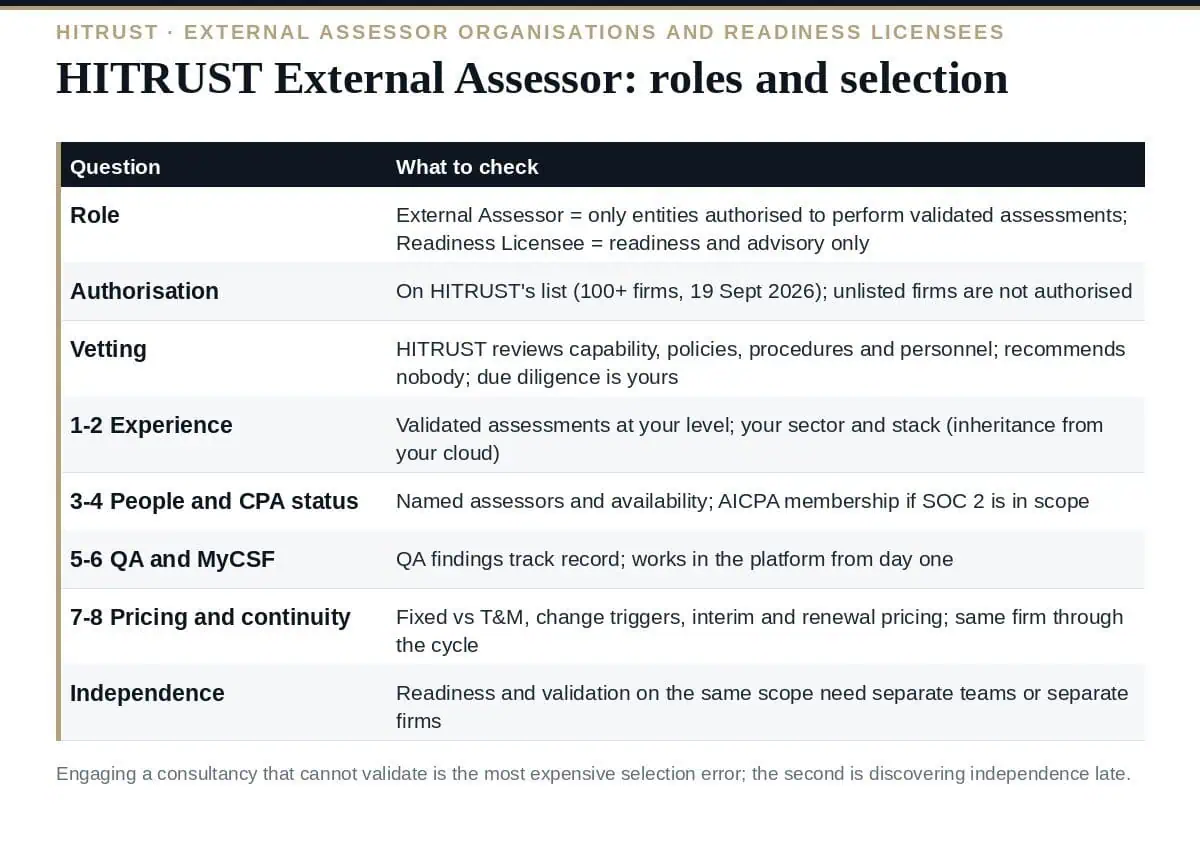
A HITRUST External Assessor is an organisation “formally approved and trained by HITRUST to conduct validated assessments” — and, in HITRUST’s own words, the External Assessor Organisations are “the only entities authorized to perform the validated assessments that are submitted to HITRUST for certification”. No CPA licence, ISO auditor registration or consultancy pedigree substitutes: a firm not on HITRUST’s list cannot produce a certification, and HITRUST is explicit that “organizations not listed are not authorized to conduct HITRUST readiness or assessment work”. Beside the assessors sit Readiness Licensees, licensed to use the CSF for gap assessments and advisory work but not to validate.
HITRUST vets both, publishes the list with filters for industry focus, assessor type and AICPA membership, and disclaims recommending any of them — the choice, and the due diligence, is the assessed entity’s. This guide sets out the two authorised roles and the line between them, what HITRUST’s vetting covers and does not, the eight questions that decide which assessor to engage, how the assessor relationship runs through MyCSF, the independence rule that stops one firm doing both readiness and validation on the same scope, and the five ways the choice goes wrong.
Free gap assessment
Could you evidence your HIPAA safeguards today?
Score every standard and implementation specification, free, including the addressable ones that still need a decision on file.
Run the free HIPAA gap assessment → or View premium report sample
| Role | HITRUST’s description | What they may do | What they may not do |
|---|---|---|---|
| External Assessor Organisation (EA) | Formally approved and trained by HITRUST to conduct validated assessments | Validated e1, i1 and r2 assessments, interim assessments and rapid recertifications, submitted to HITRUST through MyCSF for certification | Nothing else is restricted by the role, but independence rules apply to advisory work on the same scope |
| Readiness Licensee | Licensed and trained to use the HITRUST CSF for readiness assessments and advisory services | Gap assessments, remediation advice, preparation for certification | Validated assessments — a readiness licensee cannot certify |
Many firms hold both authorisations, and the list on HITRUST’s site — which ran to more than 100 organisations on 19 September 2026, from the Big Four and national CPA firms to specialist healthcare security consultancies and a hyperscaler’s assurance arm — can be filtered by assessor type. Our guide to HITRUST assessments covers the e1, i1 and r2 an assessor validates.
HITRUST’s disclaimer describes the process: each EA Organisation “has completed a vetting process that requires each EA Organization to demonstrate the capability of performing a HITRUST assessment”, including “reviewing policies and procedures and the background of the individuals performing the assessments”, with HITRUST working to keep the list current and to ensure assessors “continue to meet HITRUST standards year over year”. It then draws the line: HITRUST “cannot guarantee that any EA Organization will be successful”, “does not recommend specific EA Organizations”, and it is “the responsibility of the Assessed Entity to perform its own due diligence”. The vetting establishes capability; it does not establish fit for your scope, sector or timeline.
A firm that performs a readiness assessment and remediation advice on a scope, and then validates the same scope, is assessing its own work. HITRUST’s assurance programme requires External Assessors to maintain independence from the assessed entity, and assessors manage the conflict by separating readiness and validation teams or by declining one of the two roles for a client. For the assessed entity the practical rule is to decide early: use a Readiness Licensee or the assessor’s separate advisory team for the gap assessment, and keep the validating team independent of the remediation. Our guide to HITRUST certification cost shows readiness and validation as separate lines for this reason.
| Stage | Assessor’s role | Where |
|---|---|---|
| Scoping and tailoring | Advises on scope and, for r2, on the tailoring factors so the requirement set is defensible | MyCSF |
| Self-assessment review | Reviews the organisation’s maturity scores and evidence before fieldwork | MyCSF |
| Validation fieldwork | Tests each requirement — document review, interviews, sampling, technical verification — and records its own scores | MyCSF and on site or remote |
| Corrective action plans | Agrees CAPs for gaps within tolerance | MyCSF |
| Submission | Submits the validated assessment to HITRUST for quality assurance and responds to QA queries | MyCSF |
| Interim / rapid recertification | Performs the year-two engagement | MyCSF |
Our guide to MyCSF covers the platform; the assessor’s fluency in it is part of the selection.
What is a HITRUST External Assessor?
An organisation formally approved and trained by HITRUST to conduct validated assessments — the only entities authorised to perform the validated assessments submitted to HITRUST for certification. Readiness Licensees are separately licensed for readiness and advisory work and cannot certify.
Can any audit firm do a HITRUST assessment?
No. Only firms on HITRUST’s published list are authorised; HITRUST states that organisations not listed are not authorised to conduct readiness or assessment work.
Does HITRUST recommend an assessor?
No. HITRUST vets each firm’s capability, policies and personnel but states it does not recommend specific organisations and that due diligence is the assessed entity’s responsibility.
Can the same firm do readiness and validation?
Only with independence between the teams; assessing one’s own remediation is a conflict, and many firms decline one role per client.
How do I find one?
HITRUST’s list, filterable by industry focus, assessor type and AICPA membership, with a form to request introductions to up to five firms.
Choose the HITRUST External Assessor by evidence, not by the list alone: validated assessments at your level, sector and inheritance experience, the named individuals, MyCSF fluency, QA track record, pricing through the interim and renewal — and settle the readiness-versus-validation independence before either starts. The authorisation is HITRUST’s; the fit is yours to establish.
The Assurance Program Guide, the Validated Assessment Readiness and Preparation Guide, the Internal Assessment Plan and Report, the Third-Party Assurance Policy and the Control RACI Master are in the HITRUST CSF v11 Toolkit, or start with the free templates.

October 11, 2026
October 11, 2026
October 11, 2026
October 11, 2026
October 11, 2026

