CART
HITRUST certification cost is decided before a single control is tested, by one choice: e1, i1 or r2. The e1 is 43 foundational controls, valid for a year, and HITRUST says organisations complete it in as little as a few weeks with an average of around 30 days; the i1 is 182 curated controls, valid for a year with a rapid recertification on roughly 60 core controls in year two, and typically takes six to twelve months; the r2 is tailored from a risk questionnaire — commonly several hundred requirements — valid for two years with an interim assessment after the first.
Every level carries the same three invoices: HITRUST’s own fees for the MyCSF platform and the assessment, the authorised External Assessor’s fees, and the internal cost of evidence and remediation. None of the three is published as a tariff, so this guide builds the HITRUST certification cost from the assessment structure HITRUST does publish, gives labelled typical ranges for each line and level, sets out the multi-year arithmetic that makes an r2 cheaper than it looks, and names the four places these budgets overrun.
Free gap assessment
Could you evidence your HIPAA safeguards today?
Score every standard and implementation specification, free, including the addressable ones that still need a decision on file.
Run the free HIPAA gap assessment → or View premium report sample
| Assessment | Scale (HITRUST) | Validity | Timeline (HITRUST) | Who it fits |
|---|---|---|---|---|
| e1 | 43 essential controls; foundational cybersecurity | One year, renewed annually | As few as 4–6 weeks; average around 30 days | Start-ups, small businesses, lower-risk profiles, vendors asked for assurance quickly |
| i1 | 182 curated, threat-adaptive controls | One year; rapid recertification in year two on approximately 60 core controls | Most complete in 6–12 months | Mid-market vendors whose customers want validated leading practice; a step toward r2 |
| r2 | Tailored to risk profile, systems and regulatory scope; commonly several hundred requirement statements | Two years, with an interim assessment after year one | Set by scoping and readiness; typically the longest | Organisations handling sensitive data at scale, regulated industries, contractual r2 requirements |
The scale column is the cost driver: every requirement statement is evidenced, scored on HITRUST’s maturity levels and tested by the assessor, so the invoice scales with the count. Our guide to HITRUST assessments covers choosing between them; our guide to HITRUST scoring covers why a control you run but never measure still costs points and remediation money.
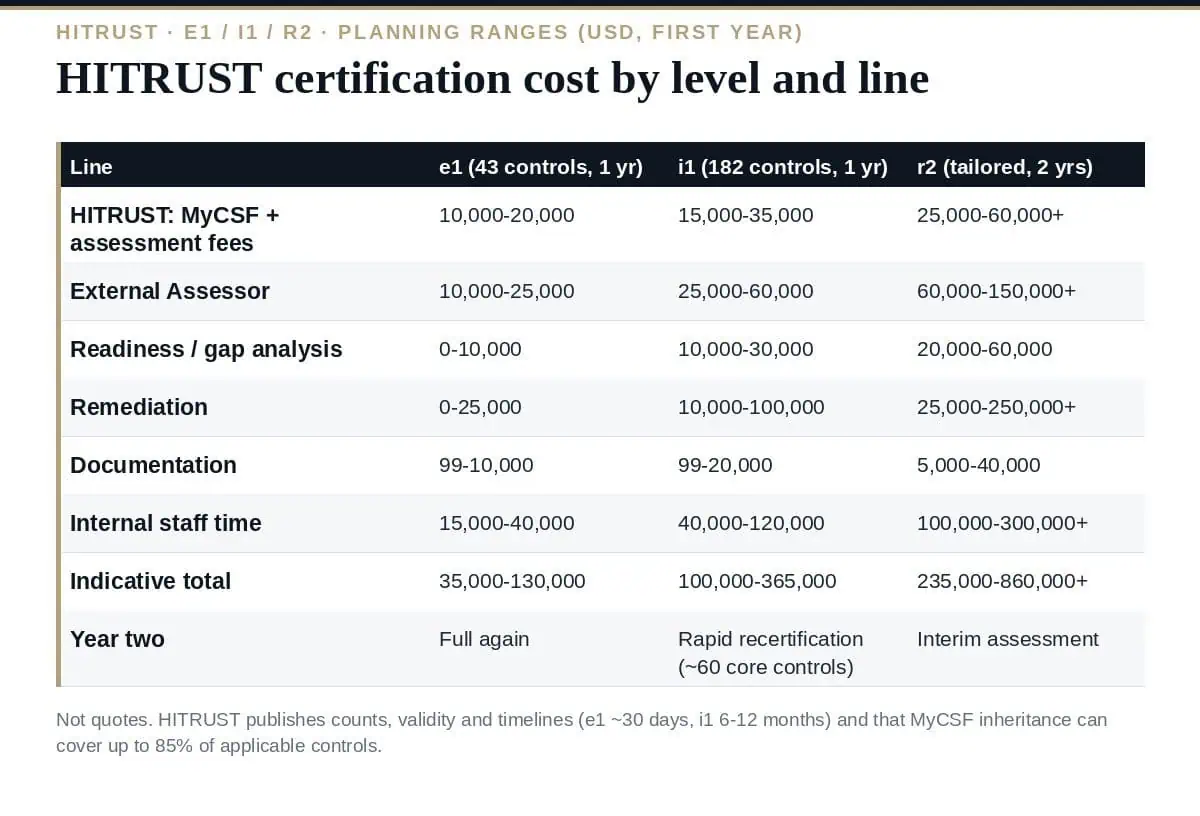
| Cost line | e1 (typical 2026 range, USD) | i1 | r2 | Notes |
|---|---|---|---|---|
| MyCSF subscription and HITRUST assessment fees | $10,000 to $20,000 | $15,000 to $35,000 | $25,000 to $60,000+ | Paid to HITRUST for the platform, the assessment object and quality assurance; quoted per organisation |
| External Assessor fees | $10,000 to $25,000 | $25,000 to $60,000 | $60,000 to $150,000+ | Validated assessment by an authorised External Assessor Organisation; scales with requirement count and scope |
| Readiness assessment or gap analysis | $0 to $10,000 | $10,000 to $30,000 | $20,000 to $60,000 | Optional; by a Readiness Licensee or the assessor’s advisory arm |
| Remediation | $0 to $25,000 | $10,000 to $100,000 | $25,000 to $250,000+ | The widest item; depends on maturity at start |
| Documentation: policies, procedures, registers | $99 to $10,000 | $99 to $20,000 | $5,000 to $40,000 | Template toolkit against consultant-written; Policy and Procedure maturity levels are scored |
| Internal staff time | $15,000 to $40,000 equivalent | $40,000 to $120,000 | $100,000 to $300,000+ | Evidence collection per requirement, MyCSF administration, assessor liaison |
| Indicative first-year total | $35,000 to $130,000 | $100,000 to $365,000 | $235,000 to $860,000+ | Planning ranges, not quotes |
These HITRUST certification cost figures are labelled typical ranges from published assessor estimates and project experience; HITRUST prices MyCSF and assessments per organisation and assessors quote per scope. The one figure HITRUST does publish is the mechanism that cuts every line: MyCSF’s control inheritance lets an organisation inherit “up to 85% of applicable controls” from certified service providers, which is why a SaaS company on a HITRUST-certified cloud pays materially less than one on its own infrastructure.
| Level | Year 1 | Year 2 | Year 3 | Three-year shape |
|---|---|---|---|---|
| e1 | Full validated assessment | Full validated assessment | Full validated assessment | Flat; cheapest per year, no carry-over |
| i1 | Full validated assessment (182 controls) | Rapid recertification (~60 core controls) | Full validated assessment | Alternating; the year-two saving is real |
| r2 | Full validated assessment (tailored) | Interim assessment | Full validated assessment | Front-loaded; the interim is a fraction of the full cost, so the two-year certificate spreads the entry cost |
Read across a three-year horizon, an r2’s higher entry cost is offset by the second year being an interim rather than a full assessment; an i1 alternates full and rapid; an e1 repeats in full annually. Which is cheapest depends on the count, the inheritance available and how long the customer will accept the level. Our guide to the HITRUST interim assessment covers what year two of an r2 involves.
How much does HITRUST certification cost?
It depends on the assessment: an e1 (43 controls) typically $35,000 to $130,000 in the first year all-in; an i1 (182 controls) $100,000 to $365,000; an r2 (tailored, commonly several hundred requirements) $235,000 to $860,000 or more — each split across HITRUST’s MyCSF and assessment fees, the External Assessor, remediation and internal time. HITRUST and assessors quote per organisation; these are planning ranges.
Does HITRUST publish its fees?
No tariff; MyCSF subscriptions and assessment fees are quoted. HITRUST does publish the control counts, validity periods and typical timelines, and that inheritance can cover up to 85% of applicable controls.
Which is cheapest over three years?
It depends on inheritance and customer requirements: e1 repeats in full annually; i1 alternates a full assessment with a rapid recertification on about 60 core controls; r2 spreads a higher entry cost over a two-year certificate with an interim assessment in year two.
How long does each take?
HITRUST states e1 in as few as 4–6 weeks (average around 30 days), i1 in 6–12 months for most organisations, and r2 by scope and readiness.
Can we do it without an External Assessor?
Not for certification: only authorised External Assessor Organisations may perform the validated assessments submitted to HITRUST.
Budget HITRUST certification cost from the level the customer named, in three invoices — HITRUST, the assessor, and your own people — and cut it with inheritance, tight r2 scoping and a maturity model that measures something. Then run the arithmetic over three years, not one, because the renewal pattern changes which level is actually cheapest.
The MyCSF and Assessment Approach Guide, the Scoping Guide and Authoritative Sources Mapping, the Validated Assessment Readiness and Preparation Guide, the PRISMA Maturity Scoring Guide and nineteen policy templates are in the HITRUST CSF v11 Toolkit, or start with the free templates.

October 11, 2026
October 11, 2026

October 11, 2026
October 11, 2026
October 11, 2026

