CART
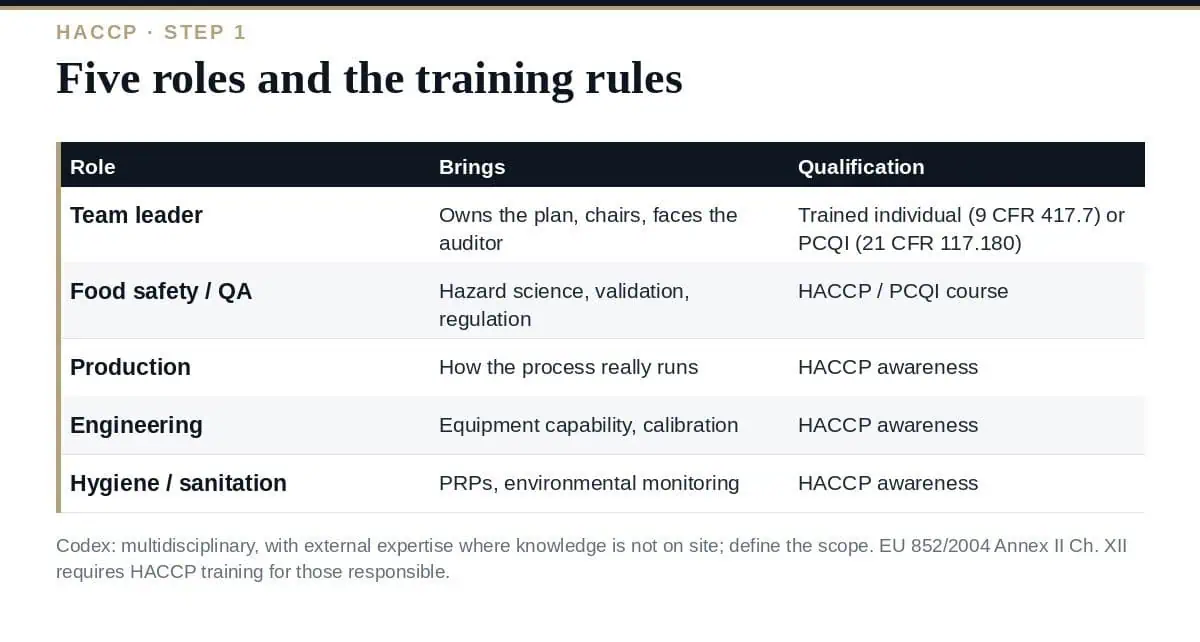
The HACCP team is step 1 of the twelve Codex steps for a reason: the hazard analysis, the CCP decisions and the critical limits are only as good as the people who made them, and an auditor who doubts the team will doubt the plan. Codex asks for a multidisciplinary team with the product- and process-specific knowledge to do the work, and for expert advice from outside where that knowledge is not on site; the 2020 revision added defining the scope of the HACCP system to the same step. The regulations turn “competent” into requirements: 9 CFR 417.7 names who may develop and reassess a meat or poultry plan, 21 CFR 117.180 names the preventive controls qualified individual, the seafood and juice rules have their own trained-individual clauses, and EU Regulation 852/2004 requires HACCP training for those responsible for the procedures. This guide sets out the five roles a working team covers, who must hold which qualification, how a small business assembles a team it cannot staff, what the team’s terms of reference and records look like, and the errors — the team of one, the team that never meets — that auditors find first.
Free gap assessment
Would your HACCP plan survive an inspection?
Score the whole of the Codex text, free - the good hygiene practices as well as the seven principles, with the US and EU overlays on top.
Run the free HACCP gap assessment → or View premium report sample
| Source | Requirement | Practical meaning |
|---|---|---|
| Codex CXC 1-1969, HACCP step 1 | Assemble a multidisciplinary team with appropriate product-specific knowledge and expertise; obtain expert advice from other sources where it is not available on site; define the scope of the HACCP system | A team, not a person; documented scope; external help is expected, not a weakness |
| 9 CFR 417.7 (FSIS) | Only an individual who has ‘successfully completed a course of instruction in the application of the seven HACCP principles’ may develop the plan or reassess and modify it; that individual ‘need not be an employee’ | A trained plan developer on the team — employee or consultant |
| 9 CFR 417.2(d) | The plan is signed and dated by the responsible establishment individual on acceptance, modification and annual reassessment | Named accountability above the team |
| 21 CFR 117.126 and 117.180 (FDA, Part 117) | The food safety plan is prepared, or its preparation overseen, by one or more preventive controls qualified individuals, who also oversee validation, records review and reanalysis | A PCQI on or over the team |
| 21 CFR 123.10 (seafood) and 120.13 (juice) | Hazard analysis and plan development by an individual trained under an FDA-recognized curriculum or qualified through experience | A trained individual for those products |
| EU Regulation 852/2004, Annex II Chapter XII | Those responsible for developing and maintaining the HACCP-based procedure receive adequate training in HACCP application | Evidenced training for the team, not just the leader |
| Role | What they bring | Typical holder | Qualification |
|---|---|---|---|
| Team leader | Owns the plan, chairs the team, controls the documents, presents to auditors and inspectors | QA or technical manager | The trained individual (9 CFR 417.7) or PCQI (Part 117) in most plants; HACCP course at minimum |
| Food safety / quality | Hazard knowledge, microbiology, allergen and chemical hazards, validation science, regulatory requirements | QA manager, microbiologist, external food safety specialist | HACCP and PCQI training; scientific background |
| Production and process | How the process actually runs — flow, timings, batch sizes, what happens on nights and at changeovers | Production manager, line supervisor | HACCP awareness; product knowledge |
| Engineering and maintenance | Equipment capability, instrumentation, calibration, what the oven, chiller or detector can and cannot do | Engineering manager, maintenance lead | HACCP awareness; instrument and calibration competence |
| Hygiene and sanitation | Cleaning, environmental monitoring, pest control, PRPs — the base the plan sits on | Hygiene manager, sanitation supervisor | HACCP awareness; sanitation training |
| Procurement and supply (often added) | Supplier controls, ingredient and packaging hazards, specifications | Purchasing manager | HACCP awareness |
The roles matter more than the headcount: in a small plant one person may cover two, and a consultant may cover the food-safety role, but a team without the production and engineering voices produces a plan that describes a process the floor does not run and limits the equipment cannot hold. Our guide to the HACCP plan in 12 Codex steps covers what the team then does.
| Element | What to document | Why the auditor asks |
|---|---|---|
| Scope | Products, process lines, hazards covered, where the plan starts and ends | Codex step 1 (2020); the hazard analysis is bounded by it |
| Membership and roles | Names, roles, the trained individual or PCQI identified | 9 CFR 417.7 and 21 CFR 117.180 name qualifications; the auditor matches them to people |
| Competence and training records | Course certificates, awareness training, dates; a competence matrix against the roles | EU 852/2004 Annex II Ch. XII; 21 CFR 117.190(a)(6) requires PCQI training records |
| Meeting schedule and minutes | Plan development sessions; review meetings; decisions and actions | Evidence the team exists between audits |
| Review triggers | New product, process or equipment change, supplier change, deviation pattern, complaint, recall, new hazard information, regulatory change | 9 CFR 417.4(a)(3) reassessment at least annually and on change; 21 CFR 117.170 reanalysis every 3 years and on trigger |
| Sign-off | The responsible individual’s signature and date on the plan and each reassessment | 9 CFR 417.2(d) |
Our guide to the HACCP hazard analysis covers the first thing the assembled team produces, and food safety culture covers why the team’s standing in the plant matters as much as its composition.
Who should be on the HACCP team?
A multidisciplinary group covering the plan’s ownership, food safety and hazard science, production, engineering and maintenance, and hygiene and sanitation — with procurement where supplier hazards matter, and external expertise where the knowledge is not on site. Codex step 1 asks for exactly this.
Does the HACCP team leader need a qualification?
Under 9 CFR 417.7 the person who develops or reassesses a meat, poultry or egg products plan must have completed a course in applying the seven HACCP principles; under 21 CFR 117 a preventive controls qualified individual must prepare or oversee the plan. Seafood and juice rules have equivalent clauses; the EU requires HACCP training for those responsible.
Can a consultant be the HACCP team?
A consultant can be the trained individual — 9 CFR 417.7 says the person need not be an employee — and can supply the hazard science, but the establishment owns the plan, signs it, runs the monitoring and must be able to explain it. A plan nobody in the plant understands fails on that alone.
How often should the HACCP team meet?
Whenever a review trigger occurs and at a scheduled minimum — quarterly is common — with the plan reassessed at least annually under 9 CFR 417.4 and reanalysed at least every three years under 21 CFR 117.170. Minutes are the evidence the team is real.
Is the HACCP team the same as the ISO 22000 food safety team?
The same idea under a different name: ISO 22000:2018 requires a food safety team and a food safety team leader with defined responsibilities. A HACCP team with terms of reference and records satisfies both.
Build the HACCP team as five roles with one trained owner: name the leader and get them the course the regulation tests for, cover production, engineering, hygiene and food safety with the people who actually do the work, buy the science you lack, write the terms of reference, and keep minutes and training records — because the plan is assessed as the work of a team, and the auditor checks that the team exists.
The HACCP Manual — Management Responsibility, the HACCP Policy Statement, the HACCP Training Records and the HACCP Audit Checklist that document the team, its competence and its reviews are in the HACCP Toolkit, or start with the free templates.

October 11, 2026
October 11, 2026
October 11, 2026
October 11, 2026
October 11, 2026

