CART
C-TPAT — the Customs Trade Partnership Against Terrorism, which U.S. Customs and Border Protection now writes CTPAT — is a voluntary supply chain security partnership launched in November 2001 that today counts, in CBP’s words, “more than 11,400 certified partners spanning the gamut of the trade community”. Members commit to meeting CBP’s Minimum Security Criteria (MSC) for their category, document how they do so in a security profile, and submit to validation by a CBP Supply Chain Security Specialist; in return they receive border benefits that range from fewer examinations and front-of-line inspections to access to FAST lanes and business-resumption priority after a disruption. There is no fee to join. This guide explains who is eligible, how the Minimum Security Criteria are organised — three focus areas, twelve categories and, for U.S. importers, 93 criteria marked Must or Should — what the security profile and validation involve, what the benefits are worth, how C-TPAT relates to AEO and ISO 28000, and where applicants fail.
| Category | Eligibility highlights (CBP) |
|---|---|
| U.S. importers and exporters | Active U.S. importer or non-resident Canadian importer (imported within the past 12 months); active importer-of-record number; valid continuous import bond; business office staffed in the U.S. or Canada; no unresolved debt to CBP |
| Highway carriers | U.S./Canada and U.S./Mexico cross-border carriers |
| Rail and sea carriers | Carriers moving cargo into the U.S. |
| Licensed U.S. customs brokers | Active licence |
| Marine port authority and terminal operators | U.S. ports and terminals |
| Consolidators, NVOCCs, ocean transportation intermediaries | Air freight consolidators and ocean intermediaries |
| Foreign manufacturers | Mexican and Canadian manufacturers; other countries through CBP’s foreign-manufacturer arrangements |
Eligibility is by category with a U.S. nexus. An operator outside these categories — a European warehouse with no U.S. trade, for example — cannot join, and reaches equivalent treatment through its own customs programme and mutual recognition; our guide to the Authorised Economic Operator covers that route. Each application is considered individually, and CBP states that issues of concern may make an applicant ineligible.
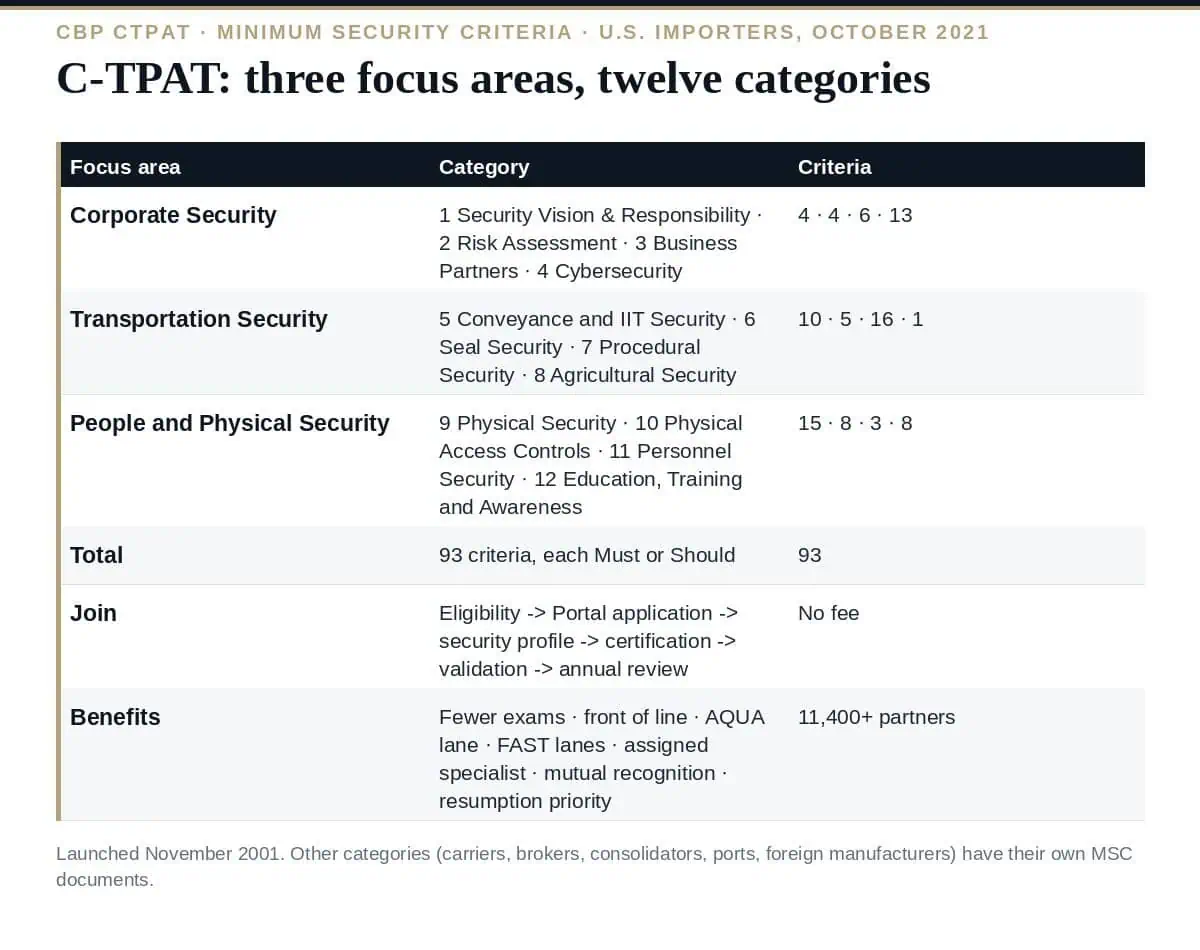
| Focus area | Category | What it covers | Criteria (U.S. importers, Oct 2021) |
|---|---|---|---|
| Corporate Security | 1 Security Vision & Responsibility | Statement of support, cross-functional security team, written review component, knowledgeable point of contact | 4 |
| Corporate Security | 2 Risk Assessment | Overall risk assessment of the supply chain; mapping cargo movement; annual review or more often as risk factors dictate | 4 |
| Corporate Security | 3 Business Partners | Written, risk-based screening of new partners and monitoring of current ones; account for partners’ CTPAT or AEO status | 6 |
| Corporate Security | 4 Cybersecurity | Policies and procedures; software and hardware defences; detection of unauthorised access; annual review; training | 13 |
| Transportation Security | 5 Conveyance and Instruments of International Traffic | Secure storage; inspection procedures; hardware to withstand tampering | 10 |
| Transportation Security | 6 Seal Security | High-security seals meeting the current ISO 17712 standard; seal inventories and audits; seal verification | 5 |
| Transportation Security | 7 Procedural Security | Cargo staging and inspection; documentation controls; incident reporting procedures with escalation | 16 |
| Transportation Security | 8 Agricultural Security | Pest contamination prevention in conveyances and cargo | 1 |
| People and Physical Security | 9 Physical Security | Barriers and deterrents; manned or monitored gates; lighting, alarms, CCTV | 15 |
| People and Physical Security | 10 Physical Access Controls | Photo ID for visitors, vendors and service providers; logs; badge control | 8 |
| People and Physical Security | 11 Personnel Security | Screening and background checks appropriate to position | 3 |
| People and Physical Security | 12 Education, Training and Awareness | Security and cybersecurity training by role; training for inspectors of empty conveyances | 8 |
Ninety-three criteria in the October 2021 U.S. importer document, each marked Must — required — or Should — expected practice that CBP encourages and will discuss at validation; by our count of that document roughly a third are Must. Criteria ID numbers are not sequential because IDs not applicable to importers are omitted. Other categories have their own MSC documents with the same structure. The criteria are written as outcomes with implementation guidance rather than as a control catalogue, which is why a management-system approach fits them; our guide to ISO 28000 vs C-TPAT maps the two.
| Benefit (CBP list) | What it means operationally |
|---|---|
| Reduced number of CBP examinations; possible exemption from stratified exams | Lower demurrage, faster release, fewer supply interruptions |
| Front-of-line inspections | When examined, examined first |
| Advanced Qualified Unlading Approval (AQUA) lane; shorter border wait times | Time at ports and land borders |
| Access to FAST lanes at land borders | Dedicated lanes for eligible highway carriers and importers |
| Assigned Supply Chain Security Specialist | A named CBP contact |
| Mutual recognition with foreign customs administrations | Treatment as a trusted trader in partner programmes such as the EU’s AEO |
| Business resumption priority after a natural disaster or terrorist attack | Your cargo moves first when ports reopen |
| Eligibility for other programmes | Trade Compliance Program; priority at Centers of Excellence and Expertise; FDA Secure Supply Chain pilot |
What is C-TPAT?
The Customs Trade Partnership Against Terrorism (CTPAT), a voluntary U.S. Customs and Border Protection programme launched in November 2001 in which eligible trade companies meet CBP’s Minimum Security Criteria, document a security profile, undergo validation and receive border benefits. CBP reports more than 11,400 certified partners.
Does it cost anything to join?
No. CBP states participation is voluntary and there are no costs associated with joining. The cost is meeting the criteria and preparing for validation.
How many criteria are there?
For U.S. importers, 93 in the October 2021 Minimum Security Criteria, in twelve categories across three focus areas, each marked Must or Should. Other categories have their own MSC documents.
Is C-TPAT a certification?
CBP uses the term certified partner, but it is a programme membership validated by CBP rather than a third-party certificate. ISO 28000 is the certifiable standard that covers the same ground.
How does it relate to AEO?
Both implement the World Customs Organization SAFE Framework. CBP has mutual recognition arrangements with partner customs administrations, so an AEO in a partner jurisdiction receives comparable treatment and vice versa.
Treat C-TPAT as a security management exercise with a customs audience: map the chain, assess the risk, screen the partners, run the seal and access programmes, train by role, and write the profile from what the validator will see. Members that build the criteria into a management system keep the benefits through every annual review; members that wrote a profile once lose them at validation.
The security risk assessment, business partner screening procedure, seal control procedure, access control and visitor procedures, training records and the C-TPAT/AEO cross-mapping are in the ISO 28000 Supply Chain Security Toolkit, or start with the free templates.

October 11, 2026
October 11, 2026
October 11, 2026
October 11, 2026

October 11, 2026

