CART
ISO 28000 vs C-TPAT is a comparison between two things that are usually mistaken for alternatives and are in fact different kinds of instrument. ISO 28000:2022 is a certifiable management system standard — “Security and resilience — Security management systems — Requirements” — that any organisation can implement and have audited by an accredited certification body anywhere in the world. C-TPAT (CBP now writes CTPAT, the Customs Trade Partnership Against Terrorism) is a voluntary U.S.
Customs and Border Protection partnership programme, open only to eligible categories of the trade community — importers, carriers, brokers, consolidators, port and terminal operators, and Mexican and Canadian manufacturers — that validates a member’s supply chain security profile against CBP’s Minimum Security Criteria in exchange for border benefits. One is a standard with a certificate; the other is a customs programme with a membership. This guide sets out the four differences that decide which you need, compares the two documents clause by criterion, explains where they overlap and reinforce each other, and shows how a logistics operator uses ISO 28000 as the system that produces the C-TPAT evidence.
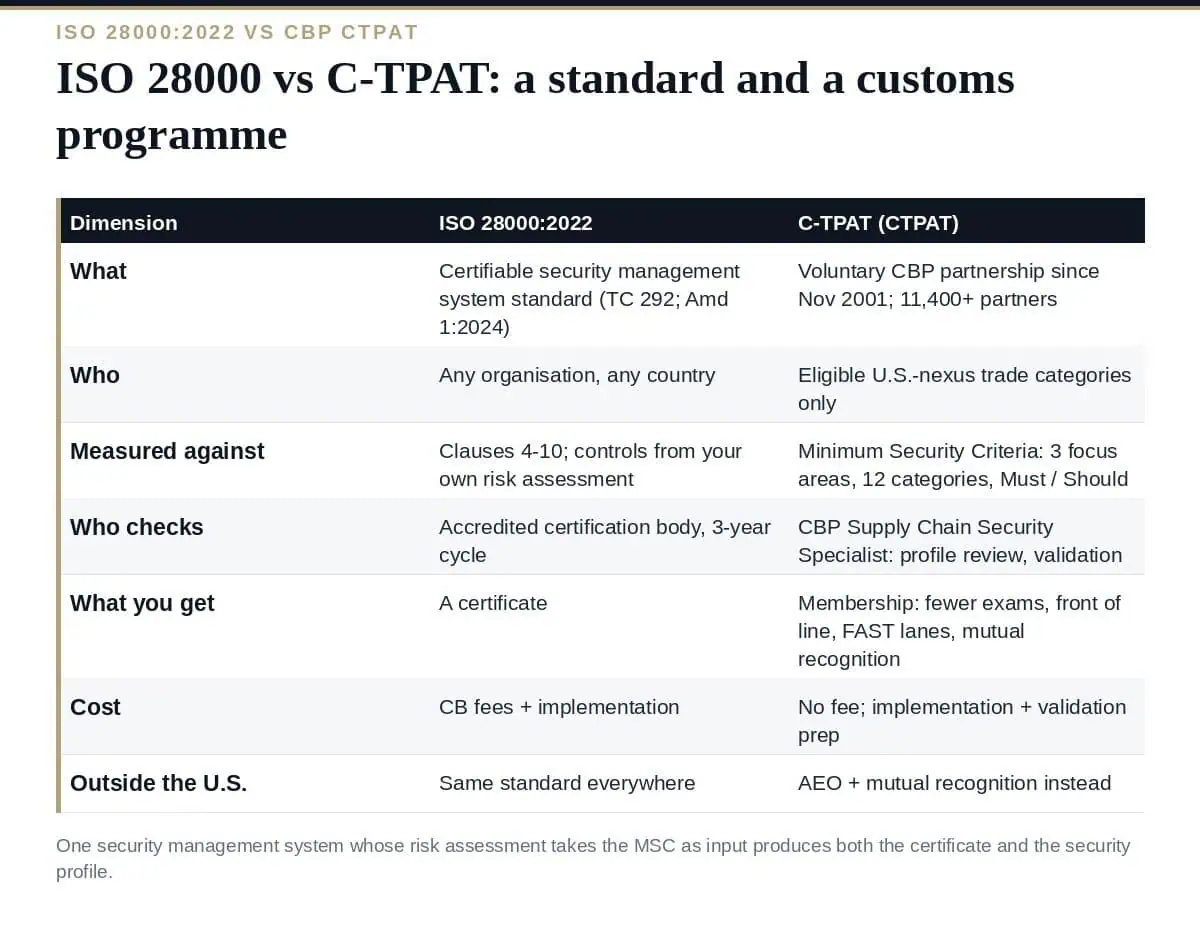
| Dimension | ISO 28000:2022 | C-TPAT (CTPAT) |
|---|---|---|
| What it is | International management system standard; second edition March 2022; ISO/TC 292; Amd 1:2024 (climate change) | Voluntary CBP supply chain security partnership, launched November 2001 |
| Who can use it | Any organisation, any sector, any country — the abstract calls it “a holistic and common approach”, “not industry or sector specific” | Eligible categories: U.S. importers and exporters, U.S./Canada and U.S./Mexico highway carriers, rail and sea carriers, licensed customs brokers, marine port and terminal operators, consolidators, NVOCCs, Mexican and Canadian manufacturers |
| What you are measured against | Clauses 4–10 of the standard; controls determined by your own risk assessment (8.3, 8.4) | CBP’s Minimum Security Criteria (MSC) for your category — for U.S. importers, the October 2021 MSC: 12 categories in three focus areas, criteria marked Must or Should |
| Who checks | An accredited certification body: stage 1, stage 2, annual surveillance, three-year cycle | CBP Supply Chain Security Specialists: security profile review, then validation visits |
| What you get | A certificate | Membership and tiered benefits: fewer examinations, front-of-line inspections, FAST lanes, an assigned specialist, mutual recognition with partner customs administrations |
| Cost | Certification body fees plus implementation | No fee to join; implementation and validation preparation |
| Scope of security | Any security risk the organisation faces — the 2022 edition widened it beyond the supply chain | Supply chain security against terrorism and criminal exploitation of cargo |
| Topic | ISO 28000:2022 clause | C-TPAT importer MSC category | Shared evidence |
|---|---|---|---|
| Management commitment and policy | 5.1 Leadership; 5.2 Security policy | 1 Security Vision & Responsibility | Signed policy or statement of support; named security owner |
| Risk assessment | 8.3 Risk assessment and treatment | 2 Risk Assessment | Documented risk assessment of the supply chain, reviewed annually and on change |
| Business partners and suppliers | 4.2 Interested parties; 8.1 outsourced processes | 3 Business Partners | Partner screening, security requirements in contracts, monitoring |
| Cybersecurity | 8.4 Controls (as determined) | 4 Cybersecurity | Policies, access, patching, incident response — 13 importer criteria |
| Conveyance, seals and cargo handling | 8.4 Controls; 8.5 procedures; 8.6 plans | 5 Conveyance and IIT Security; 6 Seal Security; 7 Procedural Security | Inspection checklists, seal procedures (ISO 17712 high-security seals), documentation controls |
| Physical security and access | 8.4 Controls | 9 Physical Security; 10 Physical Access Controls | Perimeter, lighting, alarms, visitor and badge controls |
| People | 7.2 Competence; 7.3 Awareness | 11 Personnel Security; 12 Education, Training and Awareness | Screening, training records, awareness programme |
| Performance and improvement | 9.1–9.3; 10 | Annual security profile review; validation findings | Audit results, corrective actions, management review |
The overlap is the practical answer to ISO 28000 vs C-TPAT, and it settles most ISO 28000 vs C-TPAT debates inside a logistics business: an ISO 28000 system whose risk assessment takes the MSC as an input produces the C-TPAT security profile as an output, and a C-TPAT member that wants a certificate for non-U.S. customers has most of clause 8 already evidenced. ISO 28001:2007, still published, was written to align a security management system with customs programmes of exactly this kind. Our guide to ISO 28000:2022 covers the clauses; our C-TPAT guide covers the criteria.
| Situation | Choose | Why |
|---|---|---|
| U.S. importer with inbound ocean freight; customers do not ask for a certificate | C-TPAT | Border benefits pay for the work; no fee to join |
| Freight forwarder or 3PL in Europe, Asia or the Middle East serving multinationals | ISO 28000 | Certifiable anywhere; recognised through accreditation; tender requirement |
| Mexican or Canadian manufacturer shipping to the U.S. | C-TPAT, with ISO 28000 where non-U.S. customers require it | Eligible category; FAST lanes and reduced examinations |
| Port or terminal operator with U.S. and international customers | Both, on one system | ISO 28000 clause 8 produces the MSC evidence; one risk assessment serves both |
| Organisation with security risks beyond cargo — sites, people, operations | ISO 28000 | The 2022 edition is a general security management system standard |
| EU-based operator asked about C-TPAT | AEO, then mutual recognition | C-TPAT is not open to it; AEO is recognised by CBP under the EU–U.S. arrangement |
Is C-TPAT the same as ISO 28000?
No. ISO 28000:2022 is a certifiable international management system standard for security management; C-TPAT is a voluntary U.S. Customs and Border Protection partnership programme for eligible trade categories, validated against CBP’s Minimum Security Criteria. One produces a certificate, the other a membership with border benefits.
Can an ISO 28000 certificate replace C-TPAT membership?
No. C-TPAT benefits — reduced examinations, FAST lanes, front-of-line inspections — come only with membership. An ISO 28000 system makes the C-TPAT security profile far easier to complete and validate.
Does C-TPAT accept ISO 28000 as evidence?
The security profile is written against the MSC, and ISO 28000 records — risk assessment, controls, procedures, training — are the evidence behind many criteria. CBP validates against its criteria, not against the certificate.
Which is cheaper?
C-TPAT has no membership fee; ISO 28000 carries certification body fees across a three-year cycle. Implementation cost is similar because the controls overlap; our ISO 28000 certification cost guide gives ranges.
What about AEO?
The Authorised Economic Operator programme is the World Customs Organization SAFE Framework’s equivalent of C-TPAT in the EU and other jurisdictions. CBP and the EU recognise each other’s programmes, which is how a European AEO obtains C-TPAT-equivalent treatment.
Settle ISO 28000 vs C-TPAT by asking who wants the assurance. A customs administration wants C-TPAT or AEO; a customer or tender wants ISO 28000; a port, carrier or manufacturer serving both wants one security management system whose risk assessment takes the Minimum Security Criteria as input, so that the certificate and the membership are two outputs of the same work.
The Security Management System Manual and Policy, the supply chain security risk assessment, the access, cargo and seal control procedures and the C-TPAT/AEO cross-mapping are in the ISO 28000 Supply Chain Security Toolkit, or start with the free templates.

October 12, 2026
October 12, 2026

October 12, 2026

October 12, 2026
October 12, 2026

