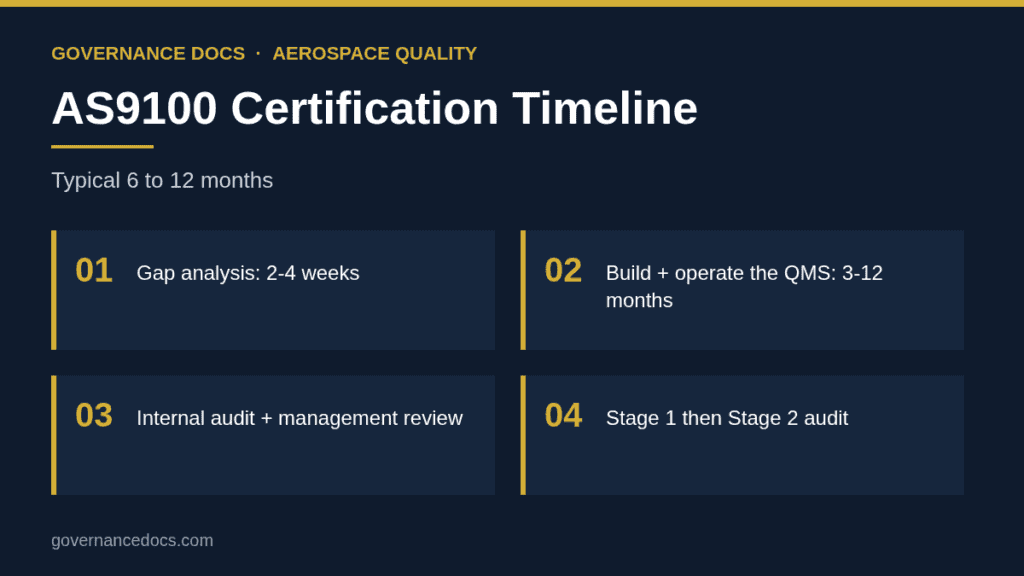
The AS9100 certification timeline for most small and mid-sized aerospace suppliers runs somewhere between six and twelve months from kickoff to certificate, and the biggest variable is not the audit itself but how long your quality system needs to run before it produces convincing evidence. A shop that already holds ISO 9001 can often move faster. A company starting from nothing, with design authority and special processes, should plan for longer.
This guide breaks the AS9100 certification timeline into phases, gives typical durations for each, and flags the delays that most often push certification dates back. All figures are typical ranges drawn from industry guidance, not guarantees. Your certification body and your customers ultimately control the calendar.
Free gap assessment
Are you ready for the 2026 edition of ISO 9001?
Score yourself against the new edition, free, including the risk and opportunity split and the clause 10 renumbering that breaks converted checklists.
Several phases of the AS9100 certification timeline overlap. You will be building documents while you start generating records, and you can book the certification body well before you are ready.
How Company Size Changes the Implementation Phase
Implementation time grows with headcount, product complexity and the number of sites. One widely cited set of estimates from the training firm Advisera puts the implementation phase alone at:
Up to 10 employees: up to 3 months
11–50 employees: 3–6 months
51–200 employees: 6–10 months
More than 200 employees: 10–20 months
Those figures cover building the system, not operating it long enough to be audited. Add the operating period and the audit stages on top. That is why a 40-person shop starting from scratch commonly lands in the eight-to-twelve-month range overall.
Other factors that lengthen the timeline:
Design authority. Clause 8.3 design and development controls add significant process and record work.
Special processes such as heat treating, welding, plating or NDT, which need validation and often Nadcap accreditation on top of AS9100.
Multiple sites, which change audit planning and add days.
No existing ISO 9001 system. Building the ISO 9001 base and the aerospace additions together takes longer than adding the aerospace layer to a working system.
Why the Operating Period Drives the AS9100 Certification Timeline
The stage 2 audit tests whether the system works, not whether it is written. Auditors want to sample evidence across the full process chain: contract review, purchasing, production, inspection, release, nonconformance, corrective action, internal audit and management review. If the system has only run for a few weeks, many of those records simply do not exist yet.
Certification bodies differ on how much history they want. Some will audit after a couple of months of operation; others expect closer to six. Ask during the quotation stage, because it is the single most useful date to anchor your plan.
Records that take longest to accumulate are those tied to events: first article inspections, supplier evaluations, customer complaints, corrective actions and at least one complete internal audit cycle covering every clause and process in scope.
Stage 1 and Stage 2: What Happens and When
AS9100 audits follow the IAQG rules in the 9101 and 9104/1 standards, which add aerospace-specific requirements on top of general certification rules. The current AS9101 revision is AS9101G, published by SAE in November 2022.
Before stage 1, your certification body will ask for organizational information to plan the audit: sites, headcount, processes, scope, customer and product information and your QMS documentation. Under the IAQG’s newer audit model, this information feeds a risk-based assessment that helps set audit focus and duration. Provide it early, because the audit cannot be scheduled properly without it.
Stage 1 confirms readiness. The auditor reviews your QMS documentation, scope, process interactions and key performance data, and checks whether you have completed internal audits and management review. Problems found here are raised as areas of concern so you can fix them before stage 2.
Stage 2 is the main certification audit. Auditors follow processes end to end, interview staff, sample records and evaluate process effectiveness. Major nonconformities must be corrected before a certificate can be issued; minors need accepted corrective action plans.
The gap between stage 1 and stage 2 is usually a few weeks. Leaving it too long risks the stage 1 conclusions going stale; too short leaves no time to address concerns.
After Certification: The Three-Year Cycle
An AS9100 certificate runs on a three-year cycle, with surveillance audits during the cycle and a recertification audit before expiry. Your certificate and audit details are recorded in the IAQG’s OASIS database, which customers use to verify your status. Plan the internal audit and management review calendar around those dates so evidence is always fresh.
Note the revision outlook too. As of October 2026, AS9100D remains the current certifiable revision, and its successor, IA9100, has not been published. Organizations certifying now will certify to AS9100D and transition later during a scheduled audit.
Seven Delays That Push Certification Dates Back
Booking the certification body late. Aerospace auditors are in demand; lead times of several weeks or more are common.
Incomplete internal audit. A partial internal audit is one of the most common reasons stage 1 does not proceed cleanly.
No management review. It must happen before stage 2, with the inputs AS9100D requires, including on-time delivery performance.
Weak supplier controls. A register without approval scope, or no evidence of supplier performance monitoring.
Missing first article inspections on new or changed parts.
Corrective actions without root cause. Auditors look for genuine analysis, not “retrained operator.”
Scope creep. Adding a site or product line mid-project can reset planning.
A Realistic Plan for a 30-Person Machine Shop
Here is a typical sequence for a precision machining supplier with ISO 9001 already in place and no design authority:
Month 1: Gap analysis against AS9100D, scope decision, certification body quotes
Months 3–5: Operate the updated system, perform first article inspections, evaluate suppliers
Month 5: Full internal audit and management review
Month 6: Stage 1
Month 7: Stage 2, then certificate after corrective action plans are accepted
Without ISO 9001 in place, add three to five months to that plan as a typical range.
How to Shorten Your AS9100 Certification Timeline
Start from templates rather than writing every procedure from scratch. The AS 9100 Toolkit provides 38 editable templates for the quality manual, aerospace procedures and registers, so the documentation phase becomes tailoring rather than drafting.
Run the gap analysis first so the project plan targets real gaps.
Book stage 1 early and work backwards from that date.
Schedule the internal audit with enough time to close findings before stage 1.
AS9100 Certification Timeline for AS9110 and AS9120
Maintenance organizations certifying to AS9110 and distributors certifying to AS9120 follow the same audit model, so the AS9100 certification timeline above applies with a few differences. AS9110 projects often take longer where the organization must also align with aviation authority approvals, because the quality system and the regulatory manual must agree. AS9120 projects can be shorter for small distributors, since design and most production clauses do not apply, but traceability, counterfeit parts prevention and split-lot records need careful attention. Our AS9110 vs AS9120 guide explains which standard fits.
Building Your Own AS9100 Certification Timeline
To turn these ranges into a plan you can defend to management, work backwards from a target stage 2 date:
Ask your certification body for its lead time and minimum operating period.
Subtract two to six weeks for the stage 1 to stage 2 gap.
Subtract four to six weeks for the internal audit, management review and closure of findings.
Subtract the operating period your certification body requires.
What remains is your documentation and implementation window. If it is shorter than the size-based estimates above, move the target date rather than compress the build.
Revisit the AS9100 certification timeline monthly. Slippage in the documentation phase almost always compresses the operating period, which is the phase auditors care about most.
Frequently Asked Questions
How long does AS9100 certification take?
Typically six to twelve months for small and mid-sized suppliers from project start to certificate. Large or multi-site organizations, and those with design authority or many special processes, often take longer.
Can you get AS9100 certified in three months?
It is possible for a very small organization that already runs a mature ISO 9001 system, but it is uncommon. Most certification bodies want to see the aerospace processes operating and producing records before the stage 2 audit.
Is ISO 9001 certification required before AS9100?
No. AS9100 includes all of ISO 9001, so you certify directly to AS9100. Having an ISO 9001 system already in place simply shortens the project.
How long is an AS9100 certificate valid?
Three years, with surveillance audits during the cycle and a recertification audit before the certificate expires.
What is the longest part of the AS9100 certification timeline?
For most organizations it is building and then operating the system long enough to produce records. The audits themselves take days; the evidence they sample takes months to accumulate.