

ISO 13485 Certification Body: The Essential 2026 Selection Guide
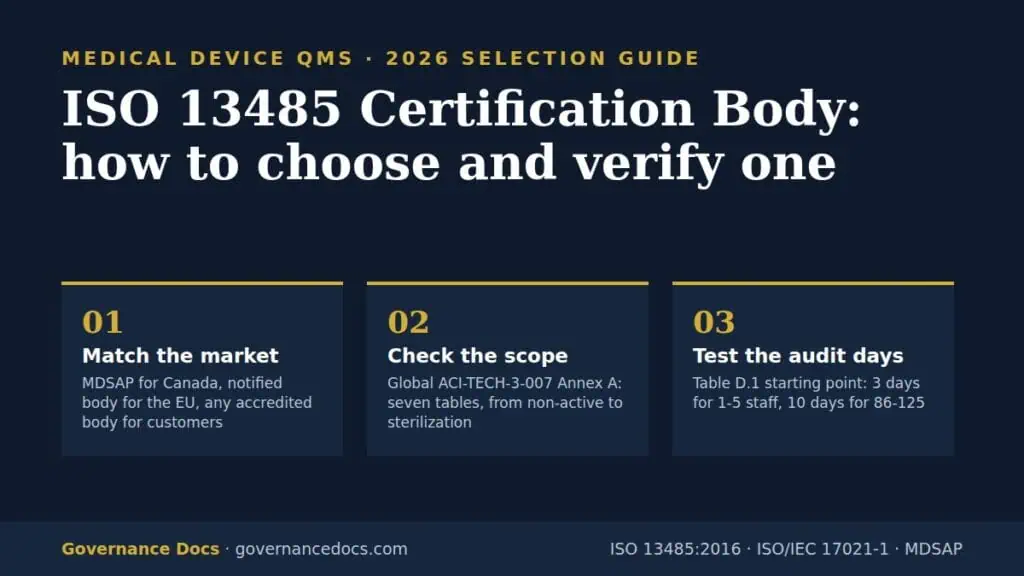
Choosing an ISO 13485 certification body is a regulatory decision as much as a purchasing one. The body you pick audits your quality management system for at least three years, and in some markets its certificate is the document a regulator asks for. Pick the wrong type of body and the certificate may be valid but useless for the market you are entering. This guide shows how an auditor would check a certification body before signing a quote.
If you are still mapping the overall route, start with our ISO 13485 certification guide and come back here when you are ready to request quotes.
Free gap assessment
How much of ISO 13485 could you evidence today?
Score clauses 4 to 8, free, with the FDA QMSR and EU MDR duties kept separate so you can see what is the standard and what is the regulator.
Run the free ISO 13485 gap assessment → or View premium report sample
What an ISO 13485 certification body actually does
An ISO 13485 certification body (often called a registrar in the US) audits your quality management system against ISO 13485:2016 and, if it conforms, issues a certificate. Accredited bodies work to ISO/IEC 17021-1, the general standard for management system certification. For medical devices they must also meet Global ACI-TECH-3-007 (M), formerly IAF MD 9. Global ACI took over the International Accreditation Forum’s role on 1 January 2026 and reissued MD 9 on 10 July 2026 “without any substantive change.”
That document adds medical-device rules on top of 17021-1. Three of them shape the relationship from day one:
- The body must check that you have evaluated regulatory compliance and reported incidents to the regulator where required (MD 4.4.1). Legal compliance stays your job; the auditor checks you are doing it.
- The body must have agreements with clients to release audit report information to regulators that recognize ISO 13485 (MD 5.1.2).
- Neither the body nor its auditors may design, make, market or service your device, or have built the quality system they audit (MD 5.2.3).
ISO/IEC 17021-1 clause 5.2.5 also bars any certification body from offering management system consultancy. If a body offers to “get you ready” through the same legal entity, treat it as a red flag.
First decide what the certificate is for
The most expensive mistake is choosing a body before deciding which regulator, if any, will rely on its work. ISO 13485 certification alone gives market access nowhere. What it does for you depends on the market:
| Market | What the regulator relies on | Who you need |
|---|---|---|
| United States | The FDA Quality Management System Regulation (QMSR), which incorporates ISO 13485:2016 by reference from 2 February 2026. FDA neither requires nor issues ISO 13485 certificates. | Any accredited body if a customer wants a certificate. An MDSAP auditing organization if you want MDSAP reports to stand in for routine FDA inspections. |
| Canada | A QMS certificate issued under MDSAP for Class II, III and IV device licences. Health Canada has accepted only MDSAP certificates since 1 January 2019. | A recognized MDSAP auditing organization. |
| European Union | Conformity assessment by a notified body under MDR (EU) 2017/745 or IVDR (EU) 2017/746. A stand-alone ISO 13485 certificate does not replace it. | A notified body designated for your device codes. Many also issue ISO 13485 certificates. |
| Australia, Brazil, Japan | MDSAP members that can use a single MDSAP audit within their own national processes. | A recognized MDSAP auditing organization. |
| Customer or tender only | Proof of an accredited ISO 13485 system. | Any body accredited for your technical area. |
If two or more rows apply, the strongest requirement decides. A Class II maker selling in Canada and the US needs an MDSAP auditing organization; a plain ISO 13485 registrar would leave Canada uncovered. Our ISO 13485 recognition guide covers each country’s position in detail.
Accreditation: the first filter for any ISO 13485 certification body
Anyone can print a certificate. An accredited body has been assessed against ISO/IEC 17021-1 and Global ACI-TECH-3-007 by a national accreditation body, such as ANAB in the US, the Standards Council of Canada, UKAS in the UK or DAkkS in Germany. Accreditation bodies that sign the Global ACI mutual recognition arrangement recognize each other’s accredited certificates, which is what makes a certificate travel.
Check three things before you request a quote:
- The body’s accreditation certificate lists ISO 13485, not just ISO 9001.
- The accreditation scope covers your technical area (see the next section).
- The accreditation is current, on the accreditation body’s own website, not a PDF the sales team sends you.
Technical areas: does the body cover your devices?
Accreditation for ISO 13485 is granted by technical area, and auditors are authorized the same way (MD 7.2.4). Annex A of Global ACI-TECH-3-007 sets out seven tables:
- A.1.1 Non-active medical devices
- A.1.2 Active (non-implantable) medical devices
- A.1.3 Active implantable medical devices
- A.1.4 In vitro diagnostic medical devices
- A.1.5 Sterilization methods
- A.1.6 Devices incorporating or using specific substances or technologies
- A.1.7 Parts and services, for suppliers that do not make finished devices
Tables A.1.1 to A.1.6 apply to finished devices. If your devices are sterile or intended for end-user sterilization, the audit team must also be competent in the relevant sterilization process from Table A.1.5 (MD 9.2.2.1). Ask every candidate which technical areas it is accredited for and how many auditors it holds in yours. A body with one qualified auditor for active implantables will struggle to schedule you.
Auditor experience is also defined. For a first authorization, an auditor must have joined at least four audits totaling at least 20 days, half of them against ISO 13485. A team leader must have led at least three ISO 13485 audits under supervision (MD 7.2.5). It is fair to ask how the body meets that for your technical area.
MDSAP auditing organizations
Only a recognized auditing organization can run an MDSAP audit. FDA’s auditing organization availability page lists 15 organizations. Thirteen are shown as recognized, including BSI, DEKRA, both DNV entities, DQS, G-MED, Intertek, NSAI, SGS, TÜV Rheinland, TÜV SÜD, TÜV USA (TÜV NORD Group) and UL. IMQ and NCC Certificações do Brasil are authorized to conduct MDSAP audits but not yet recognized. That page was last updated on 19 November 2024, so confirm status with the body before you sign.
An MDSAP audit covers ISO 13485 plus the specific requirements of the participating regulators, so it usually takes longer than a plain ISO 13485 audit. If you will need MDSAP within the next three years, choosing an MDSAP auditing organization now avoids a transfer later.
How an ISO 13485 certification body sets audit time
Audit time is not a sales decision. Annex D, Table D.1 of Global ACI-TECH-3-007 sets the starting point for an initial audit (stage 1 plus stage 2) by effective number of personnel. It replaces the QMS table in Global ACI-TECH-3-004 (formerly IAF MD 5) for ISO 13485:
| Effective personnel | Initial audit days (stage 1 + stage 2) |
|---|---|
| 1-5 | 3 |
| 6-10 | 4 |
| 11-15 | 4.5 |
| 16-25 | 5 |
| 26-45 | 6 |
| 46-65 | 7 |
| 66-85 | 8 |
| 86-125 | 10 |
| 126-175 | 11 |
| 176-275 | 12 |
The body then adjusts. Time goes up for more than one main technical area, complex devices, critical suppliers, installation at customer sites, poor regulatory compliance and multiple shifts or lines. Reductions are limited to 20% in total, for example where you do not manufacture. Pure distribution or transportation scopes may be reduced by up to 50%. Combining ISO 9001 and ISO 13485 adds at least 25% to the ISO 13485 days.
Two more rules change quotes. Sites involved in design, development or manufacturing cannot be sampled in a multi-site audit (MD 9.1.5), so each one is visited. For higher-risk devices (GHTF class C and D), stage 1 should be performed on site (MD 9.3.1.2). Our ISO 13485 certification cost breakdown turns these days into a budget, and our ISO 13485 stage 1 audit guide explains what the first visit covers.
How to compare ISO 13485 certification body quotes
Ask every body for the same scope, sites, headcount and device list, then compare line by line. Watch for these red flags:
- Audit days below Table D.1 with no written justification. An underpriced quote often grows at stage 2.
- A scope that leaves out processes affecting product safety or quality. MD 8.2.1 forbids that unless a regulator allows it.
- Consultancy, gap assessments or “pre-audits” bundled by the same legal entity.
- No mention of short-notice or unannounced audits, which MD 9.6.4.2 allows after safety signals, significant changes or a regulator’s request.
- Travel, report and certificate fees left out of the headline price.
Ask about lead times as well. Medical device auditors are scarce in some technical areas, and a body that cannot schedule stage 2 within your launch window is the wrong choice at any price.
Findings, surveillance and changing your ISO 13485 certification body
Global ACI-TECH-3-007 gives examples of major nonconformities that need accepted corrections and verified corrective actions. They include a missing complaint handling or training system and no corrective action after post-market data shows a defect pattern. Products on the market that pose undue risk, and repeated nonconformities from earlier audits, are major findings too (MD 9.4.5).
Surveillance audits must also review your adverse event notifications, advisory notices and recalls (MD 9.6.2.2). Our ISO 13485 surveillance audit guide covers what the body samples each year.
You are not locked in. Accredited certification can usually be transferred under Global ACI-TECH-3-002 (formerly IAF MD 2), provided the certificate is valid and open major nonconformities are dealt with. See our guide to changing certification body. If a regulator relies on your certificate, check its own transfer rules before you move.
Get your evidence ready before the auditor arrives
No ISO 13485 certification body will write your quality system for you. The cheapest audit is the one where the auditor finds complete, current records on day one, including the quality manual, the medical device file, CAPA and complaint records. Under the US QMSR, those same records now face FDA inspection, as our QMSR vs ISO 13485 comparison explains.
Frequently asked questions
Is a registrar the same as an ISO 13485 certification body?
Yes. “Registrar” is the common US term; “certification body” is the term in ISO/IEC 17021-1. Both mean the organization that audits and certifies your quality management system. Health Canada’s older guidance also used “registrar” before MDSAP.
Is a notified body the same as an ISO 13485 certification body?
No. A notified body is designated under the EU MDR or IVDR to assess device conformity, including the quality system. Many notified bodies also run accredited ISO 13485 certification, but a stand-alone ISO 13485 certificate is not CE marking.
Does the FDA accept an ISO 13485 certificate instead of an inspection?
No. FDA does not issue or require ISO 13485 certificates, and a certificate does not exempt you from inspection. FDA may accept MDSAP audit reports as a substitute for routine inspections, which is a different thing.
Should I choose an MDSAP auditing organization even if I only sell in the US?
Only if Canada, Australia, Brazil or Japan is on your roadmap, or you value replacing routine FDA inspections with MDSAP audits. MDSAP audits usually take longer and cost more than plain ISO 13485 audits, so the extra scope has to earn its keep.
Our ISO 13485 Toolkit provides 125 editable templates aligned to ISO 13485:2016, including the quality manual, the ISO 13485 to FDA QMSR cross-reference matrix and an ISO 13485 certification and MDSAP readiness checklist your certification body will expect to see evidence for, for $99.
When a standard changes, know first
One email a month: edition changes, new deadlines, and what they mean for documentation you already have. No sales sequence.

Governance Docs
Governance Docs LLC
Recent Posts
November 27, 2026
November 27, 2026

November 26, 2026

November 26, 2026

November 26, 2026