The ISO 13485 certification cost question has a better answer than most articles give you, because the biggest single line on the invoice is not a matter of opinion. It is set by a normative table published by the International Accreditation Forum, and your certification body is required to work from it. Once you know your effective headcount, you can calculate the audit days yourself and check any quote you are handed.
This matters more in 2026 than it did two years ago. The FDA’s Quality Management System Regulation took effect on 2 February 2026, incorporating ISO 13485:2016 by reference into 21 CFR Part 820. The standard that used to be optional for US market access is now embedded in the regulation.
Free gap assessment
How much of ISO 13485 could you evidence today?
Score clauses 4 to 8, free, with the FDA QMSR and EU MDR duties kept separate so you can see what is the standard and what is the regulator.
Certification body audit days. Set by a normative table, multiplied by a day rate.
Your own staff time. Almost always the largest real cost, and the one nobody quotes you.
Consultancy or templates, if you do not have the documentation in-house.
Surveillance and recertification, every year for the life of the certificate.
The second one deserves more attention than it gets. Building a conforming quality management system is measured in person-weeks, not person-days: document control, design controls, purchasing and supplier evaluation, CAPA, complaint handling, the risk management file, internal audits and management review all have to exist and have to have been operating before an auditor will look at them. For a first-time device manufacturer that is routinely the largest line in the programme, and it is invisible on every quote you will receive.
Only the first is fixed by rule. The rest are choices. That is why two device companies of identical size can report wildly different ISO 13485 certification cost figures and both be telling the truth — they are counting different things.
The audit-day table behind every ISO 13485 certification cost quote
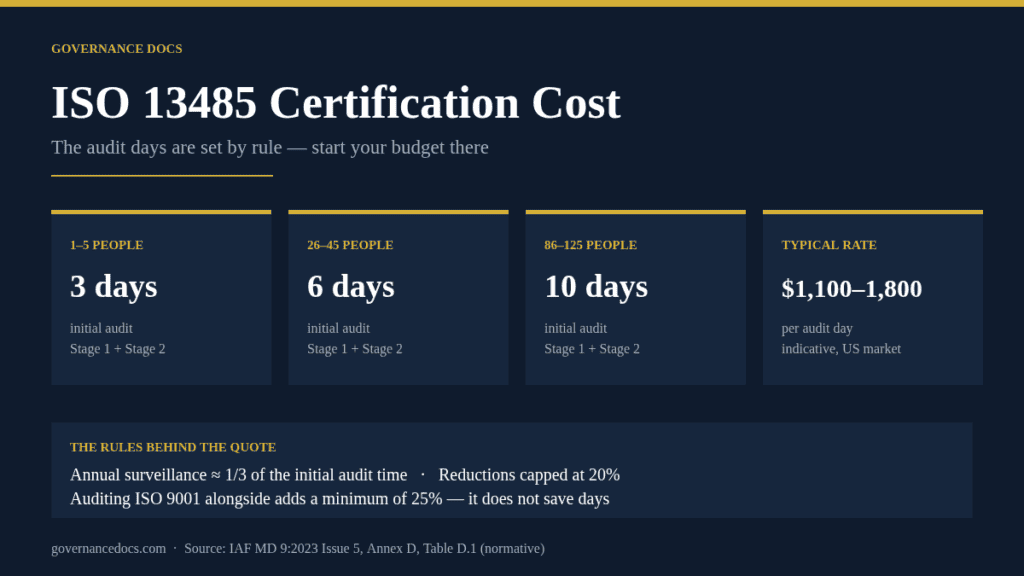
Certification bodies auditing ISO 13485 work to ISO/IEC 17021-1 plus IAF MD 9:2023 Issue 5, issued 20 November 2023. Its Annex D is normative, and Table D.1 sets the initial audit time — Stage 1 plus Stage 2 combined.
Here is where it gets interesting. MD 9 explicitly disapplies the generic quality-management audit table used for ISO 9001, and substitutes its own. Medical device audits are longer, and the gap is not small:
Effective number of personnel
ISO 13485 days (MD 9 Table D.1)
Generic QMS days (MD 5 Table QMS 1)
1–5
3
1.5
6–10
4
2
11–15
4.5
2.5
16–25
5
3
26–45
6
4
46–65
7
5
66–85
8
6
86–125
10
7
126–175
11
8
176–275
12
9
276–425
13
10
426–625
14
11
A five-person device company is looking at three audit days where a five-person general manufacturer would face one and a half. That single fact explains most of the sticker shock behind ISO 13485 certification cost complaints.
“Effective number of personnel” is not your payroll headcount. It covers permanent, temporary and part-time people working within the certification scope, counted across shifts.
Working out your own ISO 13485 certification cost
Take your band from Table D.1, then apply the rules that MD 9 and MD 5 lay down together. MD 9 clause 9.1.4 is explicit that the MD 5 requirements still apply, with the generic table replaced by Annex D. That gives you:
Initial certification: the Table D.1 figure, covering Stage 1 and Stage 2.
Annual surveillance: about one third of the initial audit time, spread across the year. It is unlikely to be less than one audit day.
Recertification: recalculated at the end of the three-year cycle on updated information.
A floor: audit duration should typically not be less than 80% of the calculated time, and audit days cannot be shaved by scheduling longer working days.
Travel is excluded from audit time — and billed separately.
Day rates are the part no standard sets. Published practitioner figures for accredited certification bodies commonly fall in the $1,100 to $1,800 per audit day range in the US market, before administrative and certificate fees and before travel. Treat that as an indicative range for budgeting, not a quote.
Company size
Initial audit days
Indicative initial CB fee
Indicative annual surveillance
1–5 people
3
$3,300 – $5,400
$1,100 – $1,800 (1 day)
16–25 people
5
$5,500 – $9,000
$1,800 – $3,000 (~1.7 days)
26–45 people
6
$6,600 – $10,800
$2,200 – $3,600 (2 days)
86–125 people
10
$11,000 – $18,000
$3,700 – $6,000 (~3.3 days)
These are certification body fees only, calculated from the normative day counts and an indicative day rate. They are the floor of your ISO 13485 certification cost, not the total.
What the ISO 13485 certification cost quote does not include
Your certification body prices the audit. It does not price the work that makes you auditable. Budget separately for:
Documentation. A conforming quality manual, procedures, records and the risk management file to ISO 14971. Either staff time or templates.
Internal audits and management review. Required before Stage 2, and a common reason first attempts fail.
Remediation between Stage 1 and Stage 2. Stage 1 is designed to find gaps; assume you will have some.
Nonconformity closure. Major findings mean a follow-up visit, at day rate.
MDSAP, if you need it. A separate programme with its own audit time, not a discount on this one.
MD 9 also lists what pushes your audit days above the table: auditing more than one main technical area, medical device complexity, relying on suppliers for processes or parts critical to device function or user safety, installing product on customer premises, poor regulatory compliance history, and multiple shifts or production lines.
If you are assembling the documentation yourself, our ISO 13485 Toolkit covers it with 140 templates aligned to ISO 13485:2016 and cross-referenced to FDA QMSR, EU MDR/IVDR and ISO 14971, for $149. Set against a day rate, it pays for itself if it saves two hours.
How to reduce your ISO 13485 certification cost legitimately
There are exactly three levers in the rules, and they are capped.
Scope. MD 9 permits reductions of no more than 20% in total from Table D.1 where the scope excludes manufacturing — wholesale, retail, transportation or equipment maintenance — or where the product range or design and production processes have shrunk since the last audit.
Distribution-only certification. Where the scope covers solely distribution or transportation services, audit time may be reduced by up to 50%.
Do not bolt on ISO 9001 casually. Auditing ISO 9001 and ISO 13485 together adds a minimum of 25% to the Annex D days. Combining certifications is often right for other reasons, but it does not save audit time. If you are weighing the two, read ISO 13485 vs ISO 9001 first.
What does not work: negotiating the day count, asking for longer days, or scoping out a site that genuinely manufactures. An accredited body cannot agree to those and keep its accreditation.
The real saving is preparation. Arriving at Stage 2 with a complete document set, closed internal audits and a management review on file is what keeps you to the table minimum rather than paying for a follow-up visit. Start from the ISO 13485 mandatory documents list and work backwards.
ISO 13485 certification cost FAQ
How much does ISO 13485 certification cost in total?
For a small manufacturer, certification body fees are typically in the mid four figures to low five figures for initial certification, with roughly a third of that annually thereafter. Total programme cost including staff time and documentation is usually several times the audit fee. Get itemised quotes from at least two accredited bodies.
Is the audit day count negotiable?
No. Table D.1 in IAF MD 9 is normative, and the permitted reductions are capped at 20%, or 50% for distribution-only scopes. A body quoting well below the table without a documented reduction basis is a warning sign about its accreditation, not a bargain.
Why is ISO 13485 more expensive to audit than ISO 9001?
Because MD 9 sets a separate, longer table. At most sizes an ISO 13485 audit runs roughly double the days of a generic quality management system audit at the same headcount, reflecting regulatory purpose, device risk and supplier scrutiny.
Does the FDA QMSR change what I pay?
Not directly — FDA does not certify anyone. But since 2 February 2026 the FDA regulation incorporates ISO 13485:2016, so the documentation you build serves both. See our guide to the FDA QMSR.
What is the cheapest legitimate route to a certificate?
Keep the scope honest but tight, build the documentation in-house from templates rather than buying it as consultancy, and do not go to Stage 2 until your internal audit and management review are genuinely complete. Nonconformity follow-up visits and re-audits are billed at day rate, so the cheapest certification is almost always the one that passes first time. Quoting two or three accredited bodies is worth doing — the day count is fixed, but day rates, administrative fees and travel are not.
Do I need certification at all?
Not always. ISO 13485 conformity is what regulators and customers require; a certificate is how you evidence it efficiently. If you sell into the EU or need customer assurance, certification is usually the cheaper route. Our guide to ISO 13485 certification covers the decision.
The bottom line
Most ISO 13485 certification cost estimates online are ranges with no method behind them. You do not need a range. Find your effective headcount, read your audit days off Table D.1, multiply by a day rate, add a third of that annually, and you have the certification body side of the number to within a rounding error. Everything above that line is your own preparation — and that is the part you control.