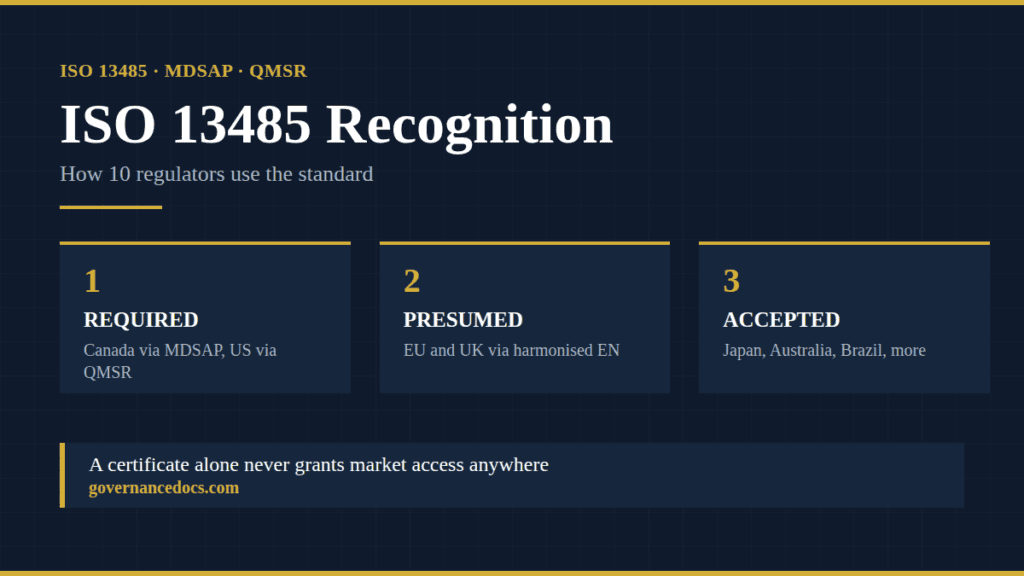
ISO 13485 recognition is close to universal among medical device regulators, but it means something different in every market. In one country the standard is written into the regulation, in another it earns a presumption of conformity, and in a third only an MDSAP certificate counts.
One rule holds everywhere. ISO 13485 certification alone does not give you market access in any country. Every regulator below also wants a product approval, registration or licence of its own.
This guide maps ISO 13485 recognition across ten regulators, with the source and date for each. For background on the standard itself, see our guide to the ISO 13485 quality standard.
Free gap assessment
How much of ISO 13485 could you evidence today?
Score clauses 4 to 8, free, with the FDA QMSR and EU MDR duties kept separate so you can see what is the standard and what is the regulator.
Regulators use ISO 13485:2016 in five distinct ways. Knowing which one applies tells you what evidence a market will actually accept.
Incorporated in regulation. The standard’s text becomes part of the law, and the regulator inspects against it. The US QMSR works this way.
Harmonised or designated standard. Following it gives a presumption of conformity with the quality system requirements it covers. The EU and Great Britain work this way.
Required certificate. A licence application must include a certificate from a recognized or accredited auditor. Singapore works this way.
MDSAP audit. One audit against ISO 13485:2016 plus national requirements serves several regulators. Canada requires it.
Aligned national rule. The regulator writes its own QMS rule that follows ISO 13485 closely or partly, and assesses against that. Japan, Brazil, China and India sit here.
ISO 13485 recognition by country: the table
Each row was checked against the regulator’s own page or legal text on or before 26 November 2026. Device class matters in every market, so read the notes below the table before you plan.
Market
Regulator
How ISO 13485 is used
Certificate alone enough?
United States
FDA
QMSR (21 CFR Part 820) incorporates ISO 13485:2016 by reference, effective 2 Feb 2026. FDA inspects; MDSAP reports may substitute for routine inspections.
No. FDA neither requires nor issues certificates, and a certificate does not exempt you from inspection.
European Union
Notified bodies under MDR and IVDR
EN ISO 13485:2016+A11:2021 harmonised by Decisions (EU) 2022/6 and 2022/15 (January 2022): presumption of conformity.
No. CE marking needs a conformity assessment and technical documentation.
Great Britain
MHRA
EN ISO 13485:2016, AC:2018 and A11:2021 designated under the UK MDR 2002 (notice 0129/26, 17 Jan 2026).
No. UKCA conformity assessment (or accepted CE marking) and MHRA registration still apply.
Canada
Health Canada
Class II to IV licences need a QMS certificate issued under MDSAP by a recognized auditing organization; only MDSAP certificates accepted since 1 Jan 2019.
No. A plain ISO 13485 certificate is not accepted, and you still need a device licence.
Japan
MHLW and PMDA
Chapter 2 of Ministerial Ordinance No. 169 aligned with ISO 13485:2016 (revised 26 Mar 2021; compliance by 25 Mar 2024). MDSAP member.
No. Japan assesses against the ordinance, and marketing authorization is separate.
Australia
TGA
An ISO 13485 certificate is not acceptable manufacturer evidence for non-IVD devices. MDSAP certificates count only if they show assessment against Australian regulations.
No. ARTG inclusion is required.
Brazil
ANVISA
Own GMP rule, RDC 665/2022, with ANVISA GMP certification for higher-risk classes. MDSAP member.
No. ANVISA notification or registration is required.
Singapore
HSA
Manufacturers of Class B, C and D devices need ISO 13485 certification from an SAC-accredited body, or MDSAP, for a dealer’s licence. Class A may use a declaration.
No. It supports the dealer’s licence, but product registration is separate.
China
NMPA
Own Good Manufacturing Practice for Medical Devices (Announcement [2025] No. 107), in force 1 Nov 2026, replacing the 2014 GMP.
No. NMPA registration or filing and GMP compliance are required.
India
CDSCO and State Licensing Authorities
The Medical Devices Rules, 2017 define the QMS as the Fifth Schedule requirements; licence applications include an undertaking of compliance.
No. A manufacturing or import licence is required.
United States: written into the regulation
The US is the strongest form of ISO 13485 recognition and the weakest for certificates. FDA adopted the 2016 text into Part 820, but it inspects your QMS itself and does not rely on certification bodies. Our comparison of QMSR vs ISO 13485 covers the FDA-specific additions.
European Union: presumption of conformity
The Commission Implementing Decision (EU) 2022/6 added EN ISO 13485:2016 and its A11:2021 amendment to the MDR list. Decision (EU) 2022/15 did the same for the IVDR. Following the standard presumes conformity with the requirements it covers, nothing more.
Your notified body still assesses your QMS under the regulation, and your technical documentation must stand on its own. Our EU MDR guide explains the conformity assessment routes.
Australia and Singapore: the evidence rules differ
These two markets show why ISO 13485 recognition needs a careful reading. The TGA says an ISO 13485 certificate is not acceptable manufacturer evidence for non-IVD devices. Singapore’s HSA asks manufacturers of Class B, C and D devices for exactly that certificate.
HSA adds a condition: the certification body must be accredited by the Singapore Accreditation Council, or you submit an MDSAP certificate instead. Its QMS requirements page sets out the rules by class, including GDPMDS options for importers and wholesalers.
MDSAP: one audit, five regulators
The Medical Device Single Audit Program (MDSAP) lets one recognized auditing organization audit your QMS for several regulators at once. The audit covers ISO 13485:2016 plus the specific requirements of each participating authority.
FDA’s MDSAP page lists five members: the TGA (Australia), ANVISA (Brazil), Health Canada, Japan’s MHLW and PMDA, and the US FDA. Official observers are the European Union, Singapore’s HSA, the UK MHRA and the WHO IVD prequalification programme.
Affiliate members are Argentina’s ANMAT, Israel’s Ministry of Health, Kenya’s Pharmacy and Poisons Board, South Korea’s MFDS, Mexico’s COFEPRIS, South Africa’s SAHPRA and Taiwan’s TFDA. Observer and affiliate status does not mean those regulators accept MDSAP in place of their own rules.
How each member uses an MDSAP audit
Canada: mandatory for Class II to IV licences. It is the only country where MDSAP is the required route.
United States: voluntary. The FDA MDSAP page says FDA may accept MDSAP audit reports as a substitute for routine inspections.
Australia: MDSAP certificates are accepted as evidence only where they cover the Australian regulations.
Brazil and Japan: both are members and use MDSAP audit results in their own QMS assessments, which still sit under national rules.
Why ISO 13485 certification alone never gets you market access
Regulators control three separate things, and ISO 13485 certification speaks to only one. The first is the quality system. The second is the product: its safety, performance and clinical evidence. The third is the company’s legal standing in the market.
That third layer covers registration, local representatives and vigilance reporting. A certificate cannot cover the second or third layer. That is why every row in the table ends in “No”.
Even for the QMS layer, ISO 13485 recognition depends on who issued the certificate. Canada accepts only MDSAP certificates, Singapore wants SAC accreditation, and the TGA rejects a plain certificate for non-IVD devices. Check yours before you rely on it.
Choosing a route across ISO 13485 countries
Match the certification route to how ISO 13485 recognition works in each market on your launch plan. This checklist covers the common cases.
List your target markets and device classes. Recognition rules change with class in every market above.
If Canada is on the list, choose MDSAP. Pick an auditing organization recognized under MDSAP and ask it to include your other member markets.
If you sell in the EU, plan the notified body. Ask whether it can run the MDR QMS assessment and your ISO 13485 audit together.
If the US is your only market, certification is optional. FDA inspects against the QMSR either way. Many firms still certify because customers and distributors ask for it.
Check accreditation for each market. Confirm your certification body’s accreditation meets local rules, such as SAC accreditation for Singapore.
Keep one regulatory requirements register. Record each market’s QMS rule, product approval and reporting duties in one place.
Singapore asks manufacturers of Class B, C and D devices for an ISO 13485 certificate from an SAC-accredited body, or an MDSAP certificate. Canada requires an MDSAP certificate for Class II to IV devices. The US, EU and UK use the standard without requiring a certificate, though EU notified bodies assess your QMS against the regulation.
Is ISO 13485 recognized by the FDA?
Yes, in the strongest form. Since 2 February 2026 the QMSR incorporates ISO 13485:2016 by reference. FDA still inspects, does not issue certificates, and does not exempt certified firms from inspection.
Does MDSAP replace ISO 13485 certification?
An MDSAP audit includes ISO 13485:2016 and adds each member’s national requirements. For markets that need a certificate, an MDSAP certificate usually covers ISO 13485 as well. Confirm the scope with your auditing organization.
Does ISO 13485 recognition change if a new edition is published?
Not automatically. Each regulator references a specific edition, and FDA has said it would amend the QMSR only through rulemaking. On 26 November 2026, ISO 13485:2016 was the current edition and no new edition was under development.
Our ISO 13485 Toolkit provides 125 editable templates built on ISO 13485:2016 and cross-referenced to the FDA QMSR, EU MDR and MDSAP — including the Applicable Regulatory Requirements Register, the ISO 13485:2016 to EU MDR 2017/745 Cross-Reference Matrix and the ISO 13485 Certification / MDSAP Readiness Checklist — for $99.
When a standard changes, know first
One email a month: edition changes, new deadlines, and what they mean for documentation you already have. No sales sequence.