

If you need AI governance frameworks, you do not have to pick just one. They need to understand how four of them fit together: ISO/IEC 42001, the EU AI Act, the NIST AI Risk Management Framework and ISO/IEC 27090. One is a certifiable management system, one is a law, and two are guidance. Treating them as four competing options is the first mistake.
This guide shows which ones apply to you, where the work overlaps, and the order that avoids rework.
Free gap assessment
How much of ISO 42001 could you evidence today?
Score every clause and Annex A control of the AI management standard, free, and see where the programme really sits.
Run the free ISO 42001 gap assessment → or View premium report sample
The four AI governance frameworks in one table
| Framework | What it is | Who it applies to / when it is required | Certifiable, attestation or law | Our toolkit |
|---|---|---|---|---|
| ISO/IEC 42001:2023 | Requirements for an AI management system, built on the same harmonized structure as ISO/IEC 27001 | Any organization that develops, provides or uses AI. Voluntary, but often asked for by customers and procurement teams | Certifiable by an accredited certification body after an audit | ISO/IEC 42001 AI Management Toolkit |
| EU AI Act (Regulation (EU) 2024/1689) | A risk-tiered regulation: prohibited practices, high-risk systems, transparency duties and general-purpose AI models | Operators placing AI systems on the EU market or whose output is used in the EU, wherever they are established. Binding, in phases | Law, with its own conformity assessment for high-risk systems. No certificate of “compliance” exists to buy | EU AI Act Toolkit |
| NIST AI Risk Management Framework (AI RMF 1.0) | A voluntary framework with four functions: Govern, Map, Measure, Manage | Any organization designing, developing, deploying or using AI. Common in US federal and sector contexts | Guidance. Not certifiable | NIST AI Risk Management Framework Toolkit |
| ISO/IEC 27090 | Guidance on security threats and compromises to AI systems: attacks, detection and mitigation | Security and ML teams running AI systems that can be attacked. Voluntary | Guidance. Not certifiable | ISO/IEC 27090 AI Security Toolkit |
Only one of the four can produce a certificate, and only one is law. The other two give you a method and a vocabulary. That difference decides how much weight each deserves in your plan.
Which AI governance frameworks apply to you
Start with legal obligation, then customer demand, then everything else. Work through these situations in order.
- You place AI on the EU market, or its output is used in the EU. The EU AI Act applies to you, whether or not you hold any certificate. This is the only framework here you cannot opt out of.
- Customers or tenders ask for independent evidence. ISO/IEC 42001 is the one you can show a third party. If a buyer asks for “something certified” for AI, this is the answer.
- You sell mainly in the US, or to US federal and regulated buyers. The NIST AI RMF is the reference your buyers are most likely to recognize. NIST describes it as intended for voluntary use, and says AI RMF 1.0 is being revised as part of the White House AI Action Plan, so check the current version before you cite it in a contract.
- You build, host or fine-tune models, or deploy agents with real privileges. ISO/IEC 27090 supplies the AI-specific security depth that the other three only touch.
- You only use third-party AI tools. You can still be a deployer under the EU AI Act, and a management system still helps. Your 27090 work shrinks to supplier checks and access control.
Free AI risk assessment
Which of your AI systems could harm people, or you?
List your AI systems, models and data, pick from 54 AI risk scenarios, including the attacks on AI described in ISO 27090, rate them for the people affected and for you, and plan treatment with ISO 42001 Annex A controls. You get a heat map, a process score and the findings an auditor would raise, free.
Run the free AI risk assessment → or View premium report sample
How the AI governance frameworks fit together
Think of three layers: a management layer, a legal layer and a security layer, with the NIST AI RMF acting as the risk vocabulary across them.
ISO/IEC 42001 is the management layer
It gives you an AI policy, roles, objectives, an AI risk process, an impact assessment, a Statement of Applicability, internal audit and management review. It is where “who owns this and how do we prove it” gets answered. The ISO/IEC 42001 toolkit covers that document set.
The EU AI Act is the legal layer
It decides which of your systems are prohibited, high-risk, transparency-bound or general-purpose, and what each must show. ISO 42001 certification does not confer conformity with the Act. What it does give you is the machinery the Act assumes you have: an inventory, a risk process, defined roles, monitoring and review. Our comparison of ISO 42001 vs the EU AI Act goes through the overlap in detail, and the EU AI Act toolkit holds the classification and documentation templates.
The NIST AI RMF is the risk vocabulary
Govern, Map, Measure and Manage describe the work of understanding and treating AI risk in a way that survives a change of regulation. The NIST AI RMF vs EU AI Act guide shows which function supports which Article, and the NIST AI RMF toolkit turns the four functions into working documents. NIST publishes the framework and its Playbook at nist.gov.
ISO/IEC 27090 is the security layer
ISO 42001 touches security in a few Annex A controls. It does not describe what a data poisoning attack looks like or how to defend a model against prompt injection. ISO 27090 does, and it is guidance rather than a certifiable standard. The full argument is in ISO 27090 vs ISO 42001, so we will not repeat it here. The ISO/IEC 27090 toolkit is the working set. One caution: ISO 27090 does not cite the EU AI Act, so any mapping between them is judgment, not a recognized presumption of conformity.
If you also run ISO/IEC 27001, your ISMS is the natural home for the security layer. Our guide to information security frameworks covers how those fit together, and the privacy compliance program guide covers the GDPR side where personal data feeds your models.
What overlaps, so you build it once
The same four artifacts turn up in every one of these AI governance frameworks. Build each of them once and cross-reference it.
- An AI system inventory. You cannot classify systems under the EU AI Act, scope an ISO 42001 management system, map risks under the NIST AI RMF or assess attack surface under ISO 27090 without a list of what you run, buy and build.
- An AI risk register. One register, with fields for impact on people (ISO 42001 and EU AI Act), risk category (NIST) and attack type (ISO 27090).
- An impact assessment. ISO 42001 requires an AI system impact assessment. Where the EU AI Act requires a fundamental rights impact assessment for certain deployers, the same facts feed both.
- Roles and training. Named accountability and AI literacy satisfy ISO 42001 competence, the NIST Govern function and the Act’s AI literacy duty at once.
One owner and one source of truth beats four spreadsheets that drift apart.
The order to adopt AI governance frameworks
There is a sensible sequence, driven by what is legally due first, then what everything else depends on.
- Inventory and screen. List every AI system and use case. Screen each against the EU AI Act prohibitions and the AI literacy duty, both of which have applied since 2 February 2025. This costs little and removes the worst exposure first.
- Classify under the EU AI Act. Decide, system by system, whether it is high-risk, transparency-bound or neither, and whether you are a provider or a deployer. This sets your legal workload and your deadline.
- Stand up the management layer. Adopt ISO/IEC 42001 as the operating system for governance, even if you never certify. If a customer is asking for a certificate, plan the audit now. If you are in the US and certification is not requested, you can run the NIST AI RMF as the structure instead and add 42001 later.
- Add the security layer for the systems that need it. Apply ISO/IEC 27090 first to externally exposed models, agents with write access and anything trained on sensitive data. Not every system needs the same depth.
- Close the high-risk gap. Build the technical documentation, risk management, human oversight and logging evidence for any high-risk system, using the structure you already have.
- Audit and review. Run an internal audit and management review. Then decide whether to seek certification.
Steps 1 and 2 are cheap and tell you whether step 5 is a large project or none at all.
The EU AI Act dates to get right
Many articles on AI governance frameworks still carry the pre-2026 timeline. Regulation (EU) 2026/1744, the Digital Omnibus on AI, entered into force on 27 July 2026 and moved some dates. Use these:
- 2 February 2025: prohibitions and AI literacy (Chapters I and II) apply.
- 2 August 2025: obligations for general-purpose AI models apply.
- 2 August 2026: general application of the Act, including the Article 50 transparency duties.
- 2 December 2026: the four additional prohibited categories inserted by the Omnibus start to apply.
- 2 December 2027: high-risk obligations for Annex III systems (postponed from 2 August 2026).
- 2 August 2028: high-risk obligations for AI in products covered by Annex I (postponed from 2 August 2027).
The common error is saying the Omnibus postponed “the prohibitions”. It did not postpone the original ones. It added new categories with their own start date. Our EU AI Act deadlines guide keeps the full timeline current.
A later high-risk date is not a reason to wait. The management layer, inventory and risk process take time to build and evidence, and every one of them is needed whichever date applies to you.
Mistakes to avoid
- Treating ISO 42001 as an EU AI Act shortcut. A certificate helps you evidence governance. It does not replace the Act’s conformity routes.
- Treating guidance as a checklist you can pass. Nobody awards a pass for the NIST AI RMF or ISO 27090, so set your own target and record why.
- Starting with the security standard. Without an inventory and owners you cannot say which systems it applies to.
Documents support compliance. They do not make anyone compliant or certified: an accredited body decides certification after an audit.
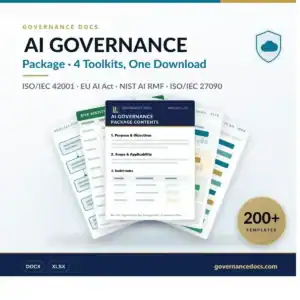
The AI Governance Package bundles all four toolkits for $279: ISO/IEC 42001, the EU AI Act, the NIST AI Risk Management Framework and ISO/IEC 27090. It is one purchase with a separate download per toolkit, licensed for internal use by one organization. Consultants serving clients need the Consultant Package.

AI governance frameworks FAQ
Do I need all four AI governance frameworks?
Not necessarily. The EU AI Act is mandatory if you are in scope. ISO 42001 is worth it if customers want a certificate or you want a durable management system. The NIST AI RMF suits US-facing programs, and ISO 27090 matters most if you build or expose models. The practical end state is a management system plus one or two of the others.
Which should I implement first?
Inventory your AI systems and screen them against the EU AI Act, then adopt ISO 42001 or the NIST AI RMF as your governance structure. Add ISO 27090 once you know which systems carry real attack exposure.
Does ISO 42001 certification mean I comply with the EU AI Act?
No. It supports many of the governance practices the Act expects, but the Act has its own conformity assessment and documentation requirements for high-risk systems. See ISO 42001 vs EU AI Act.
Can I get certified to the NIST AI RMF or ISO 27090?
No. Both are guidance, not certifiable standards. If you need a certificate, ISO/IEC 42001 is the certifiable one in this set.
Are the EU AI Act high-risk deadlines still 2026?
No. Regulation (EU) 2026/1744 postponed Annex III high-risk obligations to 2 December 2027 and Annex I to 2 August 2028. Other dates, including the prohibitions since February 2025 and the general application from 2 August 2026, did not move.

Recent Posts
November 18, 2026
November 18, 2026
November 18, 2026
November 18, 2026

November 18, 2026